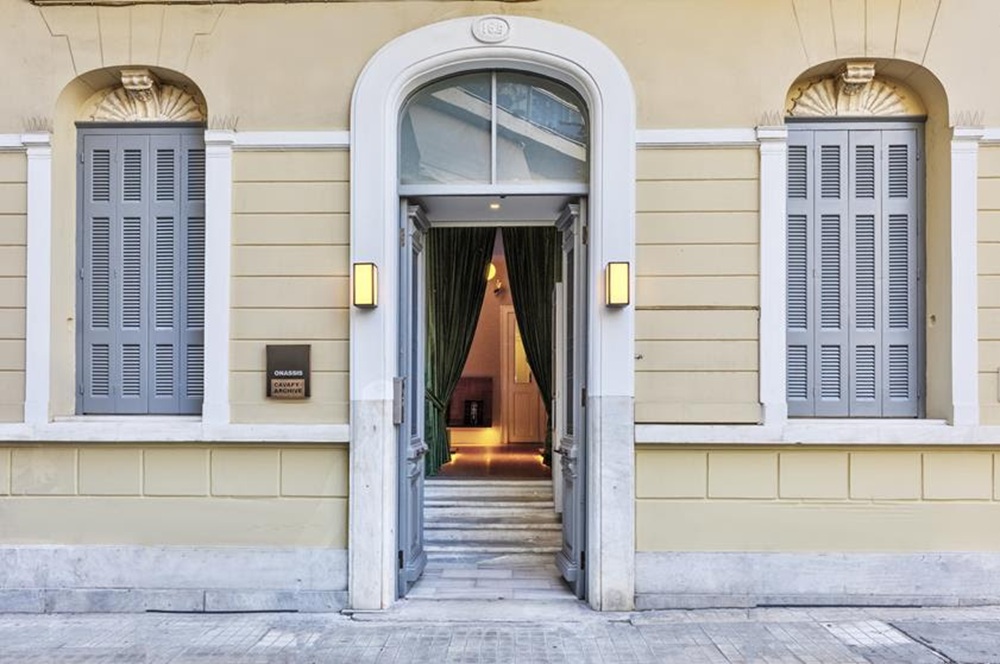
On the anniversary of the Alexandrian poet’s birth and death, the Onassis Foundation, in collaboration with the City of Athens, invites residents, visitors, and passersby to sit next to C. P. Cavafy and “converse” with him, even if only for a moment, while gazing out at the city and its vibrant urban fabric. In collaboration with the City of Athens, the Onassis Foundation officially unveiled yesterday, April 28, the sculpture depicting C. P. Cavafy, a work by sculptor Praxitelis Tzanoulinos, on the Dionysiou Areopagitou pedestrian walkway, in front of the Onassis Library and Onassis Mandra. A new landmark for the city, marking yet another return of Cavafy to Athens, following the inauguration of the Cavafy Archive in November 2023 by the Onassis Foundation. “I love Athens so much,” Cavafy wrote in 1903. A city that always captivated him. Here he sought recognition. Here his writing was put to the test, and here he wanted to be heard. Starting today, his voice is heard louder than ever.
The event was attended by representatives from the country’s political, cultural, academic, and artistic communities, and speeches were delivered by Antonis S. Papadimitriou, President of the Onassis Foundation, Minister of Culture Lina Mendoni, and Deputy Mayor for Economic Planning George Giannaros, on behalf of Haris Doukas, Mayor of Athens.
Mr. Antonis S. Papadimitriou, President of the Onassis Foundation, stated: “For the Onassis Foundation, everything is culture—and culture is certainly not confined to institutional spaces. On the contrary, it is part of everyday life on the street, in the urban fabric, in the realm of shared experiences. In this spirit, we are unveiling Praxitelis Tzanoulinos’s sculpture depicting C. P. Cavafy on the newly renovated Dionysiou Areopagitou Street. Recalling the culture of everyday life and integrating poetry into our daily journeys.”
Ms. Lina Mendoni, Minister of Culture, stated: “Dionysiou Areopagitou Street is perhaps the most cosmopolitan street in Athens, the ideal location for the installation of the sculpture of Constantine Cavafy. Here, classical Athens and Rome symbolically meet, while people from all over the world pass by every day. Praxitelis Tzanoulinos has rendered the poet’s likeness with exceptional sensitivity. And what I consider particularly important is that Cavafy is not presented as a conventional bust or a statue, but seated on a bench, inviting everyone to sit next to him, to read, to think, and to converse with him. This is a unique landmark, the third created for Cavafy with the support of the Onassis Foundation, following the Archive and his home in Alexandria. A project that invites us all to get closer to the poet and rediscover his voice through his poems.”
The Deputy Mayor for Economic Planning, Mr. George Giannaros, conveyed the statement of the Mayor of Athens, Mr. Haris Doukas: “Every corner of Athens can become a landmark. All it takes is a plan and inspiration. With the sculpted Cavafy bench and the beautification of Aischinou Street, the iconic landmark of Dionysiou Areopagitou is gaining a new identity. In collaboration with the Onassis Foundation, we moved quickly and effectively. We secured all the necessary approvals and permits so that the project could proceed without delays and the public space could be transformed into a place of culture and daily life.”
Artist’s Note
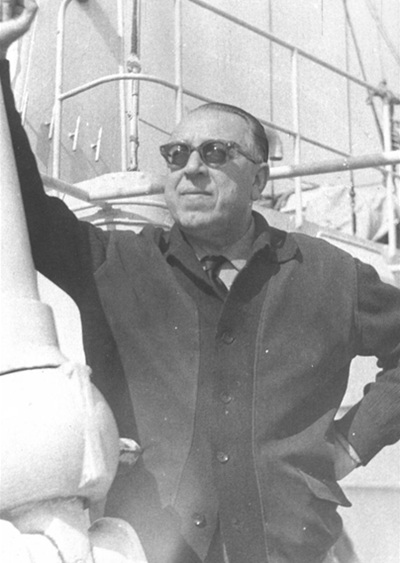
“We owe to Edward Morgan Forster the beautiful image of the ‘Greek gentleman in a straw hat, standing absolutely motionless at a slight angle to the universe,’ which he described in April 1919. Along with photographic material depicting Cavafy—and as he himself wrote, addressing himself: ‘Try to guard them, poet,/ however few there are that can be kept./ The visions of your loving./ Set them, half hidden, in your phrases’—these elements became the stimuli that decisively contributed to the work’s inception, and ‘The poet, partly concealing, partly concealed…’ emerged before me through the malleable material of clay at first and later in bronze. Thus, his figure was crafted; approached not through imitation but by expressing the image and essence of his poetic world.The artist’s endeavor is an endless adventure, especially when one must confront the rendering of such an iconic and recognizable figure, one that moves—and will always move—all of humanity with his poetry.Perhaps such thoughts also troubled the great Albrecht Dürer when he crafted his engraving portrait of Erasmus, leading him to inscribe upon it, in fine Greek, the phrase: ‘Τὴν κρείττω τὰ συγγράμματα δείξει’ (‘[His] writings will show a better likeness’).”
Praxitelis Tzanoulinos, 2026



Leave A Comment