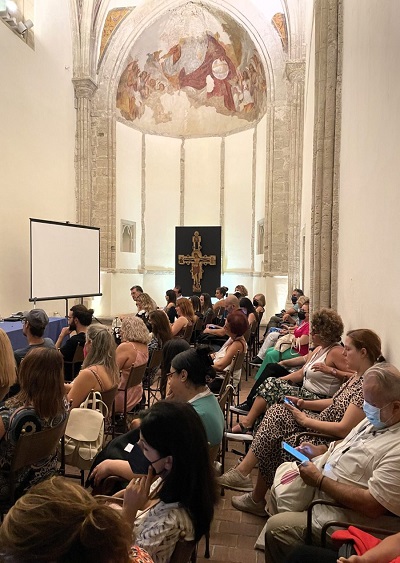
In Ancient Olympia, the birthplace of the concept of excellence, the HEYDAY International Symposium was held on May 3, 2026, at the headquarters of the International Olympic Academy, highlighting a contemporary, interdisciplinary approach to human transcendence. With the theme “Memory in Motion,” the symposium sought to unite memory with knowledge and vision, bridging the humanities and natural sciences with athletic excellence.
The central theme of the symposium was the shift from the traditional “muscle and might” paradigm to a more holistic “muscle, might, and mind” approach, redefining the concept of human excellence through the convergence of science, philosophy, art, and sports.
A highlight was the lecture titled “Pindar and Poetry to Olympic Modernity,” which highlighted the importance of cultural diplomacy, heritage, and the revival of the “Pentathlon of the Muses,” reconnecting the ancient Greek poetic tradition with contemporary Olympic thought. The natural environment of Olympia—the olive groves and the historical aura of the site—served as a living backdrop for the development of this dialectic between the past and the present.
The symposium brought together distinguished scientists, academics, and thinkers from various fields, fostering a meaningful dialogue on resilience, recovery, memory, and adaptation. Professor Dimitrios Kouvelas made a special mention, emphasizing the importance of democratic ideals through the works of Euripides, Aristophanes, and Aristotle. Meanwhile, Emeritus Professor Dimitrios Spantidos highlighted the contribution of research to cellular oncogenesis, while Professor Nikolaos Geladas took a philosophical approach to the relationship between science and art through an apt analogy with Apollo: the lyre as genetics, Apollo as epigenetics, and music as a phenotype.
The HEYDAY International Symposium reaffirms the vitality of contemporary interdisciplinarity, bringing to the forefront the need for unity in knowledge, culture, and human experience. In an era where specialization often leads to fragmentation, such initiatives highlight the importance of convergence as a prerequisite for understanding and progress.
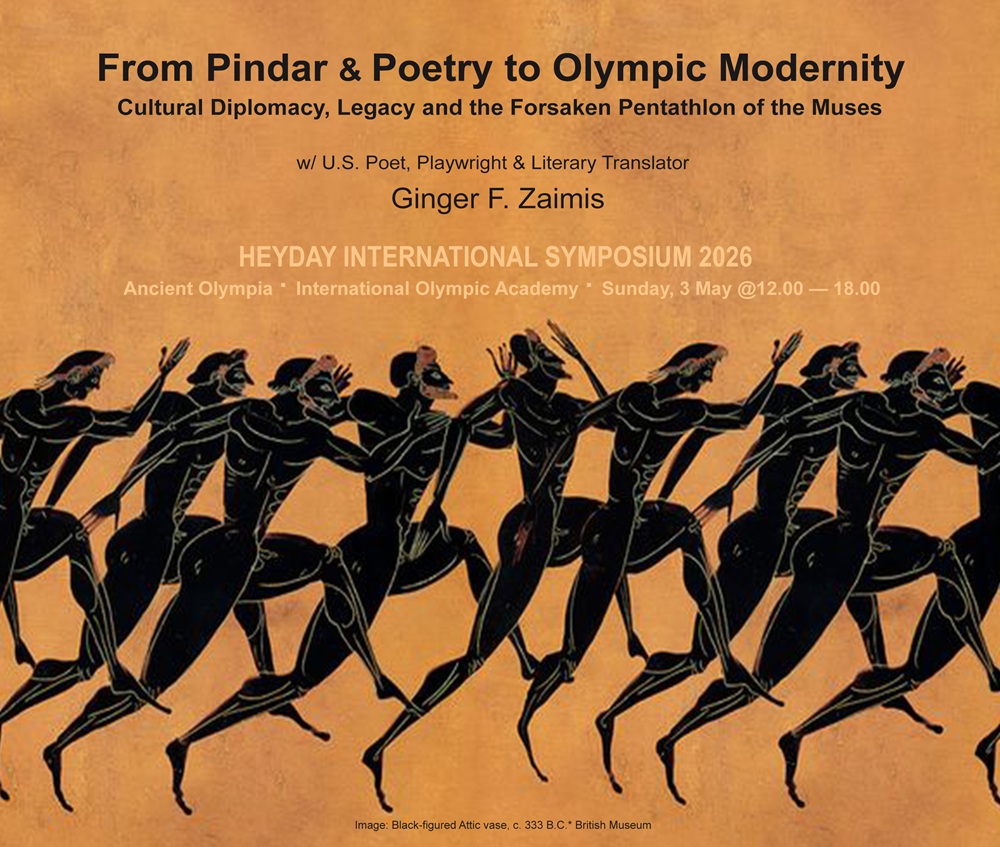
The presence of Ginger F. Zaimis also added a unique cultural dimension, linking poetry and the Olympic legacy to contemporary reality.
Ginger F. Zaimis is an U.S. poet, playwright, literary translator and scholar of the Classics who specializes in perennial archetypes and forms while reuniting the Humanities and Sciences. She is the author of multiple books, four collections, plays and performances. Her poetry is translated into world languages and her grammatology explores the intersections of contemporary modernisms and comparative literature while her philosophical translations speak the Ancient Greek to English verse. She is the architect of two new poetry forms (the Portico and Triptych), a PEN America’s Best First Poetry Collection finalist, a Keats-Shelley Rome fellow, a Centre for Hellenic Studies scholar, Harvard University and Philhellene who speaks, reads/writes and educates on themes advocating Humanity and the Humanities as intellectual, author and consciousness preservationist of the natural world.


Leave A Comment