During her visit to the Dodecanese, Minister of Culture Lina Mendoni handed over three monuments within the Medieval City to the citizens of Rhodes. These are the Recep Pasha Mosque, one of the most significant examples of Ottoman architecture in the Dodecanese, the Ottoman Mansion of Hasan Bey, which will serve as an exhibition space highlighting the history of Rhodes across the ages, as well as the restoration of the coastal fortifications of the City of Rhodes from the Naillac Pier to the Mills Pier. The projects were funded with national resources from the Ministry of Culture and resources from the Recovery and Resilience Fund. The protection, enhancement, and restoration works were completed by the relevant departments of the Ministry of Culture, the Ephorate of Antiquities, and the Service of Modern Monuments and Technical Works of the Dodecanese.
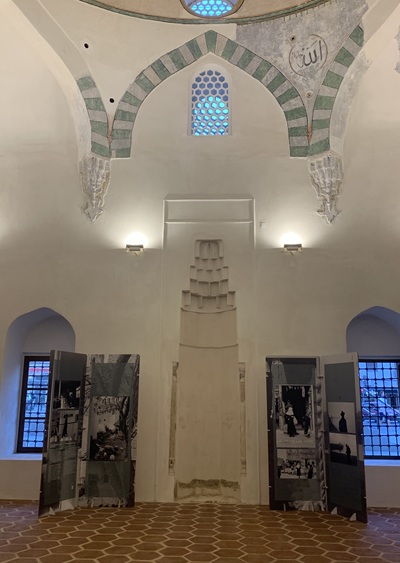
The Recep Pasha Mosque is located in Dorieos Square in the Old Town. It was built around 1587 in honor of the admiral of the same name and is one of the most significant examples of Ottoman architecture in the Dodecanese. The monument was in serious disrepair. The restoration project—with a total budget of 900,000 euros—was deemed necessary for its preservation. Through the Dodecanese Ephorate of Antiquities, extensive stabilization and conservation work was carried out—both in the mosque and in the mausoleum of Recep Pasha—to preserve its valuable painted decoration, reconstruct the plaster, marble, and wooden elements, as well as structural restoration of the minaret. The monument is being returned to the community of Rhodes fully restored, serving as a modern, exemplary cultural space.
The project “ Restoration and Enhancement of the Coastal Fortifications from the Naillac Pier to the Mills Pier,” with a budget of nearly 1,200,000 euros, ensured the long-term protection of the defensive complex in the port area. At the same time, the goal of functionally integrating the monuments with daily life and the urban fabric of the Medieval City was achieved. Meticulous masonry repairs were carried out, as well as the reinforcement of medieval and ancient foundations. The interventions focused on the stabilization and restoration of the fortifications on the tower and bastion of St. Paul, as well as on the Naillac Pier, including the battlements of the tower, the inner gate, and the embrasures of the outer bailey within the fortification complex of the Byzantine sea gate. At the same time, the spiral staircase was secured within the complex of the newer sea gate, while the upper level, the battlements, and the old staircase were restored on the tower-like gate of Saint Catherine. To enhance the aesthetic and functional quality of the complex, modern electrical and mechanical systems and special accent lighting were installed, and organized access points and circulation routes were created.
The restoration of the Ottoman Mansion of Hasan Bey has also been completed, with a budget of approximately €2,000,000. The mansion is being transformed into a new cultural hub in the Medieval City, ideal for hosting a variety of cultural events. This is a unique historic building, whose restoration highlights the aesthetic and historical value of that specific period in Rhodes. The work included stabilizing the structure, fully reinforcing and reconstructing the stonework, restoring the wooden staircase, the mezzanine, and the roof, as well as installing modern electrical and mechanical systems and security systems.
Through structural reinforcement, conservation, and the functional integration of monuments into the urban fabric, the Ministry of Culture is enhancing both the aesthetic and functional aspects of the Medieval City of Rhodes, a UNESCO World Heritage Site. The completion of these projects tangibly highlights the island’s multicultural historical stratification, returning valuable public spaces to the community and creating new, modern resources for education, historical knowledge, and sustainable tourism development.
On Chalki, Lina Mendoni inaugurated the newly established Archaeological Museum and attended the reopening ceremony of the fully restored post-Byzantine church of Panagia Choriatissa, located in the island’s castle. The two projects, with a total budget of over 1,000,000 euros, were carried out by the Dodecanese Ephorate of Antiquities, with funding from the Recovery and Resilience Facility and national resources.
Culture Minister Lina Mendoni stated: “The Aegean is the timeless cradle of Greek civilization. For the government of Kyriakos Mitsotakis and the Ministry of Culture, our presence on our islands and the restoration of their cultural heritage is our enduring duty to our islanders. Our goal remains for every island to have its own repository of memory. The newly established Archaeological Museum of Halki is the 31st museum we have opened to the public since 2019. Every museum, regardless of its size, preserves the identity and history of the place, serving as a living hub of education for future generations. At the same time, it was with great emotion that we returned the Holy Church of Panagia Choriánis, fully restored to its original religious use. The completion and handover to the local community of remote Chalki of these two significant projects is proof of the State’s commitment to the equitable cultural development of all regions of our country.”
The Archaeological Museum of Chalki, established as part of the Ministry of Culture’s policy to strengthen museum infrastructure on the islands, is housed in a traditional building in Emporio, donated by Savvas Theodoridis to the Municipality of Halki, which was renovated in accordance with modern museum standards. The museum has been equipped with modern electrical and mechanical systems, air conditioning, security, and fire detection infrastructure, as well as specialized exhibition lighting. The building is fully accessible to people with disabilities and features audiovisual aids and informational materials, including publications in Braille. The permanent exhibition presents the geography and history of Halki, highlighting the island’s location and role in antiquity through archaeological finds uncovered during excavations in recent decades.
The Church of Panagia Choriánis is located in the medieval settlement of Chorio, on the northern slope of Paleokastro Hill, below the medieval castle of Halki. Probably built in the 17th century, it is a characteristic example of post-Byzantine ecclesiastical architecture in the Dodecanese. Work on the monument included structural reinforcement and architectural restoration of the building envelope and its vaulted ceiling, reconstruction of the enclosure, and improvement of access. At the same time, work was carried out to clean and secure the painted decoration, conserve the wood-carved iconostasis and the icon stand, and restore five portable icons of particular historical and artistic value.
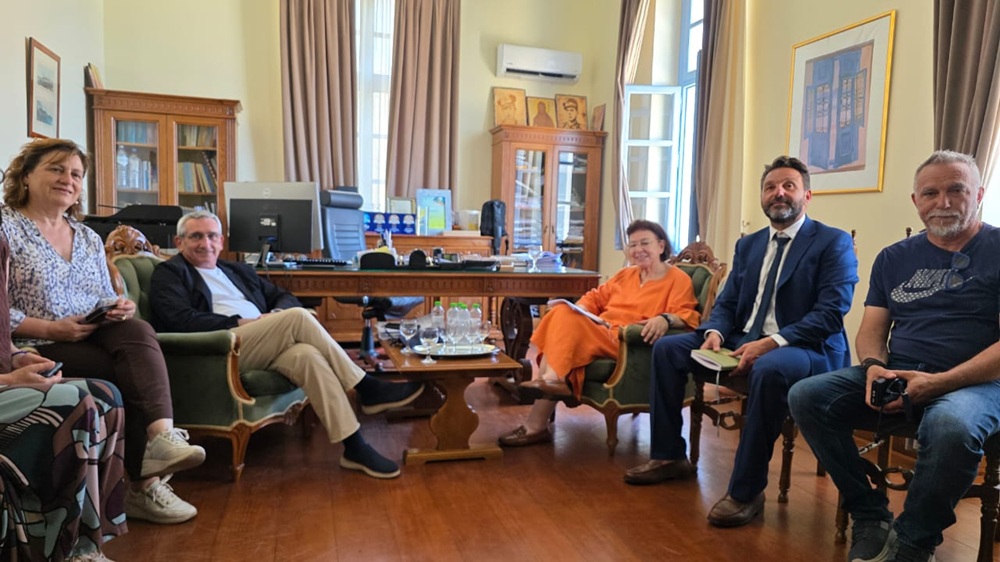
Lina Mendoni held a working meeting at the Chalki Town Hall with Mayor Evangelos Fragakis, in the presence of South Aegean Regional Governor George Hatzimarkos. The discussion focused on the critical issue of demographics, as well as the search for effective ways and incentives to strengthen and increase the permanent population of Halki. Particular emphasis was placed on the need to implement targeted projects that provide a definitive solution to the housing problem faced by public servants, such as teachers and law enforcement officers, who serve on the island.


Leave A Comment