
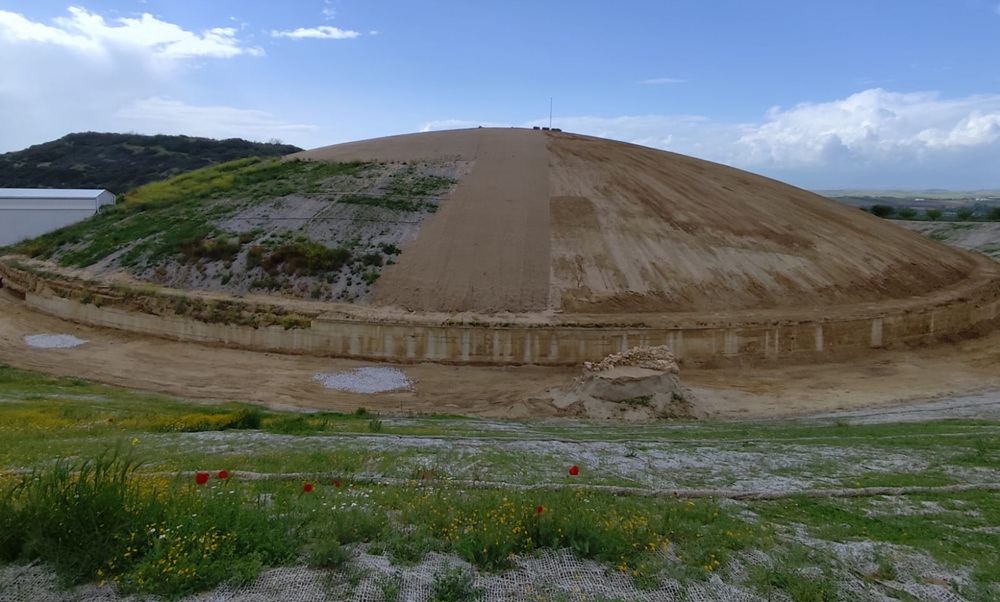
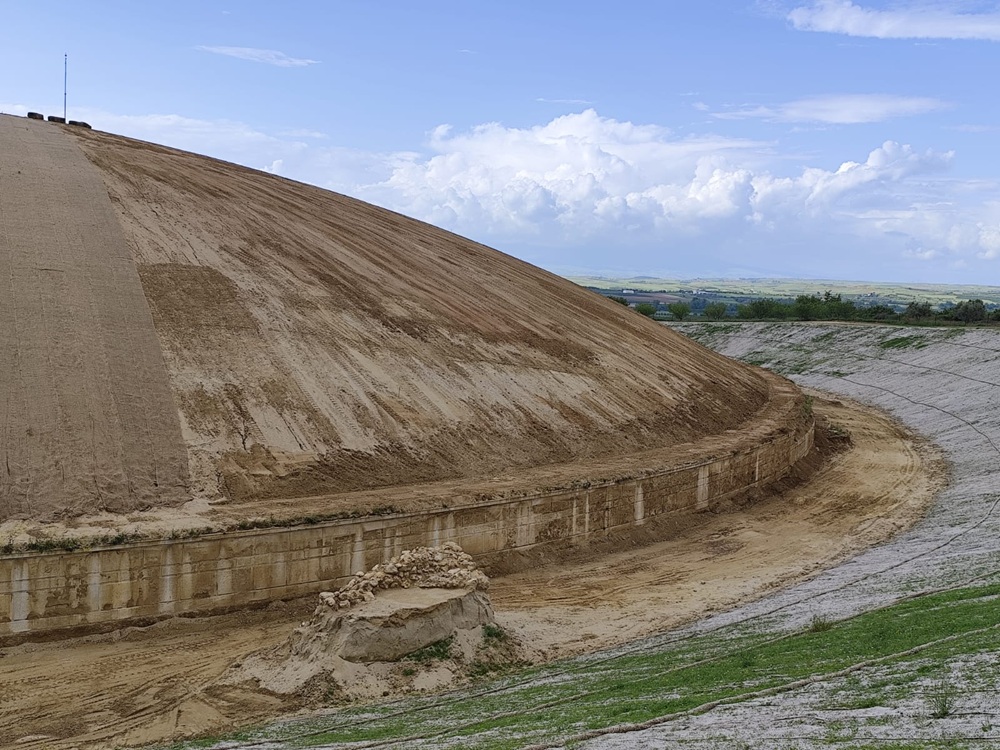
Culture Minister Lina Mendoni conducted an on-site inspection of the Kasta Tumulus in Amphipolis, where work is in full swing. For the first time, the entire perimeter of the Tumulus, measuring 497 meters, has been revealed, as well as the area occupied by the monument itself—more than 20 acres—highlighting its true scale. Lina Mendoni was briefed by Themistoklis Vlachoulis, Director of the Restoration of Ancient Monuments, and supervisor Michalis Lefantzis, on the progress of the interventions and the stages of restoration.
The excavation of the ancient enclosure and the restoration of the original geometry of the mound’s slopes and its surrounding area have already been completed. The restoration of the southern side of the enclosure, spanning 105 m, has also been largely completed, using scattered ancient marble blocks and a limited number of new blocks made of artificial stone. Concurrently, work is underway to reinforce the western section of the enclosure, involving extensive repositioning of the original counterfort, as well as the construction of the extensive rainwater drainage system for the Tumulus. These interventions cover a particularly large area, as the Tumulus occupies 22 acres, while the surrounding area covers an additional 30 acres.
At the Burial Monument, following the completion of the stabilization and restoration of the arch in the burial chamber and the installation of a metal shoring structure in the trench of the burial niche, the stabilization and restoration work on the ancient structure was completed. All older metal support and shoring structures were removed, making the interior of the monument fully visible. In the immediate future, the installation of the monumental double-leaf Macedonian marble door of the burial chamber is scheduled, followed by the wings and head of the sphinx. On the perimeter road, which follows the route of the ancient peristyle, the later phases of the monument are marked, such as the landing point of the Roman crane used to dismantle the marble of the enclosure, as well as the ramps for lowering materials from the top of the tumulus. At the same time, a rudimentary retaining wall, built of rubble masonry, is visible on the eastern slopes, an element that demonstrates the timeless approach to technical problems, from antiquity to the present day.
Following the inspection, the Minister of Culture stated: “The Kasta Tumulus is a unique and magnificent Macedonian monument which, through the completion of the work to restore its geometry and the uncovering of its entire enclosure, now clearly highlights its historical significance and value. The Kasta Tumulus is the largest burial mound discovered to date in Macedonia, with a diameter exceeding 140 meters, compared to the 110 meters of the Aigai Tumulus, a fact that clearly reflects its uniqueness and scale. To date, scientific research and available data confirm its dating to the last quarter of the 4th century B.C., while also demonstrating the exceptionally high quality and luxury of its construction, elements that link it directly to the era of Alexander the Great. The progress of the work is determined by the monument itself. Each monument is treated as a “living organism,” requiring thorough documentation, careful management, and continuous study. For this reason, interventions on the monument are carried out with the utmost care and methodical precision by the relevant departments of the Ministry of Culture, in collaboration with the National Research Foundation and “Demokritos,” our preeminent public research and scientific institutions, assisted by specialized scientific teams from Greece and abroad. The Region of Central Macedonia plays a key role in funding the project through the Regional Operational Programs of the NSRF for 2014–2020 and 2021–2027. The total budget for the interventions is expected to exceed €15 million. At the same time, procedures are underway to create an organized museum space on the eastern side of the Tumulus and the necessary visitor infrastructure. Our goal is the safe and comprehensive restoration of the monument by early 2028.”
The Minister then inspected the only surviving ancient wooden bridge in Amphipolis, which dates back to the 5th century B.C. and is mentioned by Thucydides. Work on its protection and conservation has been completed, as has the installation of a metal canopy to protect the monument. The project was carried out by the Directorate for the Conservation of Ancient and Modern Monuments and the Serres Ephorate of Antiquities, with funding from the Recovery and Resilience Fund and a total budget of 1.12 million euros.
The Minister of Culture then visited the Monastery of St. John the Baptist in Serres, where she inspected the restoration and conservation work on the historic monastic complex (12th century), which was recently completed by the Directorate for the Restoration of Byzantine and Post-Byzantine Monuments. The restoration project for the cell building in the south wing, which was destroyed by fire, and the Kountiadis building, with a budget of 1.8 million euros, was funded by the Regional Operational Program of Central Macedonia under the NSRF 2014-2020. At the same time, procedures are underway for the restoration and rehabilitation of Despotiko, the restoration of the Chapel of the Annunciation, and the completion of the “hospital,” with €2.1 million in funding from the Regional Operational Program of Central Macedonia – NSRF 2021-2027.


Leave A Comment