
By Margaret Wesseling
Playwright
Increasingly, I leave the theatre wondering why I recognize so few of them. Setting aside the quality of the productions themselves, the acting and directing – which are frequently excellent – I am increasingly haunted bythe fact that men and women are often imagined in certain stereotypical ways. These works of art sometimes purport to take the side of women, i.e. to be arguing for the feminist position that women ought to be equal with men, in the workplace, in the home, and in all ways. However I would question whether they are not based on certain assumptions about men and women that preclude a balanced view of the matter, thereby reiterating and reinforcing misogynistic attitudesand reinscribing them in the culture they claim to describe.
To give some examples: the play “Girls and Boys”, by Dennis Kelly, [2022, Theatro 104]presents a family. All of the characters in the play are encountered through a monolog by the female protagonist. The protagonist addresses the audience directly but her address is interrupted by interactions with her children, who are never present on stage but imagined by her. In this way we learn aboutfour characters: a mother, daughter, father and son in the same family. The mother is from a poor backgroundand has had a successful career as a producer in film. The father, a businessman, initially took his wife’s side in life butlater became jealous of her when she was more successful in her career than he is in his, and killed the children. The daughter chooses games which develop her creativity, while the son’s games reflect a violent imagination. The protagonist is a good mother, understanding, fair and kind.The mother and daughter, thus, are portrayed as non-violent; and the father and son as violent.Whether this reflects the protagonist’s perspective or constitutes the theme of the play, the effect is to divide the play’s characters into good and bad, and along gender lines.
I do not quite believe in this protagonist with herclimbfrom poverty to success and her paragon-like relationship with her children; neither do I believe in her husband, with his descentfrom supportive kindness to violent jealousy; the children’s behavior also seems to me to be slightly exaggerated. But all of this is acceptable in a work of art, which is not after all required to be a simple realistic reflection of reality. I find it disturbing that men and women can be forced into types like this, and I find the suggestion that violence is somehow an inherent part of maleness, to be even more disturbing. The ending is explicitly didactic, underscoring the moral and threatening to turn the play into an ideological argument.
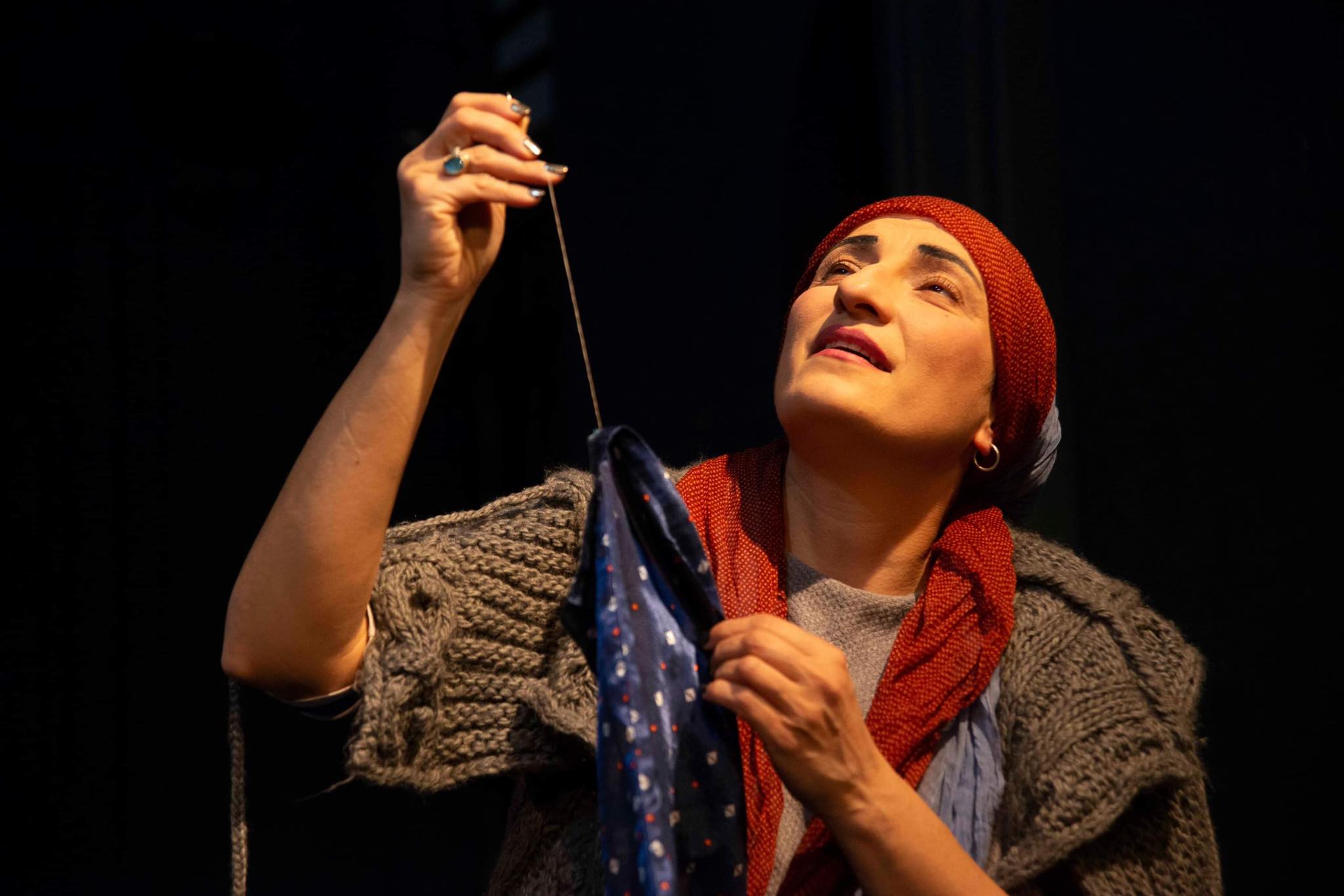
In the dance performance “Mami”by Mario Banushi[Onassis Stegi, 2022-2025], a man and a woman get married. Then the man enters into a sexual relationship with another man and leaves the woman and her mother to do all the housework and take care of the children. However, the man sometimes takes care of his own mother, who is senile. I left the theater feeling depressed. Oh, what a boring life for the women!There is a thirdfemale character in the play but she rides a bicycle around and around the stage, seemingly without purpose or human connection. The play leaves very little room for imagining women as subjects of desire rather than those left behind by male desire.Out of the many brilliantly created and sustained images in the play, two remain in my mind: a woman trying to drown herself in a watering trough, and another endlessly riding a bicycle in a circle.
Why does this pattern trouble me so much? I suppose for two reasons. One is that I find it hard to find any other kind of story, and the persistent negative message is depressing. But the other is that it wakes up a feeling of impatience and disbelief. I miss the spark that I feel in myself and everyone else around me.
I don’t see the women and men that I know.
The play “The Old Women who Gather Nettles”, [Konstantinos. Dellas, Stathmos Theater, 2024-2026], tells the stories of older Greek working women. The dances are beautiful. It was particularly moving to see the gestures and stances of working people integrated into the dances. But the stories are all negative, without a glimmer of light or humor in them. And I did not understand why all the characters are played by teenage boys. Are older women not capable of telling our own stories?What about my mother and my mother-in-law? They would have had plenty to say. I left the theater feeling sad.
In the play “The Meal” [Leia Vitali, Studio Mavromichali, Nov. 2024] the audience witnesses a woman being raped and murdered onstage during a dinner party. I was left wondering whether authentic emotions and interactions had been portrayed or if I had been watching pornography. To clarify, I was not shocked. Not much shocks me. I have seen sexual acts carried out on stage. So what? It is just that the play itself left me wondering whether the motivation for the spectacle had been investigation or pure entertainment. By putting an extreme act of violence before the eyes of the public, are the play’s creators inviting the audience to think about a social problem, or playing to its bloodlust and desire to witness cruelty?
On the other hand, the play “Marie Curie’s Story” [Warehouse Theater, Athens, October 2022] contained none of these stereotypes. This was a woman I could recognize, a woman with certain dreams, with a certain amount of energy who encounters resistance and struggles against it. She has a very particular, idiosyncratic character which develops on its own terms.The play is a monolog in Curie’s voice, based on a biography of her written by her daughter; there are characters other than that of Curie, but they do not speak and serve mainly to illustrate her interactions. It depicts Curie’s struggles against a misogynistic, patriarchal ideology — not against the nature of men.
Some plays make me ponder many things. “Karaiskakena, the Legend” by Sophia Kapsourou [Vault Theater, 2022], a monolog in the voice of the mother of the revolutionary hero Karaiskakis, suggests parallels and points of influence between her situation, her actions, and the character of the revolutionary hero; it also draws an interesting comparison between her language and attitudes and those of contemporary football fans in the stadium named after Karaiskakis. These suggestions of historical and social continuity refracted through the prism of language add depth to the narrative without limiting it. Again, there is an emphasis on learned attitudes and historical causality, but the characters play an active part in determining their outcomes. In this play, as well, I felt the pleasure of recognition that Aristotle describes in the Poetics (section IV), and that is one of the most intense pleasures of art: the pleasure of seeing a character on stage who resembled people I had seen before, and understanding them a bit better – the pleasure, ultimately, of learning.
I am well aware that we live in a time when women face difficulties. The World Health Organization estimates that worldwide, nearly one in three women has been subjected to violence, whether from a partner or from someone else This figure is very high and it hasn’t changed much in the last twenty years[1]. Everywhere a woman goes, she calculates: how will I get there, what will I wear, what will I say and how will I say it to be safe? These considerations are extremely limiting. But I can imagine a different world.
For a long time I have considered myself a feminist, not because I believe that women are in some way intrinsically or inherently better than men, but because I happen to be female and I think it is healthy to stick up for what one is. I have tried to live my life as if I was equal to a man: physically, intellectually, in terms of professional ambition, and in terms of what responsibilities I have and how I meet them. “Girls and boys are just the same” my 1970’s primary school teachers told me, and I believed them.Living this way I have of course encountered obstacles and observed that in many ways, men and women are not treated equally by society. However, I see our inequality as a social problem of learnt attitudes, not something determined by genetics.
I wonder whether the emphasis on the many social differences between men and women as stemming exclusively from something within our natures, does not ultimately narrow rather than expand our understanding of violence. By portraying women as the recipients of violence and never its perpetrators, contemporary theater runs the risk of leaving women’s agency and real strength, both physical and mental, out of the discussion altogether and thereby flattening out our perceptions of what it means to be a human being, with the full range of possibilities that is built in to humankind as a species.
The feminist movement has figures to look back on that were by no means passive recipients. On the contrary, they were proud of their strength. Sojourner Truth’s famous claims are just as true today for many women as they were 175 years ago:
May I say a few words? I want to say a few words about this matter.
I am a woman’s rights. I have as much muscle as any man, and can do as much work as any man. I have plowed and reaped and husked and chopped and mowed, and can any man do more than that? I have heard much about the sexes being equal; I can carry as much as any man, and can eat as much too, if I can get it.I am as strong as any man that is now.
[from the transcription by Marius Robinson: published June 21, 1851 in The Anti-Slavery Bugle]
Sojourner Truth was physically strong; she was also mentally strong and refused to be exploited after a certain point. Truth spoke out her whole life against conceptions of femininity which assumed that women are weaker and more refined than men. I see people like Sojourner Truth all around me. My problem is that I don’t see many characters like her on stage. And I miss them. After all, art is at its strongest when it enlarges our understanding of human beings rather than reducing them to categories.
[1] “Violence against women” World Health Organization, 18 June 2026. Violence against women



Leave A Comment