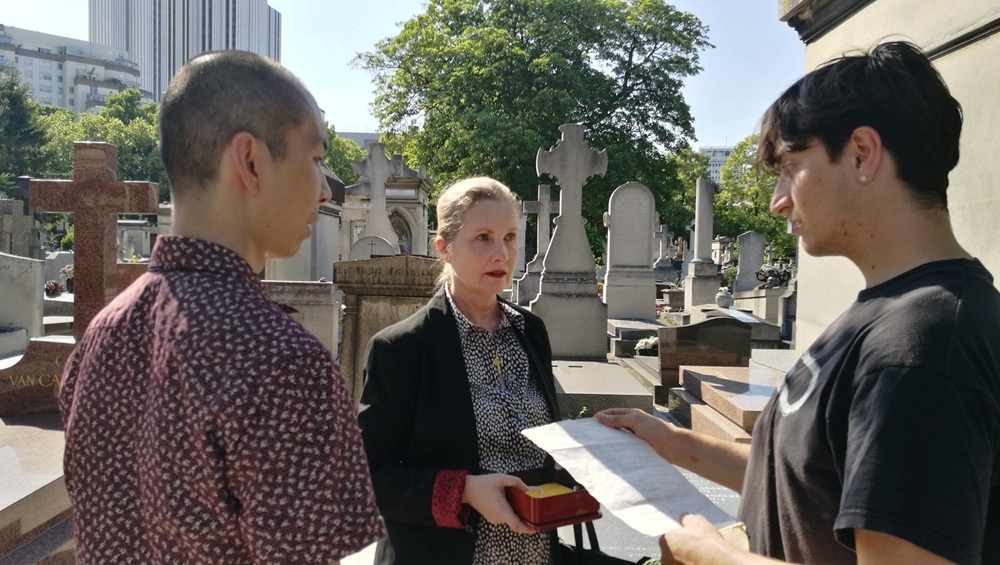
The Franco-Cypriot film “La Croix (Crossroads)” by Chinese director Hu Xueyang will be screened as part of the Bridges International Film Festival, taking place in Corinth from October 19–25, 2026. The film tells eight stories set in Paris and explores the intersections of fate, love, and redemption.
The film made its world premiere at the 21st Cyprus International Film Festival (CYIFF), where it was honored with the CYIFF 2026 Special Festival Award. Its title, “La Croix,” refers both to the crossroads of Paris and to the symbol of the Cross; its Chinese name, 交错, means “to intersect, to intertwine” and captures the web of human paths and destinies.
In the following interview, Hu Xueyang discusses the pain and shared human destinies that run through the film, the development of its narrative structure, the creative process in Europe, and his philosophy on acting and directing.
Days of Art in Greece: Homecoming, pain, the common human destiny. . . these are archetypal themes that one encounters in your film. In what way did they bring you closer to both the producers and the actors in your film?
Hu Xueyang:The pain and the fates experienced by the film’s characters were not foreign to me or to my colleagues. We have all experienced the pain and the fates reflected in the film. My mother died in a hospital bed. I myself found myself trapped alone on a remote Mediterranean island, where my passport was confiscated and I was delayed, unable to return to my homeland. One of the actors has been living in exile in Europe for more than thirty years; he left his homeland and never saw his parents again before they died. A final farewell in a dream.
D.A.: Your film moves effortlessly between suspense and drama (the scene just before the bus explodes brings Hitchcock to mind) as it unfolds eight stories. What are the challenges of such a project when you’re putting together the film’s editing? Was this (the editing) something you had in mind from the very beginning of the writing process?
Η.Χ.: I have always greatly admired Alfred Hitchcock and Stanley Kubrick. My debut film, Memory of My Childhood, was deeply influenced by Kubrick’s The Shining. In 1990, the film received a Certificate of Merit as a semi-finalist in the 17th Annual Student Film Awards’ Honorary Foreign Film Competition. La Croix originally began as a project comprising eight independent short films. However, production funding was interrupted three times over the course of two years, and the project had to be suspended and restarted on each occasion. Paradoxically, these interruptions gave me time to reflect deeply on the film’s editing and narrative structure. Eventually, during a sermon at a church in Paris, I felt as though I had received divine guidance. Suddenly, inspiration struck, and everything fell into place. The result was the film you see today: a work exploring redemption and love, employing a multidimensional, nonlinear structure across time and space, while maintaining a unified narrative in which the characters and their destinies remain interconnected.

La Croix, dir. Hu Xueyang
D.A.: Coming from the Chinese film industry, what impressed you the most during the process of producing a film in Europe?
H.X.: So far, I have made four films in Europe. Three have been completed, while the fourth is still awaiting post-production. La Croix is the first of these European films. I also spent nearly ten years in the United States, but I never considered making an American film there. Europe, however, is different. Culturally, Europe has much in common with Shanghai, the city in China where I have lived. Both are places where different cultures meet and intermingle, where colonial legacies interact with traditional culture, and where diverse influences coexist and intertwine. This is also why I chose 交错 as the Chinese title of La Croix. The word conveys the idea of intersecting, interweaving paths and destinies. Shanghai and Europe, especially Paris, feel remarkably alike to me. I lived in Shanghai’s former French Concession for many years. The architecture, the way people interact, and even everyday life and food culture all remind me of Paris. That is why I have never felt like a stranger in Europe, nor have I experienced the usual sense of being in a foreign land. But above all, what matters most to me is creative freedom—and the warmth, support, and understanding I have found in artistic collaboration.
D.A.: The way you handle your actors’ pauses and the concept of time in your film is very unique. Could you explain your philosophy to us a little?
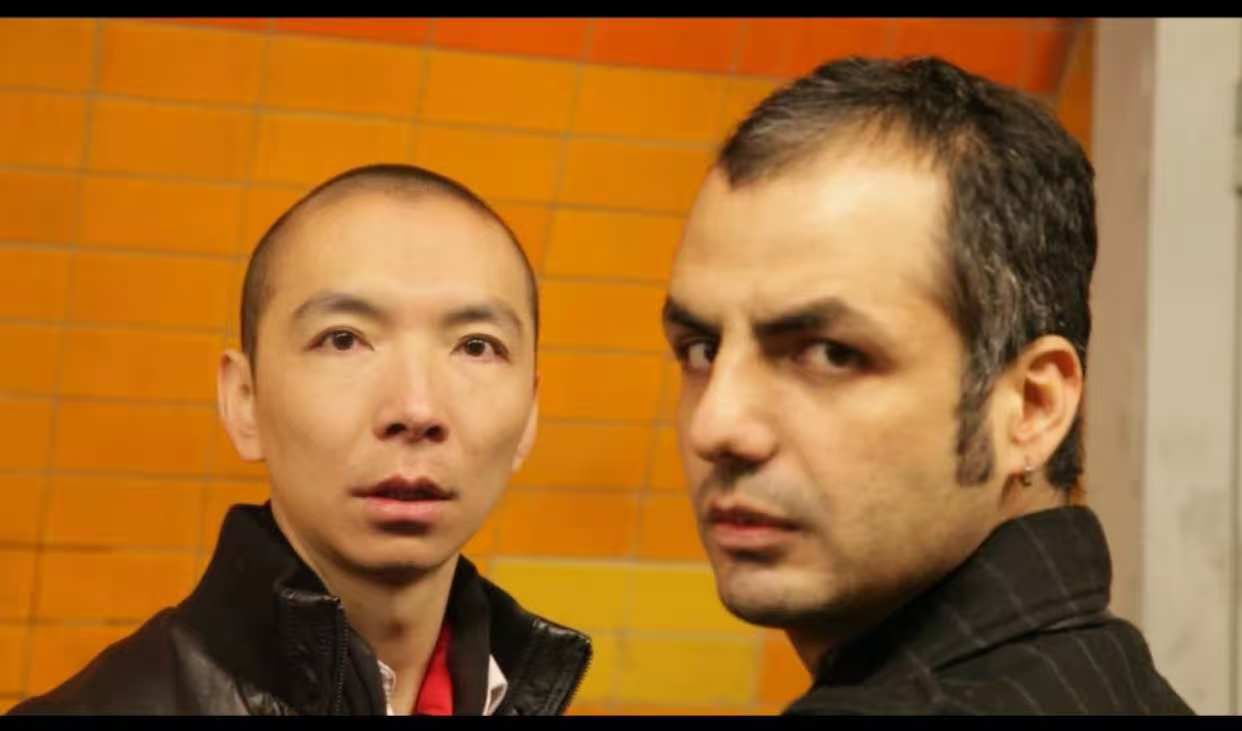
H.X.: Film acting is fundamentally an art of emotional memory. It can involve recalling an emotion that lasts only briefly, or capturing an emotion that erupts in a single instant. Once the director has established a good rapport with the actor, the next step is to wait for—or capture—that fleeting moment. It may disappear in the blink of an eye. This requires both patience and sensitivity. Acting does not begin only when dialogue is spoken. Many of the most truthful emotional moments occur before a character speaks, or after the words have been spoken. As the Chinese saying goes, “Silence speaks louder than words.” A still moment, a pause, or silence itself may reveal the most authentic emotion, often unconsciously, as an actor enters the inner life of a character. This is why film acting is often described as the art of emotional revelation. The finest film performances may require no words at all. Every subtle movement of the eyebrows and fingertips, every shift in the eyes, every tiny blood vessel in the eyes, every involuntary twitch of a muscle—all become visible on a cinema screen, magnified many times over. When a director truly understands a character, these minute expressions can be selected and used with extraordinary precision.
La Croix, dir. Hu Xueyang
D.A.: “La Croix” focuses on those things that often stem from luck, fate, or God… depending on one’s perspective. During the preparation and filming of a movie, to what extent do you allow chance to influence the life of your film? Or do you prefer rigorous preparation and no deviations from the script and the original concept?
Η.Χ.: The title La Croix carries several layers of meaning. On the one hand, it evokes the intersections of human lives and encounters along Paris’s many interconnected transport routes. On the other, it evokes the Cross, illuminated by divine love, under whose light people from different dimensions of time and space cross paths, influence one another, love one another, and sometimes save one another. Throughout the difficult production process, I gradually discovered and refined the film’s central idea, drawing inspiration from contemporary European society and its human condition. During preparation and filming, my first principle is rigour. Yet within that rigour, there must also be room for inspiration and creative freedom. I once gave a film lecture entitled There Is No Art on Set. What I meant was that, on a film set, the first priority is execution: getting the work done. The artistic vision, conceptual thinking, and creative decisions must, as far as possible, be completed before arriving on location. A director must have the ability to change the shooting plan at the last minute when circumstances demand it. I believe I have that ability. But it must never be abused, nor should a director indulge in spontaneous improvisation simply for its own sake. Otherwise, the entire crew may be left at a loss. And once filming begins, every day and every minute costs money. A director must remain accountable to the producer. As for interpreting a screenplay and understanding its artistic vision, there is a saying that a hundred readers will have a hundred different Hamlets. Likewise, if a director stages Hamlet at different stages of their life, the interpretation will inevitably change. For me, filmmaking is therefore a philosophical process of creation and exploration—one that never truly ends.


Leave A Comment