
By Panos Liakos
Classicist-Translator-Film Historian
Following the postponement of the performance scheduled for Friday, July 31, 2026, Euripides’ “The Trojan Women”, adapted and directed by Eleni Efthymiou, finally premiered on Saturday, August 1, at the ancient theater of Epidaurus.
The audience, undeterred by the unpredictable weather conditions and the stifling atmosphere that arose several times throughout the evening due to the natural disasters that struck our country yet again this summer, gathered at the most beautiful theater in the world for a historic moment.
For the first time, with full accessibility (supported by Alpha Bank), the Argolic Theater opened its gates so that everyone, regardless of disability, could enjoy the performance on an equal footing.
And just like that, just as we have all come together as communities since time immemorial to share in both joy and sorrow, beneath a sky that seemed to carry the ashes of the fall of Troy, we gathered to hear the mournful cry of the women of the city, and of all those who watch their bodies become spoils in the hands of the conqueror after the devastation of war. Written in 415 B.C., Euripides’ play could be read as an allegory for the massacre of Melos perpetrated by the Athenians and as a comprehensive commentary on Athenian imperialism, particularly in light of the preparations for the Sicilian Expedition. Drawing his material from the epic cycles, Euripides consciously chooses to focus on the fate of the female body and on collective mourning as the sole refuge and source of strength in the midst of destruction, while at the same time, the fate of the young Astyanax renders the “soul” of the play timeless in every era when genocides and internecine strife further crush the back of our planet.
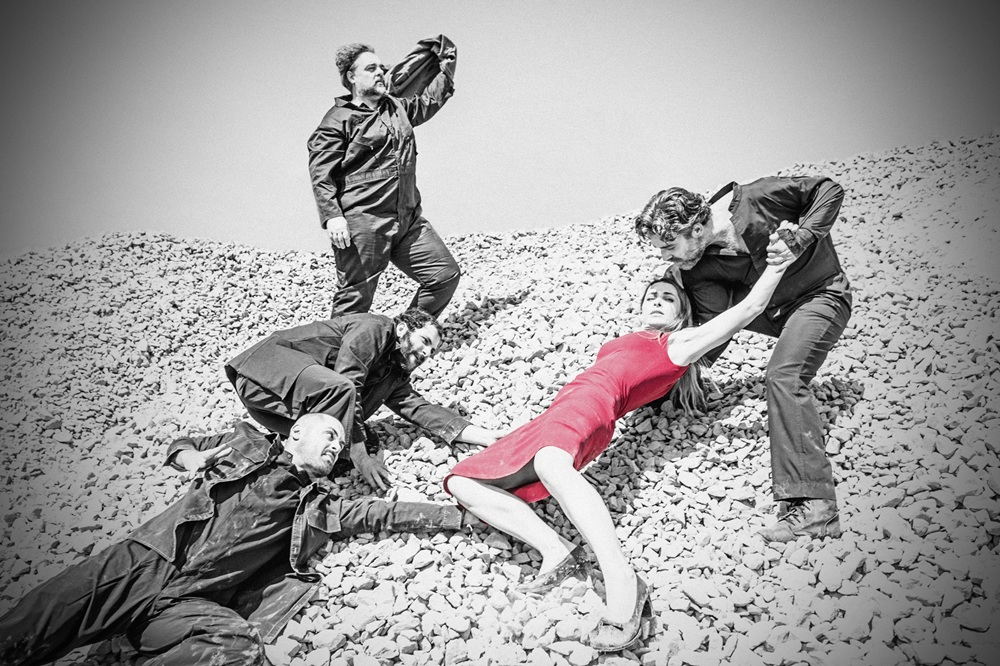
Set against a backdrop reminiscent of a ghost town in the aftermath of a modern-day bombing, Eleni Efthymiou’s play opened with the starkly poetic image of children playing amid the filthy water, taking on roles and, for the time being, unaware of the Greek army’s schemes. Very soon, the Greek messenger Talthybius arrives, sealing the fate of the leading women of Troy and stifling any sense of justice and compassion toward the most vulnerable citizens. In this light, the co-starring of the play’s central characters with the actors with disabilities from the “En Dynami” troupe adds a dramaturgically pivotal interpretation to Euripides’ text, with the climactic moments of the Chorus members, such as those by Loxandra Loukas, creating moments of rare emotion and articulating a discourse that refuses to be defined by the limitations of the body.

At the same time, it is impossible not to be moved by a performance as heart-wrenching as Lydia Fotopoulou’s portrayal of Hecuba. With disarming simplicity and an almost primal sense of dread in the face of impending total destruction, she emerges at times as a broken queen, at other times as a mother who must protect her people, and yet at other times as the leader of the collective lament, before etching herself into our memory as a preeminent tragic figure, standing over the body of Astyanax. It is difficult to break down the characteristics of such a performance, since it is composed of the finest elements from the great actress’s entire career on stage. The kinesthetic approach to the character of Cassandra is certainly striking—she is the one who foretells everything that will happen to Odysseus (played by Nancy Sideri) —while Yannis Tsarouchis’s poetic translation shines through perfectly during Andromache’s final farewell (and there, thanks to Evi Saoulidou’s performance, you could have heard a pin drop in the ancient theater) with Astyanax.
Despite the contemporary approach to the staging, Eleni Efthymiou’s choices were deliberate and avoided the realm of mere spectacle. In a possible interpretation of how the Trojan women perceived the Greeks as enemies, Efthymiou chooses to highlight what Hannah Arendt defined as the “banality of evil.” This approach works exceptionally well in the case of Talthybius, where Argyris Xafis initially draws us —as is his custom—deep into the psychological makeup of his character, then letting us discover for ourselves the layers Euripides has reserved for him (culminating in the monologue “War, how? How do you get inside a person? You slither in like a snake, insidiously…”). Nevertheless, in the case of Menelaus, as portrayed by Giorgos Christodoulou, there were moments when this very cliché of the patriarchal model was emphasized to an excessive degree. On the other hand, the casting of Vasiliki Troufakou as Helen proved to be a pleasant surprise for the audience—she never lost the tone or the fragility that define her presence in Euripides’ play.
With a musical arrangement by Lefteris Veniadis that evokes the style of Markopoulos, this production of “Trojan Women” left a lasting impression on the audience and highlighted the female—and even the wounded—body as the vessel of a revolutionary cry that echoes through the ages with words against war.





Leave A Comment