
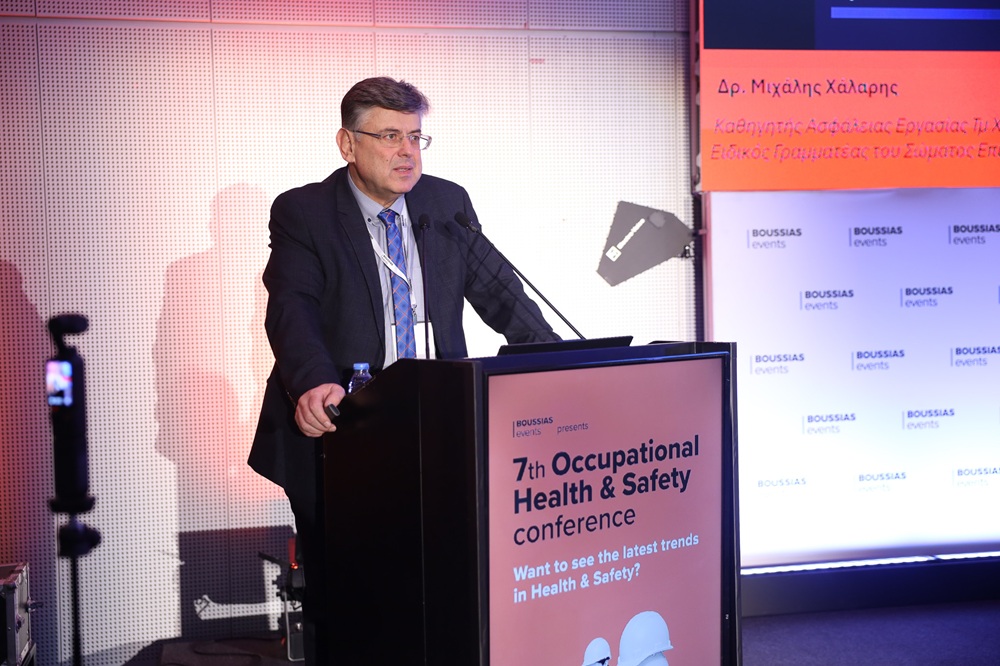
Mr. Michalis Chalaris is an Associate Professor in the Department of Chemistry at Democritus University of Thrace and Director of the MSc in Quality, Safety, Security, Health and Environmental Management. In his interview with Days of Art in Greece, he addresses issues concerning the role of the chemical industry in the modern era, the importance of prevention and scientific documentation, as well as the career prospects opening up for young scientists within an interdisciplinary and particularly demanding field of study.
The discussion highlights the importance of linking education with practical application, as well as the need for professionals who can address issues related to quality, safety, health, the environment, and sustainability. The MSc program he directs aims precisely at this connection, offering specialization in a field with growing demand and a substantial impact on both industry and society.
“…the goal is not to fear danger, but to understand it and mitigate it through knowledge, moderation, and sound planning, so that people can work safely”
Days of Art in Greece: Dear Mr. Chalaris, you are the director of the MSC program in Quality, Safety, Security, Health and Environmental Management at Democritus University of Thrace. How important is the subject matter covered in this master’s program for the modern chemical industry? Who are the prospective students in the program, and what does it mean for their future careers?
Michalis Chalaris: The subject matter we address in the MSc program is not merely a “niche” within the chemical industry. It is, I would say, the backbone of modern industrial governance: the way in which an organization transforms scientific knowledge into reliability, safety, health, and sustainability. Today, in an environment of climate pressures, increasing regulatory demands, process complexity, supply chain risks, and social accountability, it is not enough simply “to produce.” We must produce correctly: with documented quality, safety that becomes a culture, health that is actively protected, and the environment that is treated as a long-term commitment.
Democritus—our local philosopher—would remind us that knowledge remains empty if it does not lead to action and responsibility. And Aristotle would add that virtue is not theory; it is character, repetition, structure, and moderation. This is precisely what the logic of management systems in industry serves: to transform good intentions into repeatable, measurable, and improvable action. In our field, “good intentions” are not enough. A methodology is required: risk prioritization, prevention at the source, management of changes (MOC), contractor safety, process safety, monitoring of critical operations, and a unified QSSHE framework—Quality, Safety, Security, Health & Environment—as an indivisible system rather than as separate, isolated “boxes.”
The same applies beyond the chemical industry. The public and private sectors—from infrastructure and energy to hospitals, municipalities, transportation, and supply chains—need executives who can integrate technical knowledge, legislation, standards, the human factor, and strategy. In simple terms: people who see the “system” and make it function safely and with quality.
Our prospective students come from a variety of academic backgrounds: chemistry, engineering, environmental sciences, biology, and the health professions; they include industry executives, safety technicians, and professionals in production, quality control, regulatory compliance, and the public sector. This is our competitive advantage: we create an interdisciplinary class that learns to collaborate, communicate, and make decisions on complex problems—just as happens in the real-life setting of an industrial facility.
And what does this mean for their professional future? It means they develop a highly sought-after skill set: they can serve as QHSE/QSSHE managers or coordinators, as auditors, as compliance officers, as risk managers, as systems consultants, and as sustainability and ESG managers grounded in real-world data, and—for those who wish—the academic path to doctoral research is also open. In other words, we don’t just offer specialization. We offer a path to professional maturity: the ability to anticipate, document, improve—and ultimately lead.
If I had to summarize it in a “Epicurean” way: the goal is not to fear risk, but to understand it and mitigate it through knowledge, moderation, and sound planning, so that people can work safely, the Organization operates reliably, and development is sustainable. This is the purpose of our Master’s program—and this is also the challenge facing modern industry.
D.A.: You are the course coordinator for “Technological Disasters and Environmental Risks” in the master’s program “Analysis and Management of Man-Made and Natural Disasters.” How important is scientific intervention and understanding in this specific field today? What exactly is happening with man-made disasters?
M.CH.:Scientific intervention today is not merely “useful” in the realm of technological disasters and environmental risks—a field where engineering, chemistry, ecology, civil protection, and social psychology converge. It is absolutely crucial, because disasters are no longer isolated incidents. They are systemic phenomena: they arise at the intersection of technology, the human factor, organizational culture, infrastructure, climate pressures, and—very often—inadequate governance.
From an Aristotelian perspective, I would say that today we must return to the causes. Not just to “what happened,” but to “why it happened.” And here lies the great trap: in man-made disasters, the “cause” is rarely singular. Usually, it is a chain of causes—an accumulation of small deviations, silent warnings, and wrong decisions that at some point align and produce the major event.
So what is changing in man-made disasters today? I would break it down into three levels.
First, complexity is increasing. Industrial facilities, energy grids, transportation, chemical supply chains, digital infrastructure, and logistics have become more interdependent than ever. This means that a single error or failure at one point can trigger a chain reaction elsewhere. Technological disasters are no longer “local.” They become interconnected—and often cross-border.
Second, the risk landscape is changing due to climate-related pressures. Heat waves, heavy rainfall, wildfires, and floods are not merely “natural” phenomena. They are risk multipliers for technological systems: they affect storage, cooling, power supply, access, infrastructure resilience, and human performance in the field. Thus, so-called Natech situations—where a natural event triggers a technological accident—are becoming increasingly critical.
Third, the most difficult challenge: the “culture of prevention” continues to lag behind the pace of change. In many cases, the logic of compliance—ensuring we are “formally covered”—remains strong, rather than substantive prevention: change management, contractor oversight, monitoring of critical operations, effective use of near-miss data, and active leadership that gets out into the field.
Here, if you will, Democritus returns: knowledge without action is incomplete. It is not enough for us to describe the risk. We must measure it, prioritize it, and prevent it. And that is the role of science: to translate complexity into tools for prevention and management—into risk assessment methodologies, early warning indicators, scenarios, exercises, and decisions that truly reduce the likelihood and severity of the event.
That is why, in the course I teach, we do not view technological disasters as “random accidents.” We view them as a window into how a society and an industry function: how seriously it takes prevention, how much it invests in knowledge, and how much it respects people and the environment. And ultimately, this is what is at stake: moving from an era of reaction to an era of foresight, resilience, and responsible technology.
D.A.: You are a lecturer for the “Hazard Identification & Risk Management” module in the “Business Environment” course of the “MSc in Oil and Gas Technology” program. What is the academic focus of this master’s program? What are the employment opportunities in our country?
Μ.CH.:The MSc in Oil and Gas Technology is a graduate program that delves into the heart of the energy industry, where technology, economics, regulatory compliance, and risk management coexist as an integrated system. Its scope covers—in various aspects—the hydrocarbon value chain: upstream (exploration/drilling/production), midstream (transportation, pipelines, storage, LNG), and downstream (refining, petrochemicals, distribution), along with critical areas such as process safety, facility integrity, incident management, environmental protection, and ESG.
In the section I teach—Hazard Identification & Risk Management within “Business Environment”—the goal is precisely to demonstrate that risk is not a “technical footnote,” but a strategic variable: it affects costs, reliability, reputation, licensing, insurance, and even social license to operate. From an Aristotelian perspective, it is not enough to look at the result; we must analyze the causes (technical, organizational, human) so that prevention becomes a ethos—a repeatable and measurable practice. And with a “Democritian” perspective, we understand that major incidents often arise from small deviations that accumulate: this is why risk identification and change management (MOC) are fundamental.
As for employment opportunities in Greece, there are realistic and fairly broad career paths, especially if we consider the “oil and gas” sector within the broader energy ecosystem:
- refineries/petrochemicals,
- natural gas and LNG infrastructure,
- energy shipping (especially LNG)
- engineering/consulting
- public authorities/regulatory bodies and inspections,
- and, of course, international opportunities, because the sector is inherently globalized.
Simply put: this field does not “just train technicians.” It shapes professionals who can stand at the intersection where technology meets management and production meets responsibility—and this has always been a priority, whether we’re talking about hydrocarbons or the new era of the energy transition.
D.A.: You teach “Toxicology, Hygiene, and Safety in the Cosmetics Industry” in the “Master’s Program in Cosmetic Chemistry” This industry is considered one of the fastest-growing and is seen as a measure of emancipation, well-being, and more in the countries of the modern world. What are the risks that need to be anticipated in a timely manner in this industry? What are the needs in our country for specific professional personnel in the industry?
M.CH..:The cosmetics industry is indeed one of the most dynamic sectors globally, as it is linked to well-being, self-image, and even forms of social emancipation. However—and this is the crucial point—”well-being” cannot be based on invisible risks. Epicurus would tell us that pleasure is meaningful only when it does not cause pain; therefore, the industry must take timely measures to prevent anything that could harm people and the environment.
The risks in this specific industry operate on three levels:
- Product and consumer safety
Here, the “key” is toxicological assessment and safety documentation: allergens/sensitizers (especially fragrances), irritants, impurities in raw materials, potential endocrine-disrupting effects of certain chemical classes, as well as the safe use of “new” materials such as nanomaterials. Another critical factor is microbiological risk: the adequacy of preservatives, contamination control, and packaging stability/compatibility, because a “mild” product can become dangerous if production hygiene or preservation fails. - Worker and Process Health & Safety
In cosmetics factories, workers are exposed to volatile solvents, dusts/aerosols, surfactants, essential oils, and fragrance blends. There are risks of skin exposure, inhalation, as well as process-related hazards (flammable materials, thermal processes, storage, and ATEX environments in certain cases). Prevention here is “Aristotelian”: it is not enough to know the rule—it requires a culture of safety, meaning systematic implementation, training, monitoring, and a safety-conscious culture. - Environmental Footprint & Compliance
Microplastics, persistent substances, waste, water, packaging, green claims. Now the risk is not just “chemical”—it’s also a reputational/market risk if sustainability claims aren’t substantiated. This is where science, compliance, and ethics need to come together.
In our country, with its strong ecosystem of small and medium-sized enterprises and export-oriented businesses, the needs are very specific:
- Toxicologists / Safety Assessors with the ability to draft and document safety assessments.
- Regulatory Affairs professionals for dossier preparation, compliance documentation, proper labeling, and management of changes to raw materials/suppliers.
- Quality & GMP experts (e.g., ISO 22716), auditors, QA/QC, and traceability.
- Microbiologists and analytical chemists for testing for contamination, stability, and impurities.
- QHSE / EHS executivesfor employee health and safety, chemical safety, and environmental management.
- And increasingly, claims substantiation scientists, who bridge laboratory data with responsible communication.
To sum it up: the cosmetics industry can become a barometer of culture and well-being—but only when it is grounded in scientific rigor, prevention, and ethics. Democritus spoke of “euthymia” as balance and moderation. That is precisely the goal: products that promote well-being without shifting the risk from the consumer to the worker, or from today’s comfort to tomorrow’s environment.
“To put it in Aristotelian terms: the challenge is to transform knowledge into prudence—into practical wisdom that guides decision-making. And here, our region can become a pioneer in a new sense: a pioneer in applied knowledge, in documented quality, in safety that becomes a culture, in environmental responsibility that is not just a slogan.”
D.A.: You served as Chief Inspector of the Labor Inspectorate and Special Secretary at the Ministry of Labor and Social Security. You teach Occupational Safety, Process Safety, Security against Asymmetric Threats, and Infrastructure Protection. Please explain exactly what these academic fields entail and how they are interconnected. What are the needs in our country? What opportunities for collaboration exist for new academic staff?
Μ.CH.:At first glance, the fields you mentioned seem different. In reality, however, they are successive links in the same chain of protection: protection of people, production, the environment, and—ultimately—social trust.
What do they mean, in simple yet scientifically accurate terms?
1) Occupational Safety & Health (OSH)
This is the field aimed at preventing workplace accidents and occupational diseases. It concerns daily operations: ergonomics, exposure to chemical/physical agents, safe procedures, training, supervision of critical tasks, and a culture of reporting near misses. This is the level where Aristotle’s “virtue” is put into practice: ethos—a habit of proper behavior that is systematically built.
2) Process Safety
Here we are talking about something even more “systemic”: the prevention of major industrial accidents (Major Accident Hazards)—explosions, fires, toxic releases, and domino effects. It is the science of barriers, scenarios, HAZOP/LOPA/QRA, mechanical integrity, management of change (MOC), and controlled operation under abnormal conditions. While Occupational Safety protects the worker in everyday life, Process Safety protects the entire facility, the community, and the environment from low-probability but high-consequence events.
3) Security against Asymmetric Threats (Security against Asymmetric Threats)
Here we move from “accidents” to deliberate damage: sabotage, terrorism, insider threats, drones, theft/tampering with critical materials, and even attacks originating in cyberspace. Asymmetric threats do not simply aim to cause damage; they aim to cause disruption, fear, and destabilization. In modern industry, this is critical, because facilities operate as cyber-physical systems.
4) Critical Infrastructure Protection (CIP)
This is the framework that links the above to operational continuity and resilience: physical protection, cybersecurity (especially OT/ICS), backups, business continuity, crisis response plans, and coordination with public agencies. Here, we don’t just ask “how can we prevent it from happening,” but also “if it does happen, how will we withstand it, how will we recover quickly, and how will we learn.”
How are they connected?
Democritus taught us that major phenomena arise from small changes that accumulate. This is precisely the modern understanding of risk: disasters—whether accidental or deliberate—are often chains of failures.
That is why today we speak of a single continuum: Safety – Security – Resilience.
- Workplace Safety reduces daily exposure and errors.
- Process Safety shields high-risk systems.
- Security protects against deliberate interference with those same systems.
- Infrastructure Protection ensures that, even if a breach occurs, society and the economy will not collapse.
And here’s the key: when these operate as silos, they leave gaps. When they function as a unified risk management system, then the organization becomes truly secure and reliable.
What are the needs in our country?
Greece—and our region as a whole, from Cyprus to the Balkans—needs three major changes:
- Transition from “compliance” to “prevention by design”
Not just document reviews, but checks on critical barriers, MOCs, contractors, near misses, and safety leadership in the field. - Data and intelligent prevention tools
Risk-based inspection, real-time monitoring of reports/critical parameters, compliance dashboards for critical processes, predictive analytics for early detection of deviations—with guarantees of human-centered use and privacy. - Unified approach to cyber-physical risk and critical infrastructure
The energy transition (e.g., storage, hydrogen), large networks, and OT systems require new skills and interoperability among industry, regulators, and civil protection agencies.
What collaboration opportunities exist for new scientific personnel?
There is already a field that is “thirsty” for new talent and has the potential to become highly attractive:
- In industry: Process Safety Engineers, QHSE/QSSHE Managers, OT/ICS security specialists, risk analysts, emergency preparedness & business continuity.
- In consulting/engineering: HAZOP/LOPA/QRA, Seveso compliance, technically grounded ESG/CSRD, risk governance.
- In the public sector: inspections/regulatory authorities, civil protection, critical infrastructure, environmental audits.
- In research and universities: applied projects, laboratories, micro-credentials, and international programs.
And most importantly: our region can serve as a regional resilience laboratory. Through cooperation networks in Greece, Cyprus, and the Balkans—involving common protocols, training, exercises, and the exchange of know-how—new scientific staff will not simply find “a job.” They will find a mission.
If I may offer a personal conclusion, based on my experience in both law enforcement and public administration as well as in the academic community: this field needs people who combine scientific precision with prudence—Aristotelian practical wisdom. Because, in the end, security is not a slogan. It is a governance choice. It is a culture. And we can—and must—build this culture as a community with a common language: prevention, documentation, resilience.
D.A.: In the ΜSc program in Quality, Safety, Security, Health and Environmental Management you teach the course “Hazardous Factors, Basic Principles of Toxicology, and Chemical Exposure.” Our country is considered to have a low share in global production of chemical raw materials and a correspondingly low environmental impact. Is that correct? What is the future of the chemical industry in our country, and what are the prevention needs?
M.CH.: The observation is valid, but it requires careful clarification. Greece is indeed not among the world’s major producers of basic chemical raw materials. However, this does not mean that we have a “low chemical footprint” in the true sense of the term. Because chemistry is not just the factory that produces raw materials; it is the entire value chain: refining and petrochemicals, materials and construction products, pharmaceutical and cosmetic formulations, agri-food inputs, storage/transport of hazardous substances, waste management, water, occupational exposure. And—most importantly—the environmental burden is not “zeroed out” simply because we import raw materials: it is often merely shifted geographically, while the risks of exposure, accidents, and misuse remain here, in the workplace and in society.
Democritus would say that reality is often hidden in the “invisible”: in particles, in low concentrations, in chronic exposures, in small incidents that don’t make the news but shape health and the environment. That is why the course I teach—“Hazardous Factors, Basic Principles of Toxicology and Chemical Exposure”—is so critical: it teaches us to recognize the danger before harm occurs, to distinguish risk from exposure, to understand “dose–response,” to methodically evaluate scenarios, and to build real prevention.
As for the future of the chemical industry in our country, I do not see it as a “replica” of the mass production of basic chemicals. I see it as a shift toward the production of higher-quality products with greater value per unit: specialized products and formulations, chemical technology for the energy transition, low-footprint materials and processes, circular chemistry (recovery/recycling/clean streams), “green chemistry,” and the substitution of substances of very high concern. In simple terms: Greece may not be a “mass producer,” but it can become a leader in quality, innovation, and application—where chemistry meets manufacturing, health, and the environment.
And here, the prevention needs are threefold and immediate:
- Prevention of exposure at the source (hierarchy of measures: elimination/substitution, engineering controls, work organization, and PPE as a last resort).
- Maturity of management systems: from “compliance on paper” to a culture of prevention, with measurable indicators, training, reporting of near misses, and change management.
- Data and monitoring: from periodic inspections to more “real-time” monitoring (occupational health, environmental measurements, digital recording of deviations), so that we can identify weak signals early on.
From an Aristotelian perspective, prevention is not a momentary decision; it is a consistent, repeatable practice of proper operation. And this, ultimately, is the challenge for the chemical industry in Greece: to develop not “in spite of prevention,” but through prevention—as a competitive advantage, as social responsibility, and as a culture of production.
“…the cosmetics industry can become a barometer of culture and well-being—but only when it is grounded in scientific rigor, prevention, and ethics. Democritus spoke of ‘euthymia’ as balance and moderation. That is precisely the goal: products that promote well-being without shifting the risk from the consumer to the worker, or from today’s comfort to tomorrow’s environment.”
D.A.: You are a member of the “Green Chemistry” network. What does “green chemistry” mean?
M.X.: “Green Chemistry” isn’t just a slogan; it’s a practical way to design chemistry so that it prevents pollution rather than “cleaning it up” after the fact. Simply put: it’s chemistry that produces the products we want—with less waste, less toxicity, less energy, and more circularity. And this is achieved through its 12 Principles, which function as “rules of good engineering” for the laboratory and industry.
The 12 Principles of Green Chemistry (in layman’s terms)
- Waste prevention: it is better not to generate waste than to manage it.
- High yield/material efficiency: ensure as much material as possible goes into the final product.
- Less hazardous formulations: methods that reduce or eliminate toxic substances.
- Safer products: products that are effective but less toxic.
- Safer solvents and additives: where possible, avoid or replace them.
- Energy savings: lower temperatures/pressures, “milder” processes.
- Renewable raw materials: biomass and renewable sources instead of finite resources.
- Fewer “steps” and byproducts: avoid unnecessary safeguards/modifications that generate waste.
- Catalysis instead of “harsh” reagents: catalysts increase efficiency and reduce waste/energy consumption.
- Design for disassembly: products that, at the end of their life cycle, break down into harmless components.
- Real-time monitoring: measuring and controlling the process to avoid hazardous byproducts.
- Inherent process safety: design intended to reduce the risk of accidents (fire, explosion, leaks).
These principles align directly with the SDGs, as they translate sustainability into technical design criteria:
- SDG 3 (Good Health & Well-being): fewer toxic substances, safer products and work environments.
- SDG 6 (Clean Water): pollution prevention, safer solvents, less waste.
- SDG 7 (Affordable and Clean Energy) & SDG 13 (Climate Action): energy-efficient processes, reduced carbon footprint.
- SDG 9 (Industry, Innovation, Infrastructure): innovative, safe, and competitive technologies.
- SDG 12 (Responsible Consumption & Production): circular economy, less waste, design for circularity.
- SDG 14 & 15 (Life Below Water & Life on Land): fewer persistent/hazardous substances in the environment.
To put it in “Democritian” terms: Green Chemistry asks us to see the invisible—the low concentrations, the byproducts, the chronic exposures—and to design at the source. And in Aristotelian terms, it is a form of prudence: practical wisdom that links science with moderation, safety, and the common good.
In short: Green Chemistry is the chemistry of the future, because it combines competitiveness, innovation, and the protection of people and the environment within a unified framework.
D.A.: The graduate programs you are enrolled in, and the impressive number of doctoral dissertations you supervise, are certainly vital for modern industry, environmental protection, safety, health, well-being, the economy, and so on. However, it is also an opportunity for the University to develop programs that will set it apart from other universities in the country and enable it to re-establish itself on the global scientific map by attracting students from all over the world. To what extent can the region’s natural resources, industrial environment, and strategic location—given its proximity to the Balkan countries and Eastern Europe—serve as drivers of growth for Democritus University, a point of reference both in our country and internationally?
M.CH.: Absolutely. And I’ll put it in “Democritian” terms: place is not merely a backdrop—it is a variable within the system. Thrace and Eastern Macedonia offer something rare for a university seeking to distinguish itself internationally: a true “laboratory of reality.” Subsoil and raw materials, energy and transportation, ports and cross-border flows, industrial activities and critical infrastructure. All of these create a field where science does not remain theory; it is tested, measured, and transformed into evidence-based prevention and resilience.
Democritus University of Thrace, through its strategy, seeks precisely this: extroversion, innovation, digital/hybrid education, connections to the job market and lifelong learning, as well as a footprint that “makes its mark” on the international stage. When you don’t just talk about these things—but tie them to a geographical advantage—that’s when you create differentiation. Because here we can teach and conduct research on issues that concern all of Europe: industrial safety, environmental risks, infrastructure security, energy transition, crisis management, and cross-border cooperation.
And we’re not just talking in theory. The IT4EST project is a prime example: a framework where innovation is tested in the field—with “test beds,” multiple scenarios, collaboration between industry, academia, and authorities, and the transfer of know-how to real-world conditions. This is the “living lab” model: producing solutions that have an immediate impact, while simultaneously training people who can implement them.
The IRMHUB project, in turn, is based on the concept of creating a hub for integrated risk management and innovation, with a quadruple helix (university–market–public sector–society). It is precisely the kind of European architecture our region needs to become a gateway of know-how to the Balkans and Eastern Europe—not merely geographically, but scientifically and educationally.
To put it in Aristotelian terms: the challenge is to transform knowledge into prudence—into practical wisdom that guides decision-making. And here our region can become a pioneer in a new sense: a pioneer in applied knowledge, in documented quality, in safety that becomes a culture, in environmental responsibility that is not just a slogan. This—if you build it systematically—does not just attract students. It attracts collaborations, projects, international partners, and, ultimately, reestablishes Democritus University on the global scientific map as a university that does not merely describe the world: it improves it.
D.A.: And now for some more personal questions: Why did you choose this field of science? Where are you from, and what personal experiences or works of art influenced you so much that you excelled in this very unique scientific discipline?
According to literary and philosophical analyses, balance in the world is largely due to the kindness, deep cultivation, and humanism that characterize the scientists who practice this particular science. Do you agree?
When we say that these two people have chemistry between them, is there actually measurable evidence to support that observation?
M.CH.: I’ll start with the most personal aspect: I chose this field because it showed me, from an early age, that science only truly comes into its own when it becomes a “means of protection.” Chemistry is the language of matter; but Safety, health protection, and Risk Management are the language of responsibility toward people, work, and the environment. My own career—in the laboratory, the fire department, inspection, management, and crisis response—has convinced me that major failures do not stem from a “big mistake,” but from an accumulation of small deviations. This is deeply “Democritian”: the critical often lies hidden in the small and the unseen.
Speaking of my place of origin, I’ll put it a little differently: my geographical roots in the Cyclades shaped me, but my “spiritual roots” lie in the Greek tradition of moderation, balance, and responsibility. Aristotle speaks of causes and prudence—the practical wisdom that transforms knowledge into sound judgment. This is precisely what prevention is. And if you are looking for works of art that function as an inner compass, I often return to works that remind us that technical power without ethics becomes dangerous—not to “embellish” our résumés, but to remember that science is also an ethical stance.
I therefore agree with the idea that balance in the world is based on kindness, culture, and humanism—provided we express it in scientific terms: humanism is a functional prerequisite in the science of security. A culture of prevention is not imposed solely through procedures. It is built on trust, justice, respect, and concern for others. Epicurus would put it simply: well-being is a life with less fear and less pain—and prevention serves precisely that purpose.
And now for the more playful but interesting question: when we say “they have chemistry,” is there measurable evidence? The phrase is, of course, metaphorical. But behind it lie measurable biological and behavioral processes: attraction and bonding are linked to neurobiological reward and attachment systems (such as dopamine, oxytocin, and vasopressin), while psychology speaks of “interpersonal chemistry” as something evident in synchrony, mutual responsiveness, and the feeling that “we function better together than apart.” This can also be reflected in synchronization indicators (movements, rhythms, nonverbal cues) associated with social bonding.
So: there is no such thing as a “chemistry certificate.” But there is something deeply scientific and deeply human: the harmony—biological, emotional, and moral—that brings two people together not only in their feelings, but also in their ability to build something good together.
***Days of Art in Greece would like to extend its warmest thanks to Mr. Chalaris for his time and excellent cooperation!




Leave A Comment