
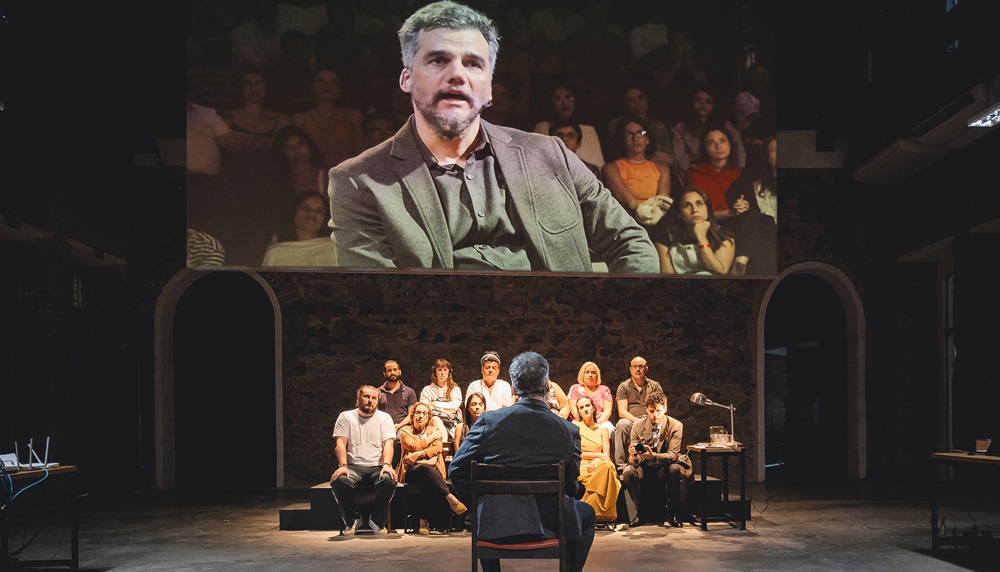
Taking as its starting point the timeless themes of Henrik Ibsen’s play, An Enemy of the People (1882), the award-winning Brazilian director Christiane Jatahy revisits the play’s core themes and characters, essentially transforming the theater stage into a participatory courtroom.
Ibsen’s archetypal, conflict-driven hero, Dr. Thomas Stockmann, seeks a second chance to address the public and an opportunity to engage in a dialectical confrontation with his brother, the town’s mayor, Peter. The reason is their conflict over the contaminated public baths in the local community, with Thomas exposing the local government’s negligence and the mayor, for his part, defending the “development” of the tourism industry—which, in essence, endangers citizens’ health in the long term.
In the absence of judges and lawyers, the audience will play the pivotal role of the jury, “weighing” the arguments of both sides and delivering its verdict each evening. Indeed, there are many moments when, based on Jatahy’s script, the jurors—through their representative—ask questions, prompting the drama’s protagonists to bring to light aspects of their backstories and interpersonal relationships. Despite the fact that the performance far exceeds two hours in length (specifically, the Sunday evening performance we attended lasted 150 minutes), Jatahy’s adaptation—with its insistence on highlighting the dialectic disxourse of the opposing forces—keeps the audience engrossed, surprising them at times with direct addresses to the audience (breaking the “fourth wall”) and presenting, in video form, the evidence submitted for the jury’s consideration.
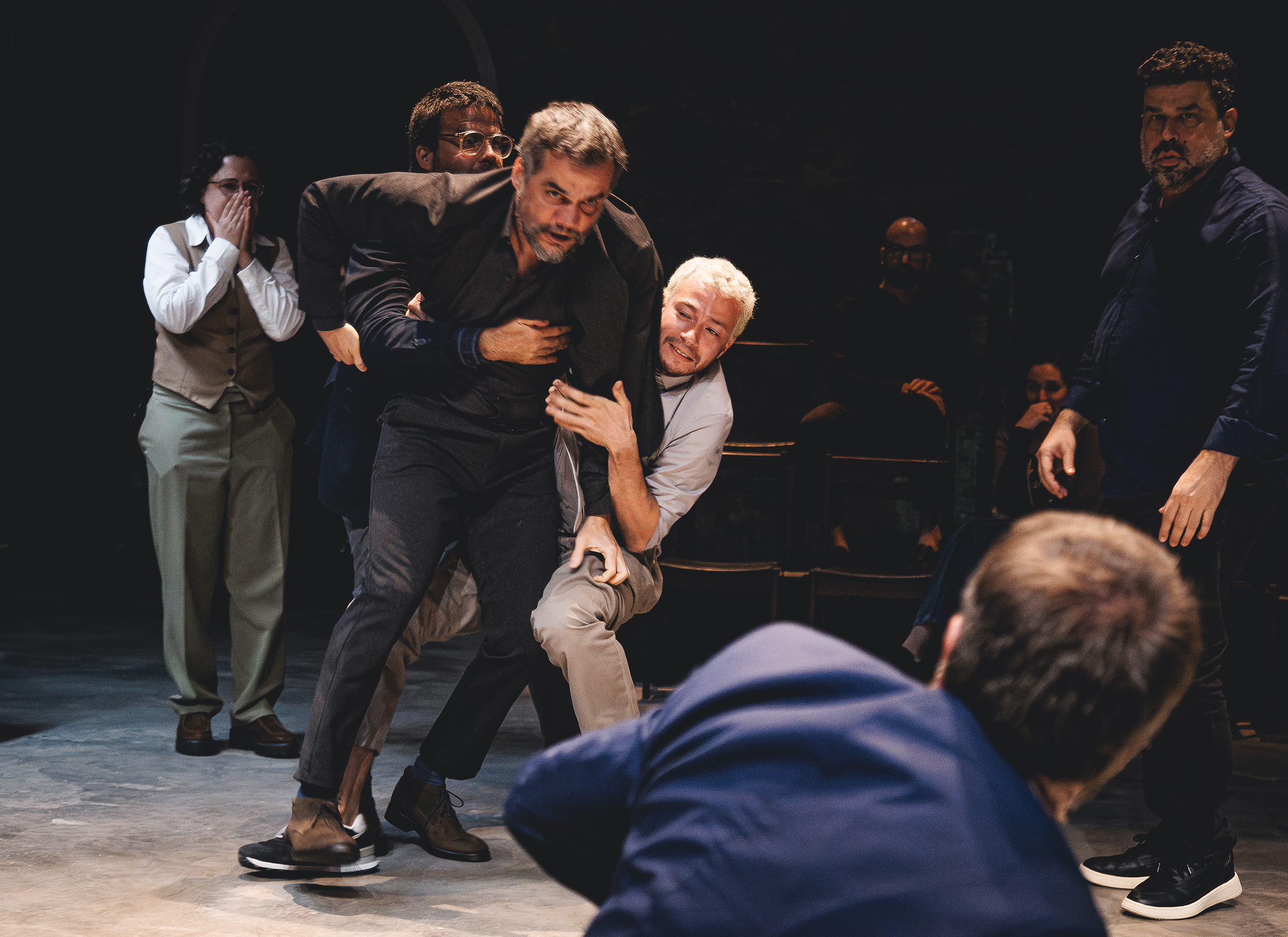
In this way, Jatahy’s modern approach makes use of contemporary on-stage filming techniques—not for the sake of it or to provoke cheap shock value and sensationalism, but rather to enhance her narrative and lend a cinéma-vérité feel to the final result. Most importantly, the actors in this adaptation usually communicate with one another by looking each other in the eyes, interacting (sometimes violently), while the cinematic elements, rather than distancing the viewer from the heart of the unfolding drama, keep them on the edge of their seats at critical moments in the play (such as during the final verdict).
With a tradition of radical political discourse (let’s also recall the recent Oscar for Best International Feature Film awarded to I’m Still Here), Brazilian artists give the impression that they know how to form cohesive teams. “A Trial” is no exception to this trend, as Wagner Moura, Danilo Grangheia, and Julia Bernat meet, clash, and fall in love on stage. Film buffs who admire Moura’s achievements on the big screen (culminating in his Oscar-nominated performance in The Secret Agent) will also come to appreciate other facets of his talent here. More specifically, his ease in connecting with the audience from the stage, the directness with which he delivers his lines, and above all, how he “modulates” his character’s emotional intensity—shifting from dialogue to physical outbursts, despair, and the melancholic reflections in his closing monologue. Danilo Grangheia was equally impressive as a formidable adversary, particularly in the way his character, as mayor, sarcastically “observed” his brother’s speeches and interjected cynical remarks. As for Julia Bernat, she selflessly navigated a dramatically challenging arc, from defending her father to breaking down in his arms following the release of an emotionally charged video.
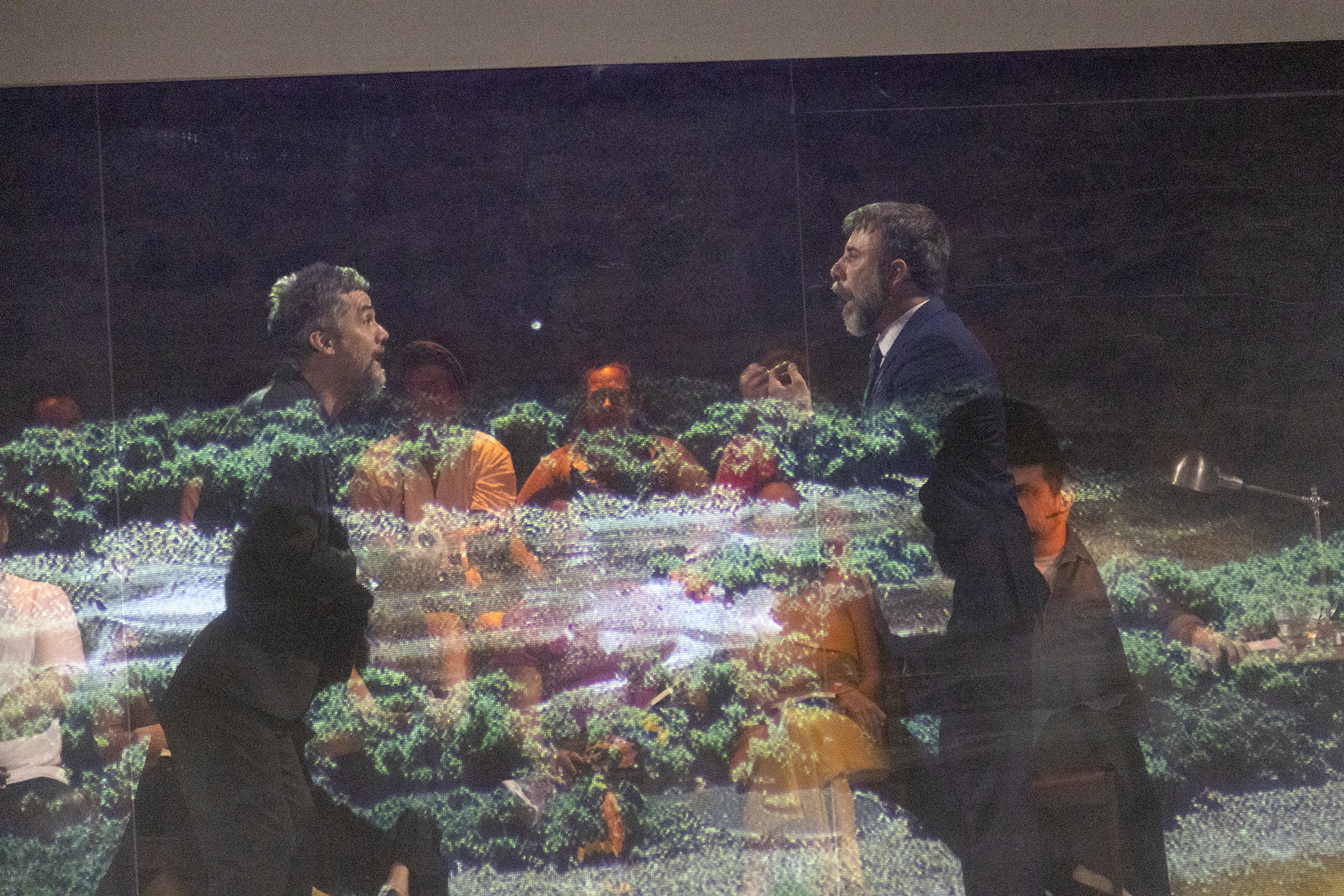
Ultimately, this “trial,” taking place before an Athenian audience in the heart of the place where democracy was born, provokes a variety of reactions and raises questions about what “truth” is, what forms it takes in today’s digital reality, and to what extent democracy functions today.
*The performance was presented as part of the Athens Epidaurus Festival in 2026. Specifically, it took place at Peiraios 260 on July 26 and 27, 2026.

Leave A Comment