
By Margarita Kataga
Art Historian
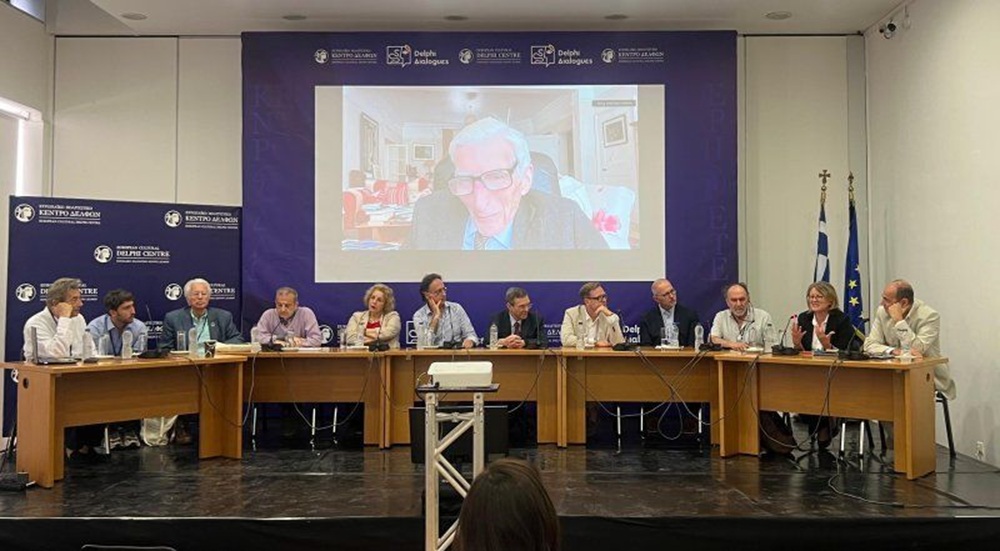
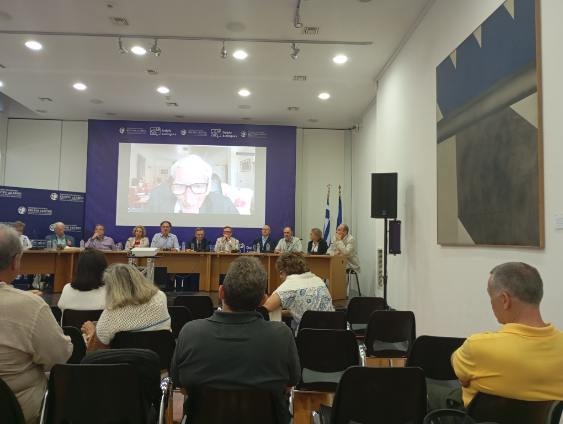
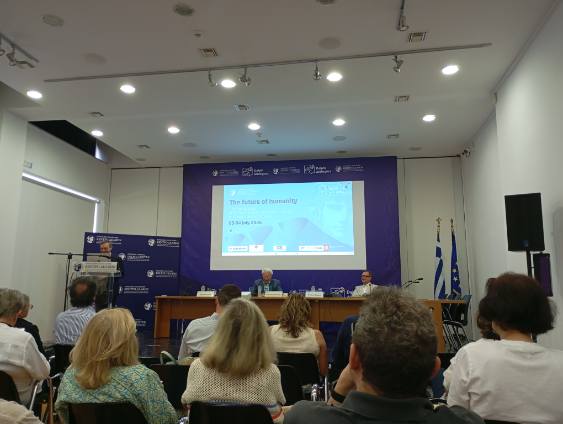
A high-level gathering of world-renowned researchers and academics was held with great success on July 3 and 4, 2026, at the European Cultural Center Delphi Centre.
The Delphic tradition, as analyzed in his presentation by Andreas Gofas, Director of the European Cultural Delphi Centre, was based on the characteristics of institutionalized ambiguity, providing a platform for personal reflection, for “Know Thyself,” personal and collective self-examination, and the proclamation of silence, emphasizing the recognition of boundaries and self-awareness within the mechanisms of society.
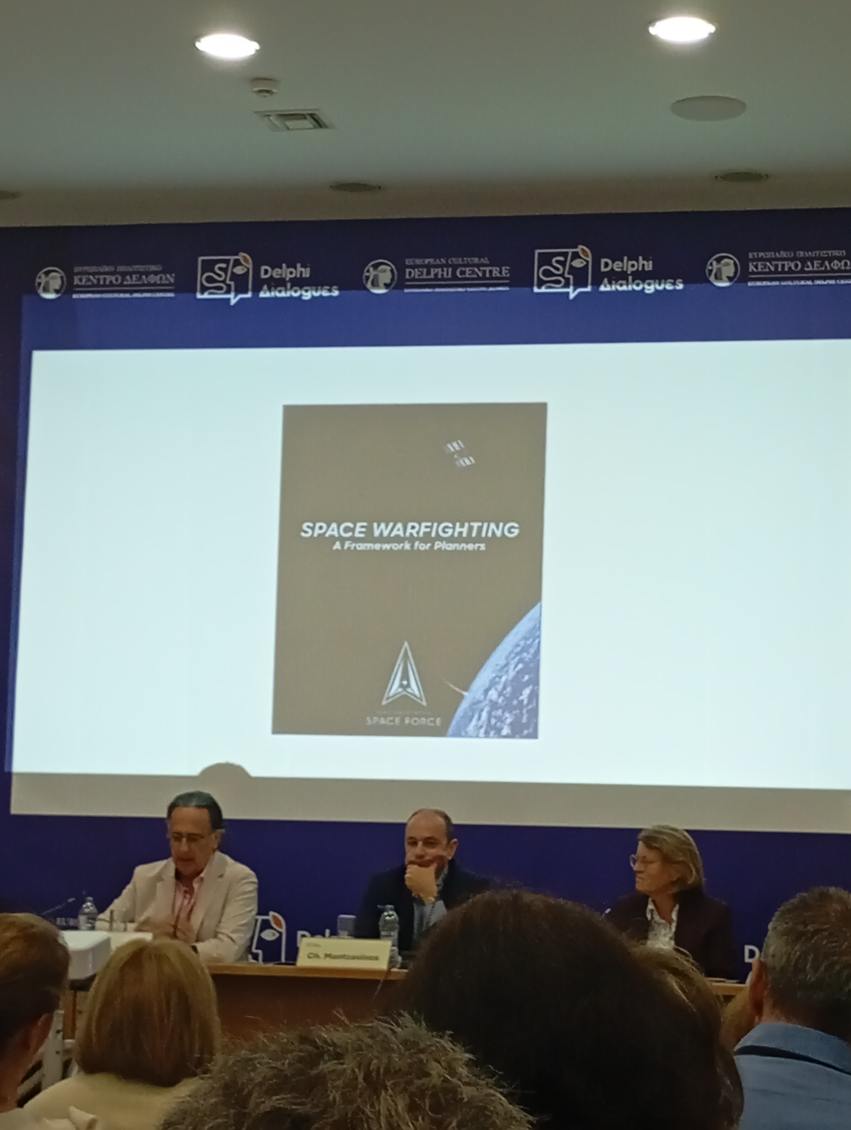
The Fourth Delphi Dialogues presented ongoing research addressing questions that concern the priorities of today’s humanity and global ethics, such as the relationship between artificial intelligence and democracy and governance, the development of neurotechnology, space exploration and the policies that govern it, the possibility of extraterrestrial life and its scientific implications, as well as posthuman evolution and the future of civilization.
Panagiotis Roilos, President of European Cultural Delphi Centre. and professor at Harvard University, in his speech titled “Space Policy and the Future of Humanity,” introduced the concept of “neo-messianism” as a key component of what he has termed “neo-medieval post-capitalism,” which fuels revisionist ambitions at the geopolitical level and is now extending into space. Space exploration, as he noted, should neither undermine the protection of Earth nor replicate the conflicts of the planet, but rather serve humanity.
The influential astrophysicist and space scientist, Professor Abraham (Avi) Loeb, advocated for the search for extraterrestrial intelligence alongside or beyond the advancement of artificial intelligence, which, as he pointed out, has already changed the meaning of what it means to be human. And Stamatis Krimizis, a university professor, space scientist, and pioneering researcher in the most significant space programs of the U.S. and NASA, emphasized: “Scientific data indicate that the existence of intelligent life elsewhere in the universe is highly probable, as there are billions of planets with conditions similar to Earth’s, while emphasizing that the preservation of life on Earth remains the highest priority.” Professor Martin Rees of the University of Cambridge, the Royal Astronomer of the United Kingdom, argued that for the first time in history, one species—humans—has the ability to determine the future of life on Earth and, possibly, beyond.
Professor Lenart Škof of the Koper Center for Science and Research spoke about the future of humanity, focusing on the “breathing space,” the inner space of autonomy that protects humans from the submersion and colonization of the soul by digital reality.
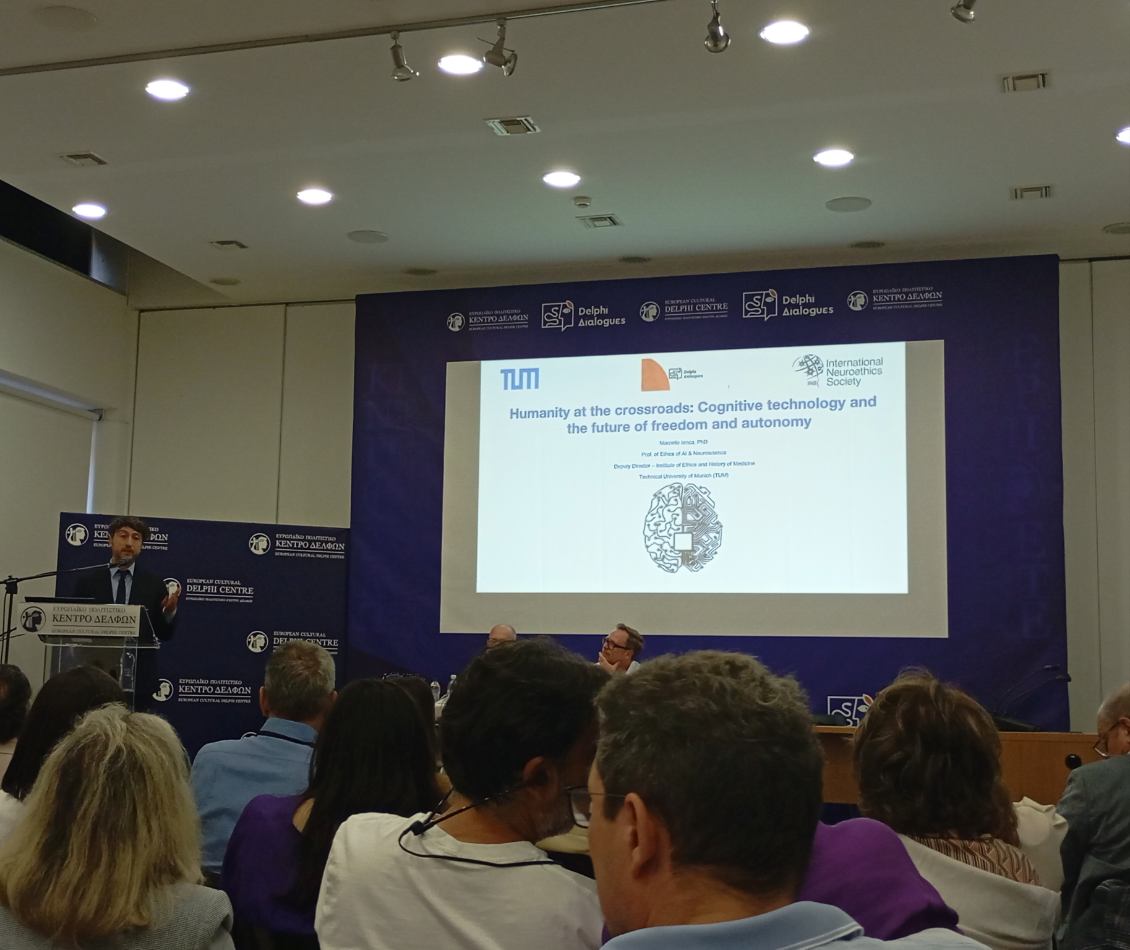
Professor Marcello Ienca, from the Technical University of Munich, spoke about the four fundamental neuro-rights we must defend in the age of neurotechnology: cognitive freedom, mental privacy, mental integrity, and psychological continuity. Professor Markus Gabriel, University of Bonn, analyzed how artificial neural networks have radically changed the course of artificial intelligence, noting that this can be a very powerful tool for knowledge, without, however, being infallible or replacing human judgment.
On the social front, Professor Ofrit Liviatan of Harvard University examined the need for legal regulation of AI and the protection of fundamental rights, while Professor Helen Margetts of University of Oxford, speaking on governance in the age of artificial intelligence, analyzed the Digital Era Governance (DEG) model, which seeks to harness the potential of AI for more effective governance, improve public services, protect the information environment, and strengthen democratic accountability.
In addition to the speakers, representatives from other research institutions also participated in the roundtable discussion. Andreas Gofas, Director of European Cultural Delphi Centre, Professor at Panteion University; the academic, space scientist, and pioneering researcher in the most significant space programs of the U.S. and NASA; Stamatis Krimizis, the former Ambassador and unpaid advisor to the Chairman of the Board of Directors of European Cultural Delphi Centre on international relations, Anastasios Kriekoukis, Professor of Philosophy at the National and Kapodistrian University of Athens, Chrysostomos Mantzavinos, and Lambis Papageorgiou, Professor Emeritus of Psychiatry at the National and Kapodistrian University of Athens.
At the Fourth Delphi Dialogues, opening remarks were delivered by the Deputy Minister of Justice, the Regional Governor of Central Greece, Mr. Fanis Spanos, and the Secretary General for Contemporary Culture, Eleni Doundoulaki. Greetings were also delivered by the representative of the Ministry of Digital Governance, Athanasios Paliatsos, Head of the Directorate of the General Secretariat for Telecommunications and Post at the Ministry, and the Mayor of Delphi, Panagiotis Tagkalis, whose remarks were read by the Deputy Mayor of Delphi, Asterinos Dimitriou.
Since its founding in 1977, the European Cultural Delphi Centre has consistently upheld the vision of bringing together different cultures and ideas. The excellent organization and hospitality extended to representatives from the journalistic, intellectual, business, and artistic spheres has, for the fourth consecutive year, underscored the Centre’s vitality as a meeting place where Greek cultural heritage intersects with the modern era and its universal perspective.
Days of Art in Greece was represented by Ms. Maria Papadogianni (Founder and Director – Days of Art in Greece) and Ms. Margarita Kataga (Journalist)
The Fourth Delphi Dialogues are held under the auspices of the S.A. of the President of the Republic, Konstantinos An. Tasoulas. To date, more than one million people have watched the Delphi Dialogues online.
The Fourth Delphi Dialogues, as a prelude to a new cultural institution of international scope organized by the European Cultural Delphi Centre: The Modern Oracle of Delphi: The Future of Humanity, were made possible thanks to the generous sponsorship of Eurobank and the Ioannis S. Latsis, as well as the support of the Ioannis F. Kostopoulos Foundation, as noted by the President of the European Cultural Center of Delphi in his opening remarks at the event. “Special thanks are due to Fokion Karavias, CEO of Eurobank; Michalis Vlastarakis, General Manager of Marketing at Eurobank, Petros Kalantzis, President of the Ioannis S. Latsis Charitable Foundation, Eva Lianou, General Director of the Ioannis S. Latsis Charitable Foundation, and Vasileios Karaindros, Director of the Ioannis F. Kostopoulos Foundation. “We are also grateful to Eurolife and Alexander Sarigeorgiou, Chairman and CEO of Eurolife FFH, Chairman of the Hellenic Association of Insurance Companies, and Vice Chairman of Insurance Europe, as well as to Angelos Androulidakis, a member of the Board of Directors of Eurolife FFH,” he added. The event was also supported by @blod.gr, the Bodossaki Foundation’s online lecture library.



Leave A Comment