
By Panos Liakos
Film Historian
Stepping out of the Tottenham Court Road station in London, you can already feel the unusual heat of this June trying to penetrate every pore of your face. Very soon, the frustration over the effects of climate change gives way to a sense of curiosity, as the traveler’s eyes are filled with images of modern complexes, large theaters, and restaurants awaiting them at the end of the journey.
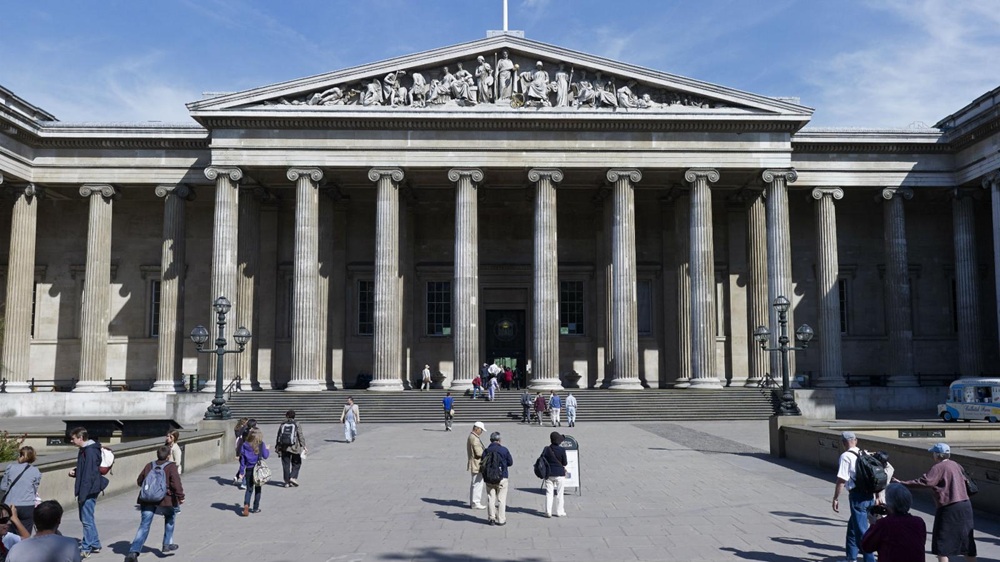
A journey that will be capped off by a visit to the British Museum—one of the jewels not only of the great capital but of the entire United Kingdom. Founded in 1753, this museum preserves artifacts from all the major civilizations of history, while also reflecting the evolution of British colonialism. The museum’s current building stands on the very site where it first opened on January 15, 1759.
Indeed, the Montagu House, with a style reminiscent of classical architecture, leaves a lasting impression on visitors encountering it for the first time as they attempt to unravel the mysteries of its vast corridors. After being captivated by the crowd gathered around the Rosetta Stone and tracing the history of Egypt, their steps will inevitably lead them to the room that now houses the Parthenon Marbles.
This is, of course, the collection of sculptures more widely known as the “Elgin Marbles,” since they were removed from the Parthenon by Thomas Bruce, 7th Earl of Elgin, between 1799 and 1803—during the years when the Ottoman Empire still ruled over the Greek territory. This collection of unparalleled beauty and expression has been on display since 1939 in the museum’s specially designed Duveen Gallery, which was created for this purpose.
The Parthenon (completed in 432 B.C.), as is well known, was a temple dedicated to the goddess Athena, the city’s patron goddess. The pediments and metopes depict scenes from mythology, while the frieze depicts the inhabitants of ancient Athens in a religious procession.
It would not be an exaggeration to compare this vivid depiction of the scenes on the metopes to the contemporary dynamics of cinematic storytelling, where one “frame” leads to the next and all together form a cohesive storyline. After all, at the time when Phidias “conceived” these representations, the Golden Age of Athens was at its zenith through the functioning of democracy, rhetoric, and, of course, theater.
If we focus on the sculptures from the south metopes of the Parthenon housed in the British Museum (today, fifteen southern metopes are in the British Museum, one in the Louvre, and one on the Acropolis), we can see a depiction of the Centauromachy. Drawing on our knowledge of ancient Greek mythology, these metopes undoubtedly depict the battle between the Centaurs and the Lapiths during the wedding feast of Perithous and Hippodamia. The myth recounts that the Centaurs, under the influence of intoxication, attempted to abduct the women, while the Lapiths emerged victorious in the fierce conflict that ensued.
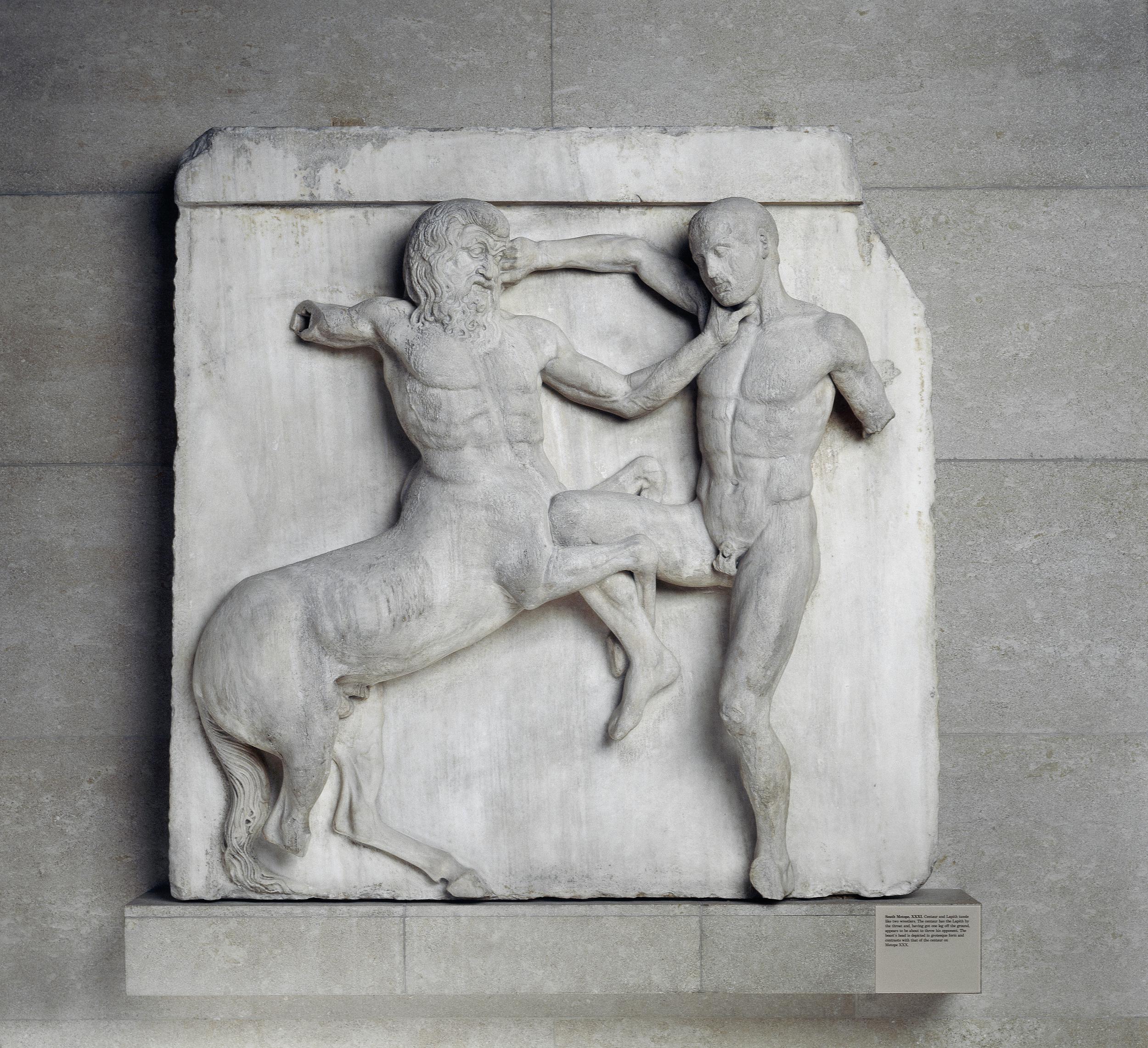
In the scene emphasized by the British Museum’s curatorial choices, we see a Centaur on the left and a Lapith wrestling like gladiators. The Lapith has grabbed the Centaur by the hair with his right hand, pressing his right knee into the Centaur’s chest, while his left hand is stretched backward. The Centaur, standing on his hind legs, grabs Lapith by the throat, wrapping his front legs around Lapith’s right leg.
The precision with which the features of these mythological figures are rendered is so remarkable that visitors can stand in front of them for several minutes, discerning even the slightest details—from the “ripple” of a lock of hair, the tension of the muscles during a struggle, to even the way the features of a set of teeth have been carved.
One thing is certain: the exploration of classical beauty is endless, and no matter how much we wander through London, our steps will always lead us back, time and again, to the treasure-filled galleries of the British Museum.
*With Information from: https://www.britishmuseum.org/collection/galleries/greece-parthenon




Leave A Comment