Biennale 9 engages with a common, recurring, yet at the same time timely, urgent, and multifaceted demand: “Everything must change.” With its dynamic phrasing, it may sound like a revolutionary cry and echo as an empty slogan, resonate as digital bait for rage, and function as an apotropaic spell; everyone can find something in it, and it belongs to no one exclusively. It is a phrase that, today more than ever, is brandished equally by social revolutionaries and tech feudal lords, by persecuted activists and fascist demagogues, by opposing social classes and diametrically opposed collective forms of expression, by countercultures and institutional propaganda. It is used to erase the divide between home and the street, between clicking and marching, to usurp ambivalence and distort solidarity.
Biennale 9 addresses the asymmetry between our available vocabulary and what we are asked to describe and experience, as well as the ambiguous position of art, both central and marginal at the same time, in a world of violent shifts and widening inequalities. It engages with forms of playful resistance, with fleeting tactics of deconstruction and solidarity, with the feedback loop of call and response, or what Arthur Jafa has described as the “quantum dimension of emancipation.”
It takes shape as a para-biennial that acknowledges and incorporates into its very structure the paradoxes of confinement and escape, chooses the winding paths, the whirlpools of time, and advocates the tactics of joyful militancy and the innermost labor required by the care of the neglected and oppressed, the strange and otherworldly.
If it is true that today “in the face of the new tyrannies that are spreading, we must use art not to ‘ask questions’ but to give bold answers that no one has asked of us” (according to Luce deLire), Biennale 9 takes the stage to experiment with an anarchy of responses, to reject what is proper and what is suggested in the face of outright censorship, but also beyond its obvious dictates.
Through its projects, its philosophy, and its choice of venues, it proposes a form of radical intelligence (hence the abbreviation “RI”) and advocates for non-fascist Artificial Intelligence that does not reproduce forms of domination but supports autonomy and freedom based on collective activity and suppressed knowledge.
If new forms of solidarity and vocabularies, a “social alternative,” need to be invented in order to change the life that genocidal capitalism has built, then Biennale 9 wishes to explore the distance between the utterly improbable and the possible defined by this need, as well as the unfolding, transformative dynamics of the collective, of the solidarity-based refusal, of the aesthetic sociality that emerges as at least one response.
She thus chooses to draw inspiration from Saidiya Hartman’s research on the small scale of Black life, where waywardness is the “insatiable longing for a world not ruled by a master, man, or the police […] social poetry that sustains the dispossessed […] a brief entry into the possible.”
The abbreviation “S9” in the Biennale’s Greek title refers to an old folk and colloquial of Eastern origin, for Thessaloniki (Saloniki), thus introducing a dual movement into the Biennale’s narrative—toward and away from the city. An attempt to cultivate a—if only temporary—sense of connection with neglected places, subjects, ghosts, and symbols of its life, but also to explore there what links Assata Shakur’s letter to the Pope with the poems of Rimbaud, Christopoulos’s Vardari with Emma Goldman, the critique of fascist hate politics written in the language of love, as per Sara Ahmed, with Beckett’s dark humor and the radicalism of Pasolini, a creator who has been honored many times in the north of the Greek south.
Through its joint articulations, its visual frequencies and vibrations, its formidable mixes and the abundance of frictions and malfunctions, through its peripheral and precarious position within the art economy, Biennale 9 transforms a narrative into intimacy, adopting the stance of the rebellious urgency. It employs the method of critical fiction and is shaped improvisationally by what it proposes and explores.
Professor T. J. Demos, essayist for the Biennale 9 catalog and a collaborator with its curator, notes: “Amid the ruins, the speculative mythologies of an emancipatory future take shape. […] These are points of contradiction where aesthetics becomes situational, tactical—a field for struggle. At the point where art and politics converge, the question is not whether resistance is possible, but how it will be organized now, at what cost, and for whom. […] Small steps matter, even when everything must change.”
If, as Gayatri Chakravorty Spivak says, “revolution is like housework—you have to do it every day,” then the 9th Biennale of Contemporary Art, Everything Must Change. RI9 wishes to be part of this everyday reality and, by exploring it, to incorporate a proposal for life.
The Participants:
Basma al-Sharif, Minos Argyrakis (†1998), Nanos Valaoritis(†2019), Marina Velisioti, Meriem Bennani, Danielle Brathwaite-Shirley, The Callas (Lakis& Aris Ionas), Disobedience Archive, Errands Group, Forensic Architecture, Pierre Huyghe, Arthur Jafa, Dionysis Kavvalieratos, Maria Karavela (†2012), Christos Karakolis, Katerina Komianou, Dimitris Korres, Panos Koutroumpousis (†2019), Maria Kriara, Stefanos Levidis, Ligia Lewis, Le Nemesiache, Sofia Ntona, Eva Papamargariti, Nikos Gavriil Pentzikis (†1993), Agnieszka Polska, Oliver Ressler, Ben Rivers, Jakob Steensen, Kostas Sfikas (†2009), Antigoni Tsagkaropoulou , Eleni Tomadaki, Stelios Faitakis (†2023), Alexis Fidetzis, Matsi Chatzilazarou (†1987) with Andreas Empeirikos (†1975), Leonidas Christakis (†2009), VASKOS (Vasilis Noulas, Κostas Tzimoulis), Lewis Walker, Phillip Warnell & Juri Akiyama, Marie Wilson (†2017), Anna Zemánková (†1986), and an anonymous artist [work: Anonymous, Zakynthos (?), 18th century, Tripartite Christ, Loverdos Collection (L 434/CL 429), Byzantine and Christian Museum, Athens].
The main exhibition also includes the following installations:
Pan Daimonium. Surrealism as a State of Mind, featuring archives and works by: Samuel Beckett, Victor Brauner, André Breton, Marcel Duchamp, Nikos Engonopoulos, Max Ernst, Nikolaos Kalas, Wifredo Lam, André Masson, Mario Prassinos, Jean Tinguely, and others. The same section features the largely unknown art film Daphni (1951, dir. Angelos Prokopiou & George Hoyningen-Huene) and the Surrealist happening by the Municipality of Theos (1983) on the movement in Greece.
Museum of Friendship, featuring works from the collection of Jean-Marie Drot (1929–2015), located on the island of Ios.
“The Earth in Turmoil” and the Agitprop Machines, featuring works by the Russian Avant-Garde from the G. Costakis Collection at MOMUS—Museum of Modern Art, Thessaloniki. The same section also features the pioneering animation Interplanetary Revolution (1924)—the first film produced by the animation studio of the State Committee for Cinematography (GosTechKino).
Flipper Zone. Playing Against the Spectacle, featuring original publications and reprints from the Situationist International and by Guy Debord, Jacqueline de Jong, Asger Jorn, Ivan Chtcheglov, and artworks in various media created by: Nikos Arvanitis, Marina Gioti (lecture-performance), Echelle Inconnue, Experimental Jetset, Forensic Architecture, Maria Papanikolaou, Eva Stefani, and Hito Steyerl. This section is co-curated by Nadia Argyropoulou and Vanessa Theodoropoulou.
Escapes, a series of curated reading spaces within the exhibition where visitors can read (or listen to) texts, comics, poems, books, archives, and lyrics. Among these, one space is dedicated to the poet and writer Katerina Gogou (1940–1993) and another to the artist Maria-Electra Zoglopitou (1970–1997). Also featured are the Fugues curated by the Provisional Academy of Arts, titled “ResigNation / A script on the dead,” and Basma al-Sharif.
The time-bound projects include:
Rap Riot – a musical project/event commissioned by Biennale 9 and presented by Ladelle, Dolly Vara, Sara ATH, and Penny & Iria (visuals) for the public opening on May 23 at 10 p.m.
Playing Otherwise – a project inspired by Biennale 9 and implemented in collaboration with the Heinrich Böll Foundation – Thessaloniki Office and the Another Football platform, with the aim of reclaiming the common good of sports communities and celebrating the revolutionary potential of play. A three-sided footbal –the first of its kind in Greece—will take place among the self-organized teams FC Abalos, Becazzes FC, Faltsa FC, and Muhabeti FC on May 24, from 3:30 to 5:30 p.m., at the Kardia Stadium, hosted by the Municipality of Thermi – National Youth Capital 2026.
Wayward Waters – a series of events (performances, lectures, public interventions) that will unfold throughout the Biennale, beginning on May 22 with the activation of public water fountains in the wider TIF-HELEXPO area through two performances: the DJ-lecture “Overflowing with Joy” by Chara Stergiou and the lecture-performance “Take Water Personally” by Christos Vrettos and VASKOS. The series is organized in collaboration with Greenpeace Greece and its broader program “Rendezvous at the Fountains,” TIF-HELEXPO, and various other cultural platforms and civil society organizations in the city. The program also includes a visit to the Biennale 9 site at The Kalochori Lagoon and the Axios Delta National Park, a visit to the mussel farms in Chalastra, stops, walks, discussions, presentations, and remarks by representatives of partner organizations, such as iSea, the Hellenic Center for Biotopes and Wetlands (EKBY), Thermaic Gulf Protected Areas Management Authority.
Moving in Riot — a film screening program that launched in the run-up to the Biennale in October 2025, in collaboration with the Thessaloniki International Film Festival and the Greek Film Archive, and featured works by: Cecilia Bengolea, Nikos Theodosiou, Dimos Theos, Giorgos and Heracles Mavroidis, Valentin Noujeim, and others. The program will run throughout the duration of Biennale 9 at the “Xanthippe Hoepel” Amphitheater of MOMUS—Museum of Contemporary Art and will be announced in stages. Specifically for the three-day opening weekend, it includes the following works: Acts and Intermissions by Abigail Child (USA, 2017), BLKNWS: Terms and Conditions by Kahlil Joseph (USA, 2025), The Encampments by Michael T Workman and Kei Pritsker (USA/Palestine, 2025), Herbicidal Warfare in Gaza (2019) and No Traces of Life (2026) by Forensic Architecture, U.F.O. Lost in HEAVEN by Errands Group (Greece, 2025), We Are Making A Film About Mark Fisher by Simon Poulter and Sophie Mellor (UK, 2025), Murdering the Devil by Ester Krumbachová (Czechoslovakia, 1970), and TIF: The City’s Pavilion (Greece, 2026) by Alexandros Litsardakis, commissioned by Biennale 9.
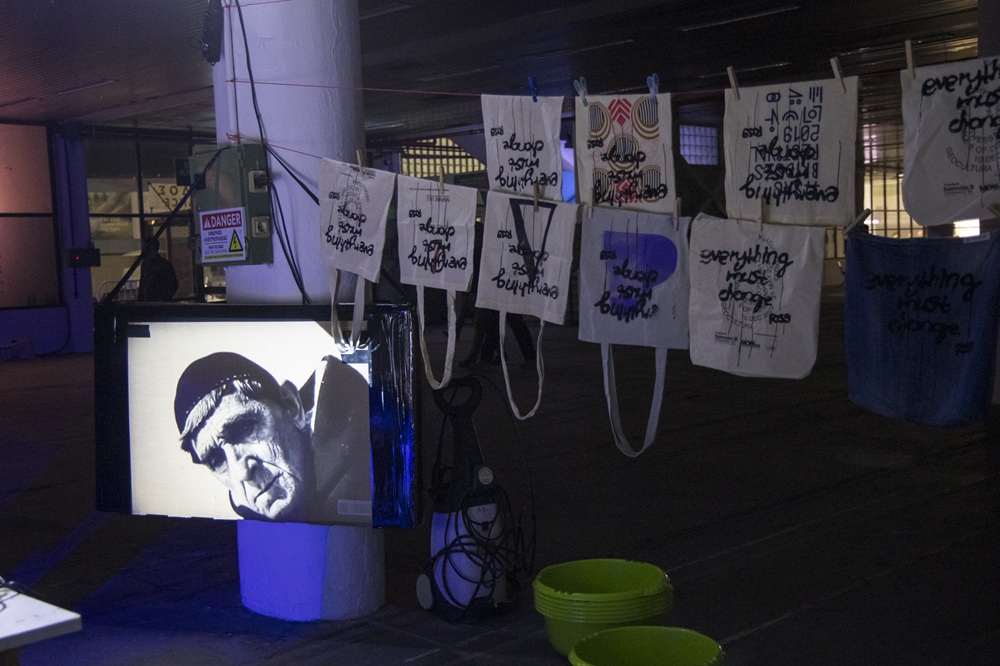
In Motion is a performance program that was launched with a presentation by the Aerites dance group titled TIF ARTHO’ last October. It included an action by Mephisto Me Studio to live-paint canvas bags from other events with the Biennale 9 logo, as well as actions by the environmental organization Mamagia.
Dimitris Ameladiotis is participating in the Biennale with the performance *The (Un)plant*, which will premiere at the Axios Delta National Park on May 23 and will be restaged during the Biennale.
The visual arts duo VASKOS (Vasilis Noulis & Kostas Tzimoulis) will present the performance From Vardari to Omonia, featuring students from Thessaloniki (May 22 & 23, TIF-HELEXPO, Pavilion 2, ground floor). The performance is presented with the support of the NEON Culture and Development Organization.
During the opening, the public will have the opportunity to watch a performance featuring a robot and a human in live interaction, within Antigone Tsagaropoulou’s installation, In the wild. Performer: Mochi Georgiou.
The program of performances and project activations will continue and be expanded throughout the duration of the Biennale.
where
The spaces activated at Biennale 9 draw us into a critical fissure:
- Buildings within the Thessaloniki International Fair (HELEXPO) complex that highlight the site’s connections to the fundamental socioeconomic narratives and political rituals of modern Greece from the 1960s onward, as well as its current significance as a battleground between competing visions for the function and future of public space. It is also home to part of the Biennale and the MOMUS Museum of Contemporary Art, which houses the collection of Alexandros Iolas.
- The unique Kalochori Lagoon on the western outskirts of Thessaloniki, a landscape shaped by immigrant communities, industrial development, and the gradual emergence of a wetland as a result of land subsidence, groundwater depletion, and the mixing of river and sea water. Now part of the Axios Delta National Park, the lagoon is rich in rare biodiversity, hosts activity beyond human presence, and features in contradictory narratives of “symbiotic relationships” as the city expands relentlessly in that direction.
Curator: Nadia Argyropoulou
Visual identity: studio precarity
Architectural Design: Y2K
Assistant to the curator: Evelyn Zempou
Lighting Design: Edeko Lighting Studio
Visual artist advisor: Μakis Faros
Text editor: Fotini Pippi
MOMUS Production Team: Angeliki Charistou, Eftychia Petridou, Silia Fasianou

Leave A Comment