By Dr. Konstantinos V. Zormpas
The Orthodox Academy of Crete is celebrating (today) a truly impressive milestone: 3,000 conferences! Three thousand scholarly, theological, ecclesiastical, educational, and cultural gatherings. Thousands of scholars, theologians, clergy, people of letters and the arts, students, and young people from Greece and around the world have passed through Kolymbari over the years. The Academy’s first conference, held in collaboration with the World Council of Churches, was titled “Christian Worship and Modern Man” (August 13–26, 1968), while the 3,000th Conference is the 15th Conference on Physics (ICNFP 2026), a major international scientific conference to be held at the Orthodox Academy of Crete from August 19 to 30, 2026, with the participation of scientists from around the world.
But behind those 3,000 conferences lie 3,000 opportunities to meet. People from different countries, speaking different languages, belonging to different churches and religions, representing different academic disciplines and cultures, sat around the same table. They spoke. They listened. They agreed. They disagreed. They may have reconsidered some of the things they had taken for granted. And that, ultimately, is what matters most. Because dialogue doesn’t begin when we agree. It begins precisely when we discover that we disagree and, despite that, choose to remain at the same table.
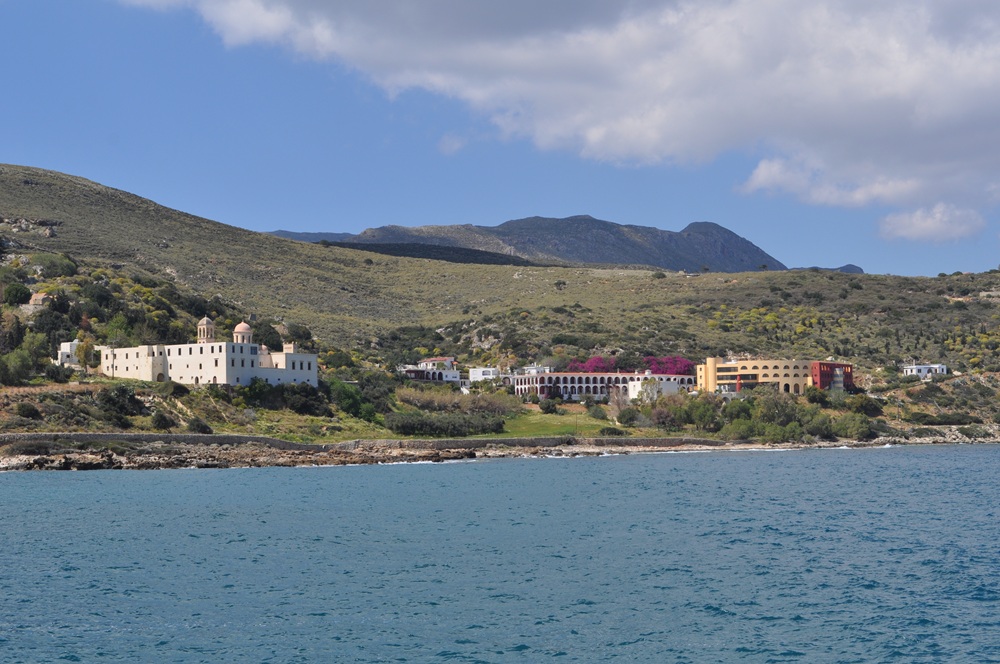
At the beginning of this journey stand two figures who left an indelible mark on the history of the Orthodox Academy of Crete: the late Metropolitan of Kissamos and Selino, Kyros Irineos (Galanakis), and Dr. Alexandros Papaderos. Their vision went beyond the creation of yet another ecclesiastical institution, next to the “great Monastery,” near Kolymbari—the Holy Patriarchal and Stavropegic Monastery of Odigitria of Gonia. They envisioned a place where the Church would engage with modern people and their questions. A space where Orthodoxy would not be afraid to dialogue with science, culture, society, other Christian traditions, and the world. And this vision was born in Crete. Perhaps not by chance. For throughout its history, Crete has learned to encounter different cultures, to accept influences without losing its identity, and to transform the vicissitudes of history into creativity time and again. This is precisely what genuine dialogue requires: identity without fear and openness without losing one’s identity.
And here lies one of the Academy’s most important legacies. The Church has no reason to fear the questions of the world. On the contrary, it must listen to them. It must engage in dialogue with them. Even when it does not have ready answers. Because faith is not threatened by questions. It is more at risk when it stops listening to the person who asks. Over the years, the halls of the Academy have brought together worlds that were once presented as adversaries.
Theology has engaged in dialogue with Physics and Biology. Medicine with Bioethics. Ecology with the theology of Creation. Philosophy with New Technologies. Faith has engaged with the great existential questions of modern humanity. Artificial Intelligence, Genetics, biotechnologies, and the immense power of information are creating possibilities that, until just a few years ago, belonged to the realm of fantasy. Theology is not called upon to fight science. Nor does science need to fear theology. Both are called upon to serve humanity.
Over the course of 3,000 conferences, there have certainly been moments that have taken on particular historical significance. Among them, the Holy and Great Council of the Orthodox Church in Crete, held in June 2016, stands out. At that time, the Orthodox Academy of Crete found itself at the center of global Orthodoxy. Primates, hierarchs, theologians, and delegations from Orthodox Churches gathered in Kolymbari for an event that had been in the works for many decades. The Council has since become known as the Council of Crete. For those of us who had the responsibility to serve at that historic moment, this experience was not merely organizational or institutional. It was a school of life. It taught us that unity is never a given. It requires effort. Patience. Humility. Perseverance. And above all, the door to dialogue must remain open even when things get difficult. The presence and trust of His All-Holiness Ecumenical Patriarch Bartholomew toward the Academy—the Foundation’s spiritual patron—and toward the Church of Crete thus constitute a special chapter in our history. And with it comes a great responsibility: to continue serving unity not as a slogan, but as a daily ecclesiastical ethos.
Having served the Orthodox Academy of Crete for many years, I have learned something that is not easily captured in annual reports and summaries. Conferences come to an end. But the connections remain. A program can be filed away in an archive. A paper can be published in a scholarly volume. But what cannot easily be measured is the human connection that was forged. The scholar who returned to Crete years later. The young researcher who made a connection here that proved decisive for his career and returned to Kolymbari. The theologian who met a physicist and was forced to rethink some of his certainties. The scientist who discovered that theology is not necessarily at odds with scientific knowledge and went on to become a clergyman. The friendships forged around a table that breathed new life into the Municipality of Platanias. Meetings, such as those between Mikis Theodorakis and François Mitterrand in Spilia and Afrata, which were linked to a particularly significant period in Greece’s European journey. The people who returned time and time again. These are the true “proceedings” of a conference. They are recorded not only in books, but in people’s lives.
There is, however, one more responsibility. The Orthodox Academy of Crete must never become an international institution that is merely geographically located in Crete. It must belong to Crete. It must listen to the local community. It must discuss its problems. It must open its doors to young people. It must engage in dialogue with schools, universities, parishes, and people involved in culture and the creative industries. Because an institution’s international presence gains true value when it gives something back to the place that gave it birth. Knowledge. Education. Culture. Reflection. Opportunities. And, above all, the opportunity to come together. And after 3,000 conferences, what next? This is the most fundamental question of this anniversary. What will we do after 3,000 conferences? An institution with a long history sometimes runs the risk of becoming overly attached to its past. But the best tribute we can pay to those who founded the Academy is not to repeat what they did. It is to preserve the courage with which they dared to do something new—especially during a difficult era when dialogue had to be cultivated amid the dictatorial monologue. The blessing of His Eminence Metropolitan Amphilochios of Kissamos and Selino, President of the Academy, and of the members of the Board of Directors is crucial to its future.
The Academy of the coming decades must listen more closely to young people. And perhaps it should activate its branch in Nopigia, the Euro-Mediterranean Youth Center. It should further open up dialogue with universities and international research centers (the Academy itself is a research center established by Greek law). To dare to engage in discussions about artificial intelligence, bioethics, the climate crisis, loneliness, inequalities, wars, migration, peace, overtourism, and the future of Crete and Europe. And to remind us of something we’re in danger of forgetting today: We can disagree without becoming enemies!
Let’s move from numbers to responsibility. The 3,000 conferences mark an important milestone. They are not, however, a destination. They are a reminder. Three thousand times, doors were opened. Three thousand times, people came together. Three thousand times, someone spoke and someone else was invited to listen. Someone opened their arms, and someone cried. And perhaps, in some of these encounters, someone left a different person than when they arrived. That cannot be measured. But perhaps this is ultimately the most important outcome of a genuine dialogue and, at the same time, the deepest vindication of the ministry of the Foundation’s people.
Behind each of the 3,000 conferences stands the Academy’s human resources—all those who have served and continue to serve the Foundation. The 3,000 conferences are, above all, 3,000 moments that demonstrate the power of collective effort. In a world that is becoming technologically more powerful but humanly more fragmented, we still need places where people can meet one another. Where we can look each other in the eye and say, “I don’t agree with you. But I want to listen to you.” Perhaps this simple phrase encapsulates more than 3,000 conferences. And perhaps this is the most important legacy for the next 3,000 conferences. Because dialogue is not the art of persuading others. It is the courage to allow our encounter with another person to change us, even if only a little.


Leave A Comment