A bilingual publication (Greek-English) dedicated to the Exodus from Missolonghi (1826), a pivotal event in the Greek Revolution. It serves as the accompanying catalog for the exhibition of the same name, which was organized by the National Historical Museum and the Region of Western Greece and took place with the exclusive sponsorship of Piraeus Bank as part of the 200th-anniversary commemorations of the Exodus.
The exhibition is on view at the Chrysogelos Mansion in Missolonghi from March 20 and, following an extension, will remain open to the public through December 31, 2026. Piraeus Bank’s participation in the celebrations marking the 200th anniversary of the Exodus of Messolonghi is part of its EQUALL Corporate Responsibility initiative, which includes, among other things, a broad range of initiatives to promote culture and preserve the country’s historical and cultural heritage.
The catalog offers a concise overview of the events of the Second Siege of Messolonghi (1825–1826), the impact it had, and the influence it exerted on the formation of the nation’s collective memory. It is a 288-page publication, the content of which is divided into five sections: The Siege, The Exodus, Memory, The Salt of the Struggle, and The Exodus: Another Perspective. The book, like the exhibition, goes beyond historical facts to highlight the conditions under which the besieged endured the blockade, as well as the culmination of their anguish leading up to the decision to evacuate, featuring testimonies and accounts from the last defenders of Messolonghi. It focuses on the personal stories of fighters, survivors, and prisoners of war, depicts daily life in besieged Messolonghi, and presents the first impressions of eyewitnesses following the destruction. Finally, it explores how the event was recorded in both local and official history, as well as its place in collective memory as the greatest collective sacrifice of the Greek Revolution of 1821.
The catalog includes all of the exhibition’s exhibits and texts, as well as selected supplementary materials, such as the woodcuts by Vasso Katraki; readers also have access, via a QR code, to the digital materials (narrative videos and animations). Its meticulous design strikingly showcases the unique pieces, works of art, personal items and weapons, costumes, and medals from the collections of the National Historical Museum, as well as the rich archival material, documents, newspapers, and photographs from the Historical Documents Archive and the Photographic Archive of the Historical and Ethnological Society of Greece, while extensive transcriptions of selected archival documents are published for the first time, accompanying photographs of the documents.
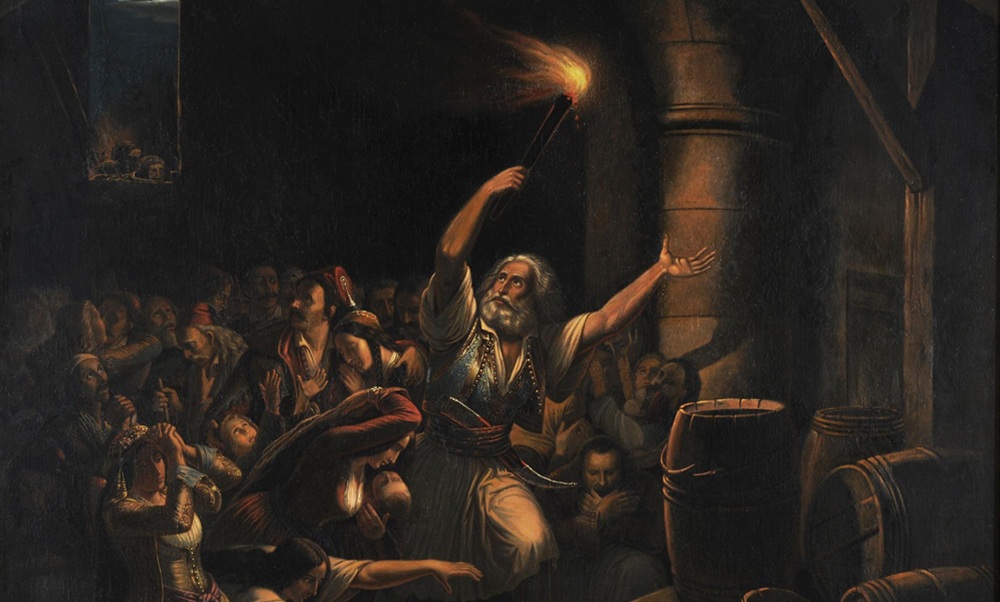
Among the exhibits, the section dedicated to the city’s printing press—where the Hellenic Chronicles were printed—stands out, the bow of the ship “Aris” belonging to Andreas Miaoulis, who led the supply operations; the “Plan of the Mesolonghi Garrison” by engineer Michael Kokkinis; portraits of freedom fighters, such as that of the leader Christos Kapsalis by Polychronis Lembesis—a work that was prominently featured during the celebrations marking the 200th anniversary of the Exodus. Also featured is the iconic painting by Theodoros Vryzakis, “The Sacrifice of Kapsalis,” from the collection of the National Gallery, as well as the oil paintings “The Remaining Members of the Mesolonghi Garrison Set Fire to the Gunpowder Magazine” by A. Jaquème and “Scene from the Siege of Mesolonghi” by Horace Vernet, from the collection of Michalis and Dimitra Varkarakis. Finally, the section “The Exodus, Otherwise” offers an original approach to the historical event through depictions of the Exodus in public history: a) figures of Exodus participants and scenic compositions from shadow theater, works by Thanasis Tzoitis; b) dioramas featuring custom-made Playmobil figures by Angelos Giakoumatos and Vasiliki Fati; and c) pages from the graphic novel “’21: The Battle of the Square” by Soloùp (Ikaros Publications).
The publication features forewords by Dr. Olympia Vikatou, Secretary General for Culture at the Ministry of Culture; Nektarios Farmakis, Regional Governor of Western Greece, Georgios Hatzinikolaou, Chairman of the Board of Directors of Piraeus Bank, Christos Megalou, CEO of Piraeus Bank, Marietta D.-A. Minotou, Chair of the Board of Directors of the Historical and Ethnological Society of Greece, and Dr. Charikleia G. Dimakopoulou, Secretary General of the Historical and Ethnological Society of Greece. The catalog is available at the EIM’s physical and online stores.(https://nhmuseum-shop.gr/
Editors: Natasa Kastriti, Reggina Katsimardou
Texts and Documentation: Ifigeneia Vogiatzi, Natasa Kastriti, Reggina Katsimardou
Translations provided by: Anna Kandia
Translations edited by: Dr Harikleia Dimakopoulou
Graphic design: Vasilis Georgiou, Nestor Pavlidès
Language: Greek–English


Leave A Comment