Highlighting touch as a sensory means of perceiving and integrating our experience of the world, AMA House presents, on Friday, November 6, the exhibition “The Eyes of the Skin,” curated by art historian and researcher Vicky Tsirou, featuring three internationally recognized female artists: Ruthi Helbitz Cohen, Maro Michalakakou, and Shekine Naidi.
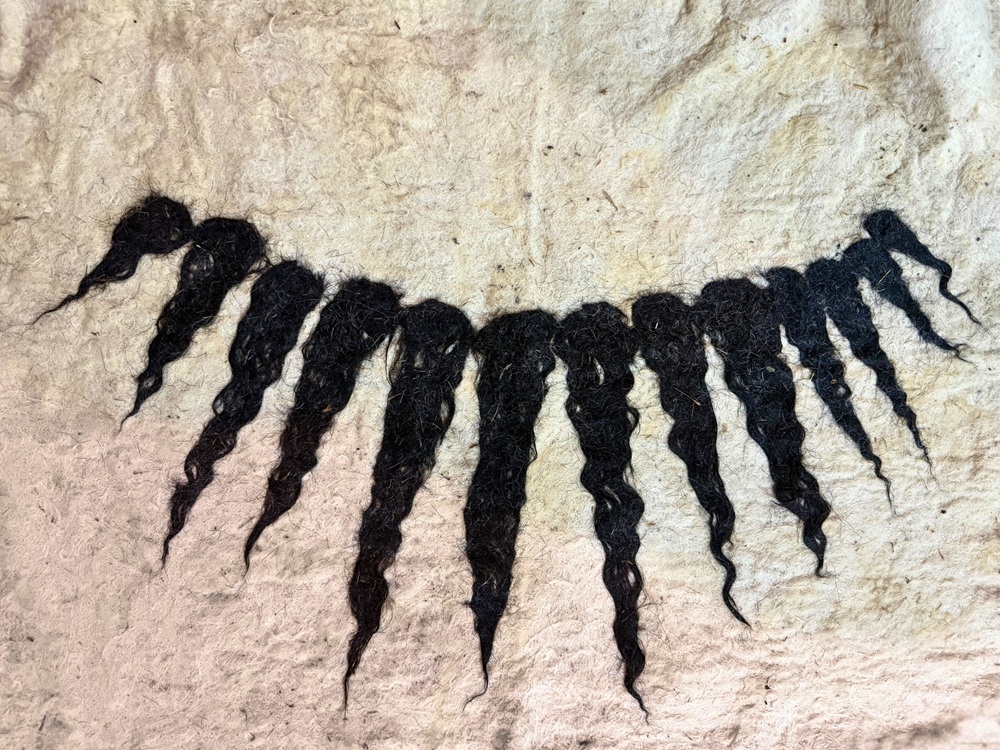
Based on the book of the same title by Finnish architect and thinker Juhani Pallasmaa, The Eyes of the Skin, the exhibition explores the possibilities of a tactile perception of the world, where, as Pallasmaa writes, “the hands want to see, the eyes to caress.” Through paintings, sculptures, videos, installations, new commissions, and productions, the participating artists approach the female body, trauma, and transformation through materiality and fairy-tale-like narratives. The works in the exhibition form a polyphony of materials—paper, coffee, ink, red and blue velvet, sheep’s wool worked using the ketsé technique, and polished marble—materials that, taken together, define what media theorist Laura Marks, described as “haptic visuality”: that is, an enhanced function of vision that is less concerned with distinguishing form and more with detecting texture.
The body remains constantly present, even when it is absent. It emerges in the female figures of Ruthi Helbitz Cohen, transforms into amorphous, zoomorphic creatures in Maro Michalakakou’s watercolors, and recedes from the field of vision, making room for community and the collective body through the tactility of Shekine Naidi’s sculptures.
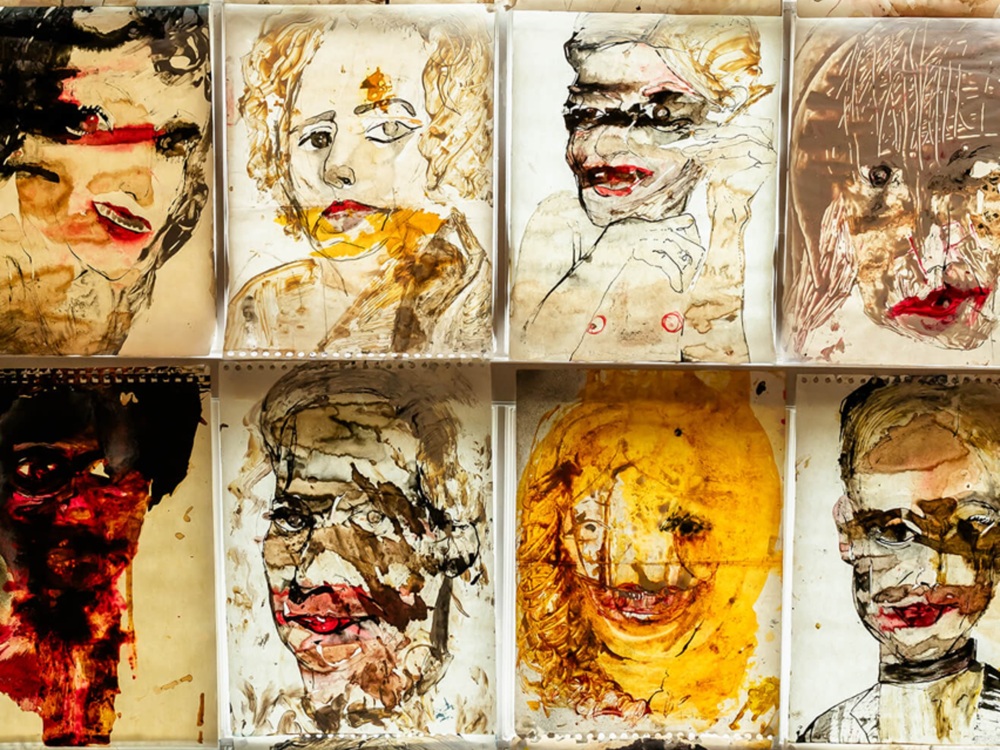
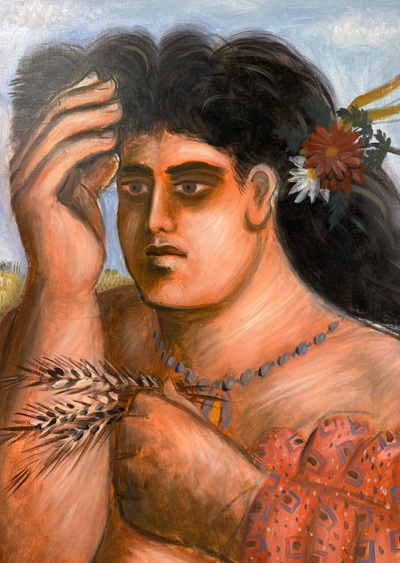
The female figures in Helbitz Cohen’s paintings and collages appear at times with the characteristics of a dynamic femme fatale and at other times with the innocence of a femme enfant, seeking answers and, perhaps, refuge. Through the faces of influential women, mythical deities, and familiar figures from the artist’s daily life, Athena Pallas, Lilith, “Black Leda,” Chana Senesh, as well as the biblical Ruth and Naomi, emerge on the page. These figures inhabit worlds where beauty coexists with distress, and they never cease to challenge established notions of vulnerability and power.
Maro Michalakakou’s otherworldly, hybrid figures hover between dream, imagination, and reality. In her watercolors, colorful snails, butterflies, birds, and other arthropod creatures—with vivid hues and prominent skeletal structures—share limbs, habits, appearances, and senses, composing new, armored forms of existence. With their segmented bodies, these forms evoke an idealized future scenario in which different species coexist harmoniously not only with one another but also within one another. At the same time, in her velvet works, the artist shaves the surface of the material with surgical precision, revealing forms such as a snake’s shed skin, a tulip, and other symbols that explore the relationship between life and death, as well as the possibility of aesthetic, ethical, and existential freedom.
Shekine Naidi’s sculptures and installations represent milestones in an ongoing exploration of the artist’s identity, situated between East and West. Drawing on Persian folktales, contemporary events, and traditional techniques, Naidi offers an allegorical commentary on the tensions of the present. As a counterpoint to these, she uses natural sheep’s wool, a material associated with care, community, protection, and the warmth of the body. Her installation, “Red Lake,” refers to the toxic aquatic environment of the lake of the same name that has formed in the underground caverns of the abandoned mine in the Mitsero area of Cyprus. Here, the landscape itself is transformed into a wound and a body. The marble flowers she carves and places on its surface take the form of precious talismans and offerings to the body of Mother Earth.
As Pallasmaa aptly notes in his book, “an encounter with a work of art involves a physical interaction.” Encounters with the works in the exhibition establish a direct “one-to-one” relationship that transcends the visual recognition of form, shape, and color and gives rise to the impulse to accompany the visual experience with the desire to touch. It is as if the gaze seeks confirmation of what it perceives through contact with the surface.
From this perspective, the exhibition proposes various interpretive avenues regarding the ways in which the world of experience is organized and structured around the body as its center, through historical events (History) and narratives viewed through the lens of a feminist reinterpretation of history (herstory). Ultimately, if the body can be considered the smallest architectural structure we inhabit, then the works in the exhibition—structured across distinct levels, rooms, terraces, and floors, function as the modular axes of the historic building from the interwar period that houses the AMA House in Kypriadis Garden City.
The exhibition, The Eyes of the Skin, marks AMA House’s first winter exhibition since its founding in 2021, further enriching its artistic and exhibition program with activities and events throughout the year. The exhibition’s public program will include guided tours, workshops, and performance events, which will be announced shortly.


Leave A Comment