Working across sculpture, installation, and sound, the Greek artist explores how material experimentation gives rise to shifting relationships between form, space, and perception.
For Greek artist Kyriakos Alexandros, sculpture is not necessarily defined by the creation of a singular, self-contained object. It can emerge through the accumulation of materials, the relationships between individual elements, or the subtle transformation of an existing space. Working across sculpture, installation, drawing, and sound, Alexandros constructs environments in which material properties and spatial relationships become inseparable, inviting viewers to reconsider their experience of physical presence, structure, and movement.
At the center of his practice lies a sustained investigation into the behavior and possibilities of materials. Rather than beginning with predetermined forms or attempting to impose specific meanings upon them, Alexandros approaches making as an open-ended process of experimentation. Gravity, weight, balance, repetition, and erosion become active forces in the development of his work, allowing forms and relationships to emerge through direct engagement with matter. His installations often occupy an uncertain position between stability and collapse, shelter and exposure, calm and tension.
From Piraeus to Chicago
Born in Piraeus, Greece, Kyriakos Alexandros graduated with honors from the Athens School of Fine Arts in 2019, where he studied painting, drawing, sculpture, ceramics, and photography. His multidisciplinary education was complemented by professional experience in archaeological conservation, fabrication, and performance production, including work at the Kerameikos archaeological site and involvement in the preparation of Dimitris Papaioannou’s Transverse Orientation.
His work has been presented in exhibitions in Greece and internationally, including at the Byzantine and Christian Museum and the Numismatic Museum in Athens, as well as the Aesthetica Art Prize exhibition in York, United Kingdom. In 2023, Alexandros moved to Chicago as a recipient of the Fulbright Foreign Student Program fellowship, completing his Master of Fine Arts in Sculpture at the School of the Art Institute of Chicago in 2025. His artistic activity in the United States has included exhibitions at Marina City Towers and the Alliance Française de Chicago, contributing to the continued development of his practice across different artistic and cultural contexts.
Forced Acts of Affection: Between Shelter and Coercion
In Forced Acts of Affection (2025), Kyriakos Alexandros constructs a tent-like structure of reinforced plaster, held together by its own weight. Ropes extend across the surrounding space, tracing lines of tension, while sand spreads across the gallery floor, forming a provisional landscape. Through openings, obstructions, and shifting perspectives, the installation compels viewers to question their movement through the gallery and their relationship to a space that appears accessible yet resists entry.
The title brings together care and coercion, suggesting how gestures intended to protect can also become instruments of control. This tension emerges through the work’s material and spatial relationships rather than through a predetermined narrative. What resembles a place of refuge is also a structure whose very construction contradicts its purpose.
Against a contemporary backdrop of war, displacement, and violence justified in the name of protection and stability, the installation absorbs that contradiction into its own construction. Its apparent promise of safety becomes a deliberate illusion, confronting the viewer with the absurdity of current times. In this reversal, the work turns the logic of coercion against itself, exposing the uneasy distance between intention and consequence.
Pendulum: The Odyssey Reimagined
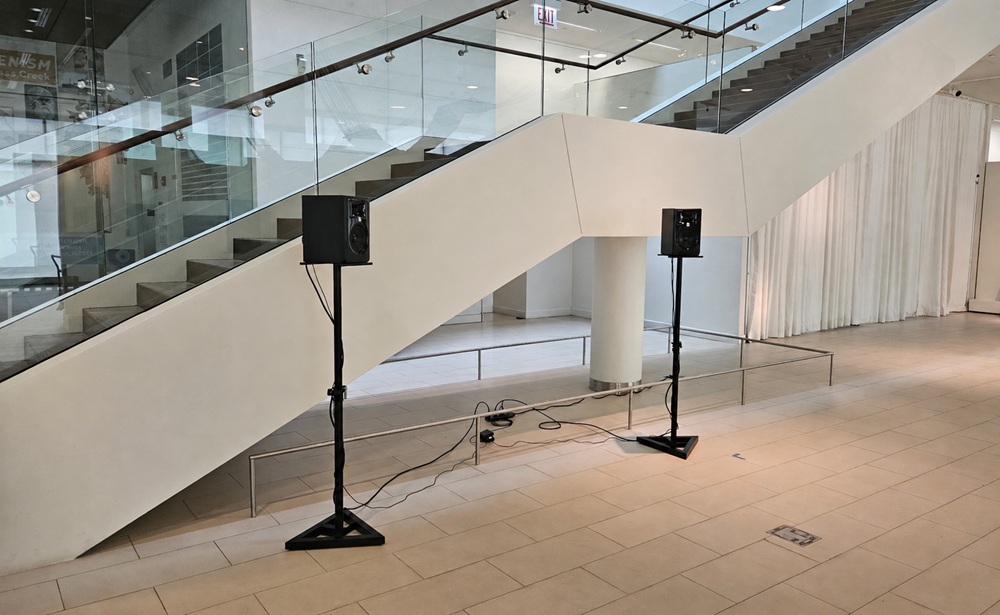
Kyriakos Alexandros is among the sixteen contemporary artists participating in The Odyssey Reimagined at the National Hellenic Museum in Chicago. Open to the public since October 1, 2026, and scheduled to run through January 2028, the exhibition is curated by Cortney Lederer and Sydney Gush of CNL Projects. It revisits Homer’s Odyssey through contemporary perspectives through painting, sculpture, installation and sound. Alexandros presents Pendulum (2026), a sound work exploring the relationship between time, uncertainty, and return.
Created entirely from contact microphone recordings of sand, Pendulum transforms the friction, pressure, and movement of grains into an evolving acoustic environment. Through spatial processing, these sounds acquire unexpected qualities, at times resembling wind, water, breath, or mechanical movement. As they oscillate between two speakers, the composition establishes a rhythmic sense of movement that gives the work its title.
Rather than illustrating a particular episode of the ancient epic, Pendulum approaches its themes through sound and spatial experience. Sand, a familiar material associated with shifting landscapes and the passage of time, becomes the source of an intangible yet spatially perceptible work. Its recurring movement between speakers suggests a journey without a fixed destination, offering an open-ended reflection on nostos and belonging.

Leave A Comment