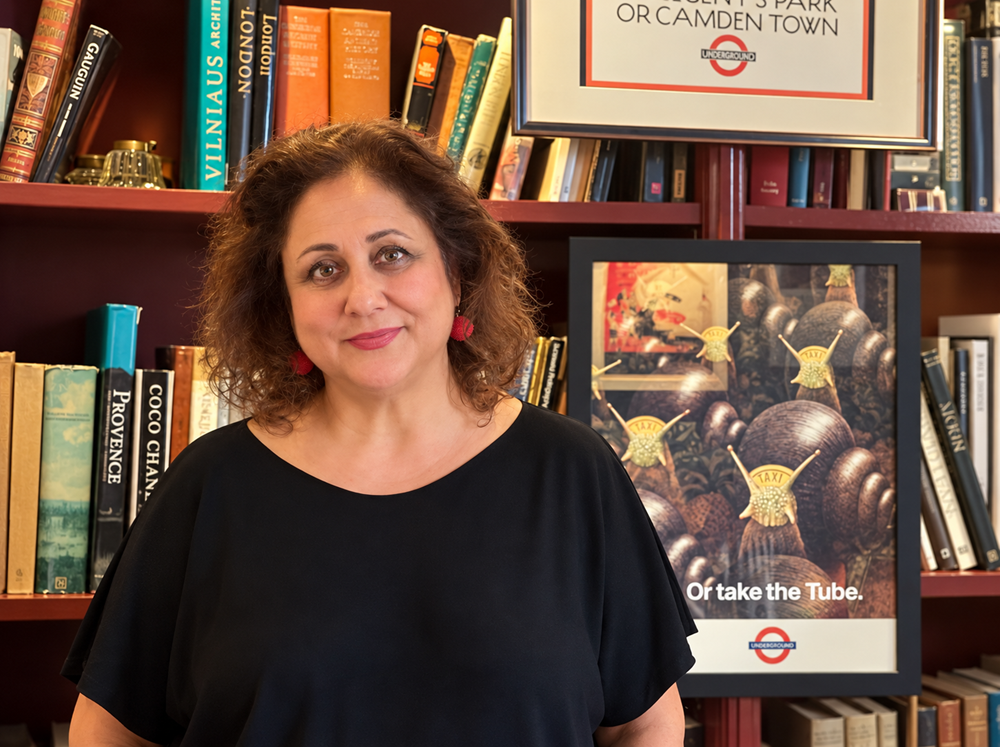
On the occasion of her interview with Days of Art in Greece, Katerina Kostiou, Professor of Byzantine and Modern Greek Philology at the University of Patras and founder of the Laboratory of Archival Documents and Press (EATT), highlights the literary archive as a dynamic field of knowledge production rather than a mere repository of the past.
With research spanning Cavafy studies, literary theory, and Modern Greek literature from the 19th to the 21st century, Ms. Kostiou combines archival research with teaching, the training of young researchers, and the public dissemination of literature, highlighting the role of the university archive in preserving and revitalizing the study of literary heritage.
Days of Art in Greece: Dear Ms. Kostiou, the Laboratory of Archival Documents and Press was founded in 2016 on your initiative. What was your initial vision for the role of a literary archive within a department of literature, and how has its institutional and research focus evolved over the past decade?
Katerina Kostiou: The founding of the Laboratory of Archival Documents and Press in 2016 was the result of a conviction that had gradually taken shape through my personal research experience: that the literary archive is not merely a place where the past is preserved, but a privileged site for the production of new knowledge. Literary research, as I understand it, cannot be limited to the interpretation of published works. It must also take an interest in the processes that precede publication, in the paths of writing, in the authors’ networks of communication, and in the historical and cultural environment within which literature takes shape.
In this sense, the archive allows us to move from the finished work to the workshop where it was created. A manuscript, a letter, a draft, or even a seemingly insignificant note can fundamentally alter the way we understand a text or an entire literary career. And that was precisely my original vision: to create a space within the University of Patras where archival materials would not be treated as museum artifacts, but as active resources for research and education.
I believe that the EATT’s decade-long journey has confirmed the importance of this choice. Its development was not merely quantitative. What I consider most important is that, gradually, a perception emerged of the archive as a meeting ground for different scholarly perspectives, as well as a space for communication between the University and society.
“Cultural democracy is not limited to the ability to view an artifact. It truly begins when one gains the ability to approach it critically, to ask new questions, and to participate in the dialogue about the past.”
I would say that this development marks a shift from the collection and preservation of archival materials toward their systematic scholarly and public use. Archival research is now linked to teaching, the training of young researchers, publications, academic conferences, and initiatives aimed at broader audiences.
Of course, developing such an initiative within a Greek public university is not a given. It requires sustained effort, collaborations, human resources, financial resources, and, above all, long-term planning. However, I believe that the experience of these past ten years has shown that a university laboratory can make a substantial contribution not only to the preservation of our literary heritage but also to the renewal of the ways in which we study and teach it.
D.A.: The first archive to be donated was that of Argyris Chionis (2017), followed by significant literary and periodical archives. How do you approach the process of acquiring archives from authors and heirs, what criteria do you use for acquiring new archives, and how do you handle issues such as ethical use, copyright, and the long-term preservation of the material?
K.K.: The donation of a personal archive is, above all else, an act of trust. The creator or his or her heirs entrust to an institution not merely a collection of documents, but a part of a person’s personal and intellectual history. Often, this material was not originally intended for publication: private correspondence, diaries, personal notes, and unpublished texts. You can therefore understand that the responsibility assumed by the host institution goes far beyond the obligation to ensure safe storage.
The relationship with creators and heirs must be based on mutual respect, transparency, and clarity regarding the terms of the transfer. It is important for them to know what will happen to the material, how it will be cataloged, who will have access to it, and under what conditions it may be used or published. Acquiring a file does not automatically mean acquiring the copyright to its content. These are separate issues that must be handled with particular care, as must the protection of personal data and the rights of third parties.
As for the selection criteria, I do not believe that the value of a work is determined solely by the author’s place in the established literary canon. Certainly, the significance of the work is a key criterion, but equally interesting may be an archive’s ability to shed light on unknown aspects of literary history, to reveal relationships between authors, to document the history of a periodical, or to reconstruct an intellectual milieu. In particular, journal archives allow us to view literature not only as the sum of individual works, but also as a field of collective processes, debates, and aesthetic ferment.
There is, however, another factor that I consider crucial: the ability to make effective use of the material. The collection of archives cannot be an end in itself. Every new acquisition creates obligations regarding classification, documentation, preservation, and, where possible, digitization. An archive that remains unclassified and inaccessible risks becoming just another storage space for memories.
Therefore, the goal is to ensure that the conditions are in place for this material to be gradually integrated into the research and educational process, while always respecting the limitations imposed by its nature. And this raises a broader issue: the need for a coherent policy on literary archives in Greece, with institutional support, specialized staff, and stable funding.
“The archive allows us to move from the finished work to the workshop where it was created.”
I would like, however, to point out one more thing. Every archive is an unknown abyss. Even when we believe we know an author well, engaging with his or her works can lead us to unexpected discoveries and overturn established interpretations. This opportunity to reevaluate our knowledge is, for me, one of the most fascinating aspects of archival research.
D.A.: The title of the anniversary event links the archive with education and “cultural democracy,” while at the same time an international conference on archival practice in the digital age is being organized. How do you define the concept of “cultural democracy” in relation to literary archives, and what do you believe is the contribution of a university research center such as EATT to broadening access, participation, and the interpretive community surrounding modern Greek literature?
K.K.: The concept of cultural democracy lies, in my opinion, at the heart of the discussion regarding the social role of archives. It is not merely about the right of access to cultural heritage, however important that may be. It is also about people’s ability to actively participate in the production, interpretation, and reshaping of cultural memory.
Archives are not neutral spaces. Their formation involves choices: what we consider worth preserving, which artifacts we classify, which voices we highlight, and which we marginalize. In other words, an archive does not merely reflect an already established image of the past; it actively participates in shaping it. This is why archival policy is inevitably linked to issues of power, representation, and access to knowledge.
From this perspective, cultural democracy requires a shift from viewing cultural heritage as the exclusive domain of experts to viewing it as a common good. This does not mean downplaying the importance of scientific expertise. On the contrary, it is scientific documentation that makes meaningful and responsible access possible. It does mean, however, that the knowledge produced within the university should not remain confined exclusively to the academic community.
This is precisely where I believe education can play a decisive role. Students’ engagement with primary sources fosters different relationships with literature. The manuscript of a poem, for example, allows us to follow the writing process, to perceive the author’s choices and revisions, and to understand that a literary work does not appear as something given and definitive, but is the result of a complex creative process. The archive, therefore, can also serve as an extremely fruitful educational tool.
The digital age certainly offers new possibilities. Digitization and the online availability of archival materials can dramatically expand an archive’s audience, transcending geographical and institutional limitations. We should not, however, equate digitization with the democratization of knowledge. Technology is a tool, not an end in itself. The crucial question is what material is digitized, how it is documented, who can search for it, and, above all, whether they have the means to understand and make use of it.
This is one of the reasons why I consider the international academic conference on archival science in the digital age to be particularly important. We live in an era in which the production and circulation of digital records are radically transforming not only the practices of preserving memory, but also the very concept of the archive. The question is no longer merely how to preserve the records of the past, but also how to manage the memory being produced today, in an environment characterized by an information overload, technological mediation, and constantly changing ways of accessing knowledge.
In the case of EATT, our goal is to link these theoretical explorations to specific practices: the scholarly processing of collections, the training of young researchers, the development of collaborations, publications, and public initiatives that can bring archival material into contact with diverse communities of readers.
To summarize, I would say that cultural democracy is not limited to the ability to view an artifact. It truly begins when one gains the ability to approach it critically, to ask new questions, and to participate in the dialogue surrounding the past. If the archive succeeds in setting this process in motion, then it ceases to be merely a custodian of memory and becomes a vibrant cultural space. And I believe that this is one of the most important missions of a contemporary university research center.

Leave A Comment