What does Pleiades have to do with the Morning Star? How did the stories about the constellations come about? What did the ancient Greeks believe about “shooting stars” and meteorites? And how can a traditional Zakynthian fairy tale intersect with printmaking, painting, and modern technology?
These are some of the questions that students from local schools in Zakynthos will be asked to answer—and to offer their own creative interpretations of—as part of the educational program “Starry Night: A Journey from Pleiades to Morning Star,” organized by the Helmis Natural History Museum in collaboration with the Ministry of Culture (funded by the “Creative Greece 2026” initiative under the auspices of the Ministry of Culture) from October 19 to 23, 2026.
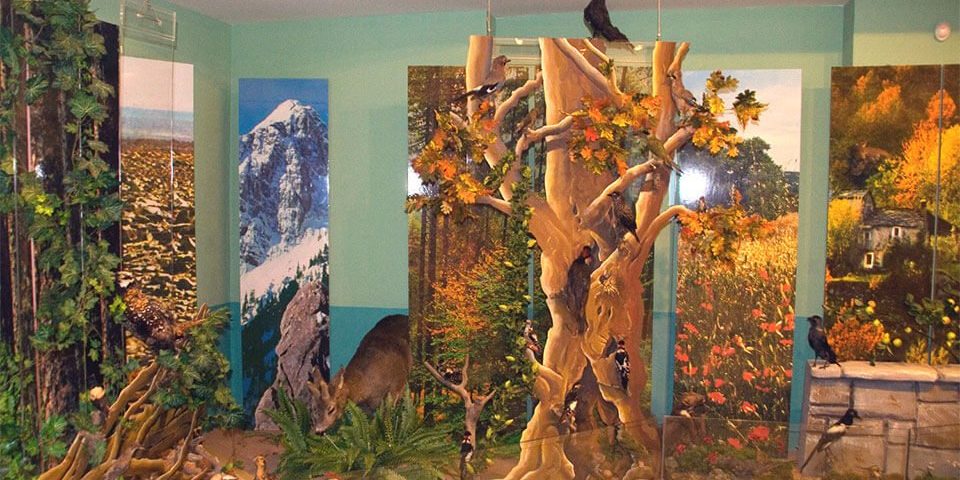
This is an initiative that aims to bring children closer to the starry sky—not through a typical presentation, but through storytelling, observation, play, art, and direct interaction with museum objects and authentic specimens. Constellations with Greek names, ancient myths, Zakynthian traditions, meteorites, engraving, painting, theatrical games, and modern applications of artificial intelligence come together to form a multidimensional program designed to help students discover that the sky we see today is full of stories that travel through time.
From Van Gogh to the Greek constellations: From antiquity to the present day, people have observed the stars, trying to recognize patterns in the sky and give them names and stories. Perseus, Andromeda, the Big and Little Dippers, Centaur, the Pleiades, and the Morning Star are just a few of the stops along this journey. The Helmi Museum’s initiative seeks to unite this ancient need to interpret the sky with the folk traditions of Zakynthos and contemporary artistic expression. Thus, the title of the project refers to Vincent van Gogh’s iconic “Starry Night,” a work that served as the starting point for a broader exploration of humanity’s relationship with the night sky. At the heart of the initiative are three 90-minute educational programs, each of which approaches the theme from a different angle.
Three workshops—three different perspectives on the sky for students from local schools and students with disabilities.
“Pleiades and the Morning Star” Comes to Life: The first program, led by museum educator Zoe Nikitaki, is based on live storytelling, dramatization, music and movement, and visual arts.
The program features the traditional Zakynthian folktale “Pleiades and the Morning Star,” which was recorded by M. Minotou in 1920 in villages across Zakynthos. This fairy tale, a quintessential example of the island’s folk mythology, is brought to life within the Museum and serves as a tool to introduce children to the symbolism of the constellations and the local intangible cultural heritage.
Through role-playing, storytelling, dramatization, music and movement activities, and art projects, students will step into the shoes of the story’s characters and create their own painted paper figures.
In this way, the traditional fairy tale does not remain merely a story of the past, but becomes an opportunity for creativity and communication with the younger generation.
Constellations Become Prints: The second program is dedicated to printmaking and is presented by Konstantinos Stoupathis, museologist, educator, and volunteer president of the Helmis Natural History Museum. Students will learn basic techniques of engraving, stamping, and printing, and will create their own works inspired by constellations, zodiac signs, and celestial bodies. Wooden and plastic stamps featuring mapped constellations, Greek names, and symbolic forms will be transformed into tools for artistic creation. At the same time, students will experiment with black-and-white and color prints, using a printmaking press and linoleum blocks.
Authentic meteorite specimens will play a special role, as students will be able to observe and touch them, linking the tangible experience of the museum object with imagination and drawing. After the workshop concludes, the students’ artwork will be printed in multiple copies, and a selection of their creative work will also be featured in a digital exhibition on the Helmis Museum’s website.
From the Navel of Delphi to Meteorites—The third program, “Constellations, Meteora, Meteorites, and Shooting Stars in Ancient Greece,” is presented by T. Theodosiou, founder of the Athens Meteorite Museum. Here, history, archaeology, mythology, geology, and astronomy come together in a unique educational journey. With the help of audiovisual material, projections, and artificial intelligence applications, students will be transported in their minds to the world of ancient Greece—and specifically to Delphi—in search of answers about the famous Sacred Stone and the Omphalos of Delphi. What was the Sacred Stone? Why was it of particular importance to the ancients? Why was it located near the Pythia? And what was the relationship between the ancient people and celestial stones and celestial phenomena?
These questions serve as the starting point for a process of discovery, during which students come into direct contact with meteorites, minerals, and geological specimens, as well as materials from the Museum’s educational kit and museum suitcase. The program will conclude with a unique “treasure hunt” in the Museum’s garden, where students will search for “meteorites,” as well as an art workshop. On a pebble, each child will paint their own “celestial symbol,” choosing a constellation, a zodiac sign, a planet, the Sun, or the Moon.
A journey that begins in Zakynthos and looks skyward
For five days, from October 19 to 23, 2026, the Helmis Museum will become a meeting place for art, science, mythology, and Zakynthian tradition.
From Pleiades and the Morning Star to the ancient constellations, from traditional folktales to printmaking, and from meteorites to artificial intelligence, students are invited to look at the sky in a different way.
After all, behind every constellation there may be a story, behind every meteorite a journey spanning millions of years, and behind every child’s drawing a new way of looking at the world.
“Starry Night: A Journey from Pleiades to the Morning Star”
October 19–23, 2026
Helmis Natural History Museum – Zakynthos



Leave A Comment