The Ministry of Culture is giving new impetus to the protection and promotion of Samos’s cultural heritage with the start of restoration work on the Church of the Dormition of the Virgin Mary in Karlovasi and the reopening to the public of two important monuments on the island: the post-Byzantine church of St. Johns in Ano Vathi and the Early Christian Cemetery in Pythagoreio.
Church of the Dormition of the Virgin Mary
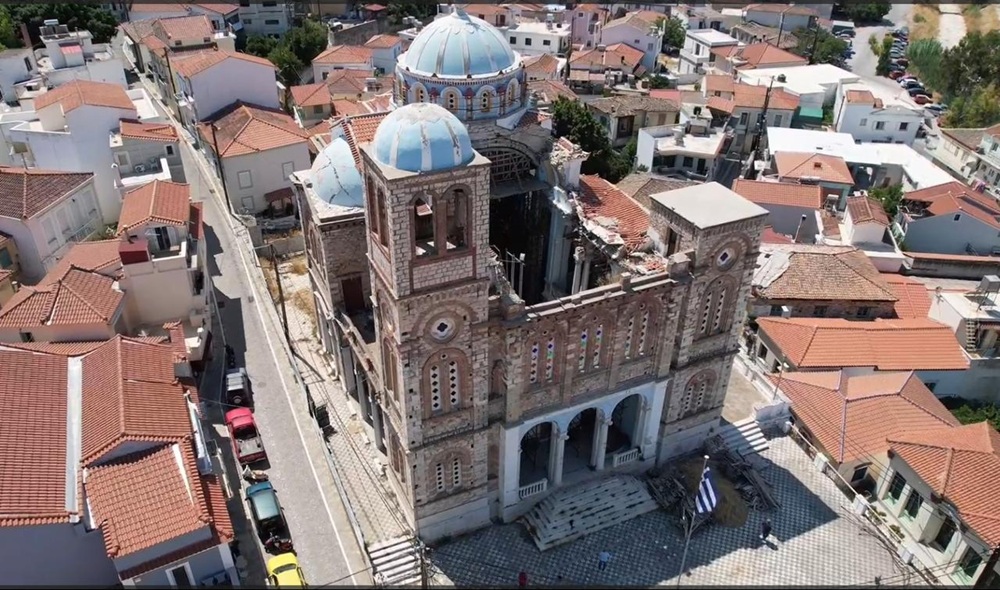
The Metropolitan Church of the Dormition of the Virgin Mary in Karlovasi was severely damaged by the earthquake of October 30, 2020. To protect the church, the Ministry of Culture immediately funded emergency stabilization measures, with a budget of 265,748 euros. At the same time, a project was launched to stabilize, restore, and reinforce the church against earthquakes. The contractor was selected through a competitive bidding process and has already begun work, with a three-year timeline for project completion.
Agioi Giannakides
The Church of Saint Johns (“Agioi Giannakides”) in Ano Vathi on Samos is one of the island’s most important post-Byzantine monuments and a designated historic landmark. Its design as a twin church, dedicated on the one hand to Saint John the Baptist and on the other to Saint Nicholas, its four domes, the ornate bell tower, the shared narthex, and its distinctive architectural features make it unique. Built in the second half of the 18th century as a dependency of the Holy Monastery of Zoodochos Pigi, the Church of Agioi Giannakides is a monument of exceptional architectural, historical, and cultural value. The church was reopened to the public following an extensive and demanding restoration. The project addressed serious deterioration issues that had accumulated over decades. Based on specialized studies and using compatible materials, work was carried out to stabilize and reinforce the monument, conserve its painted and sculpted decorations, upgrading the infrastructure, and landscaping the surrounding area, all with the utmost respect for its authenticity and historical value. The next phase will involve the conservation of the wooden iconostases and icons, funded by the North Aegean Region.
Early Christian Cemetery
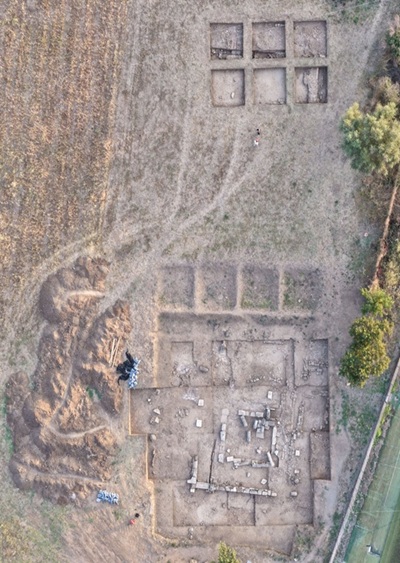
The Early Christian Cemetery of the ancient city of Samos, located at “Glyfada” in Pythagoreio, is one of the island’s most important early Christian monuments. It was in use from the 4th century AD until the mid-7th century AD, reflecting the transition from the ancient to the Christian world. Systematic excavations began in 1969 under the direction of archaeologist Konstantinos Tsakos, and as part of the project—which was completed with funding from the Recovery and Resilience Facility—an archaeological excavation was conducted, the monument was restored, and the surrounding area was landscaped to make it safe and accessible to visitors.
The excavations revealed the cemetery in its entirety, including the central 4th-century martyrion, 28 coffin-shaped tombs, 17 arcosolia (arched funerary monuments found mainly in catacombs), and the reuse of older Hellenistic tombs, confirming the site’s continuous use over time. Significant finds, such as clay vessels, crosses, jewelry, approximately 500 lamps, and nine gold solidi (an iconic gold coin introduced by Constantine the Great) from the time of Justinian I, enrich our understanding of the burial practices and daily life of the early Christian communities on Samos. At the same time, extensive conservation and stabilization work was carried out on the monument, along with enhancement projects such as drainage, the creation of walking paths, lighting, informational signs, and viewing and rest areas.


Leave A Comment