
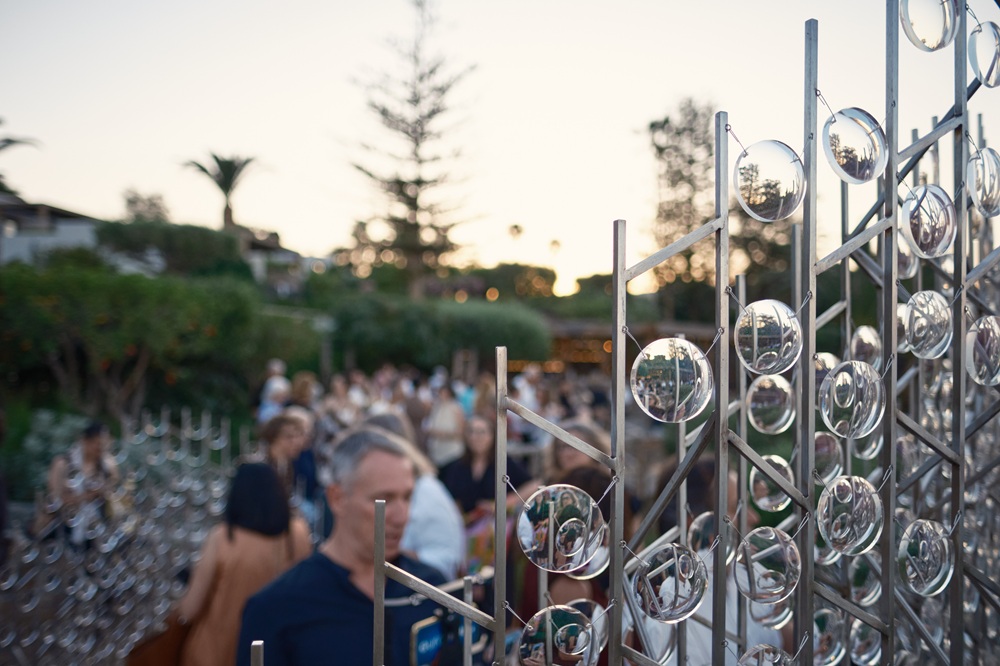
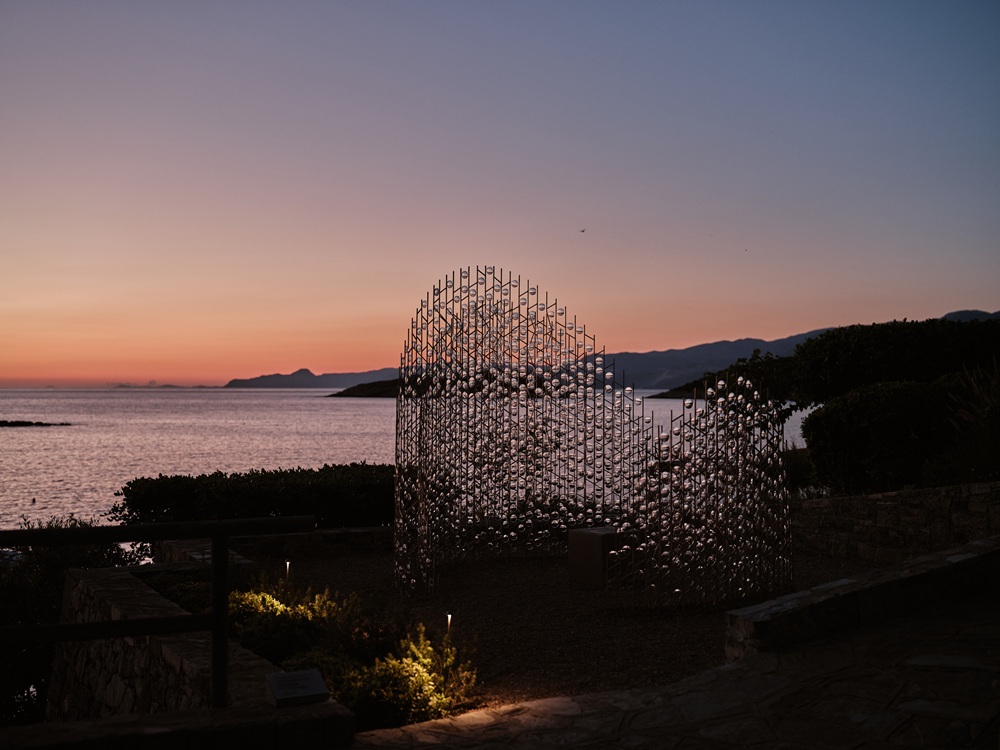
A few days ago, the sculpture installation Chronotopia by Caitlind R.C. Brown and Wayne Garrett from Canada was unveiled in Agios Nikolaos, Crete; the work won the 2026 Art Award from the G. & A. Mamidakis Foundation.
Set on a hilltop surrounded by greenery, the sea, and the open horizon, Chronotopia was a unique experience for those who attended the presentation from Crete, Athens, and abroad. The large-scale site-specific sculptural installation, which stood out among more than 450 proposals from 65 countries, will remain on permanent, open display as part of the G. & A. Mamidakis Foundation, which includes over 70 works by prominent Greek and international artists.
Access to the work, as well as to all other works in the Foundation’s collection in Agios Nikolaos, Crete, is free to interested visitors and residents.
Moreover, for years now, the G. & A. Mamidakis Foundation has been designing and implementing, among other things, educational and artistic activities primarily with children from schools of all levels in the region, with the aim of familiarizing them with art and artistic expression.
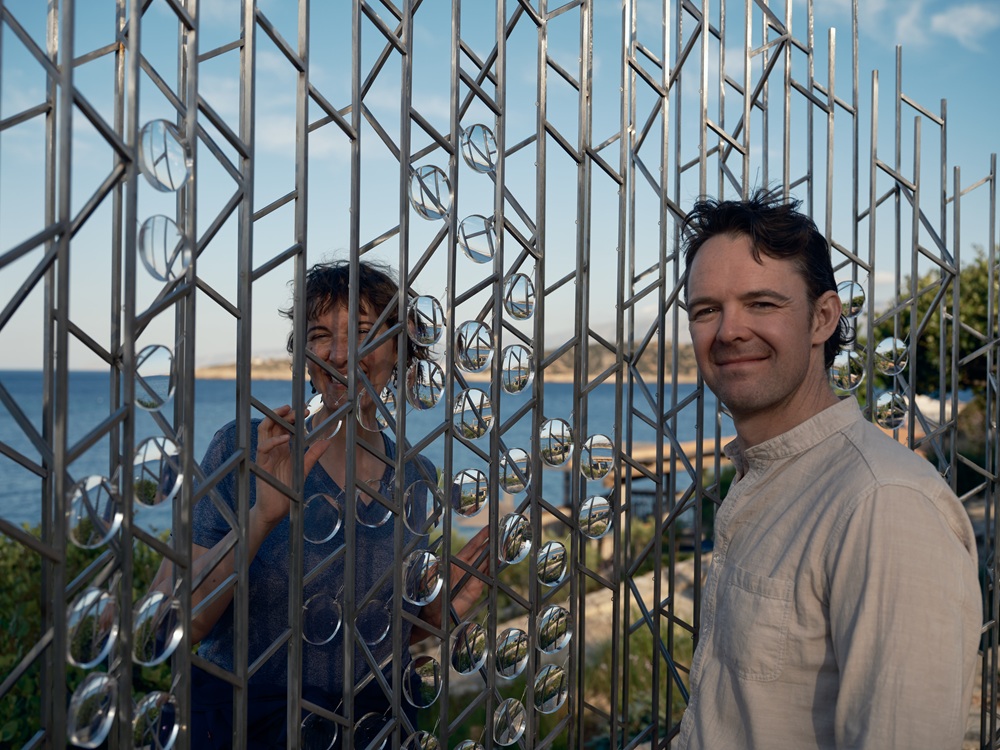
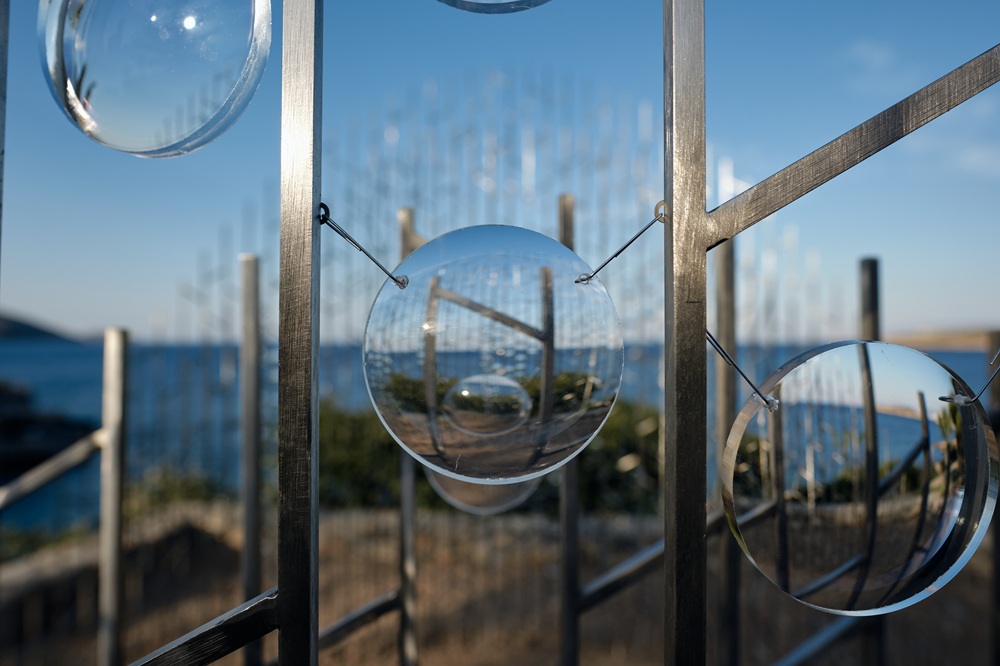
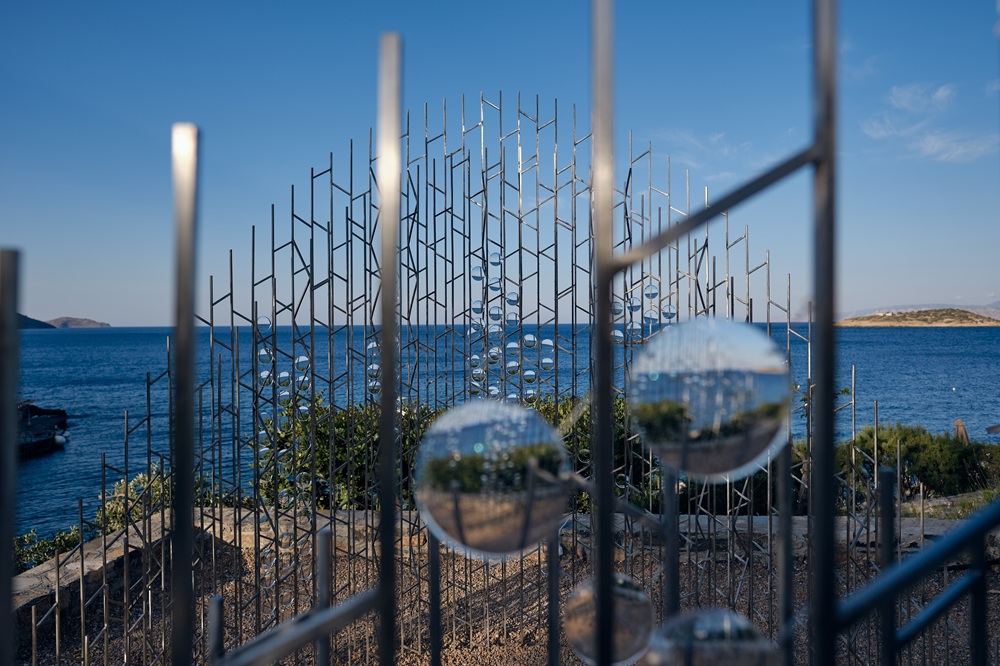
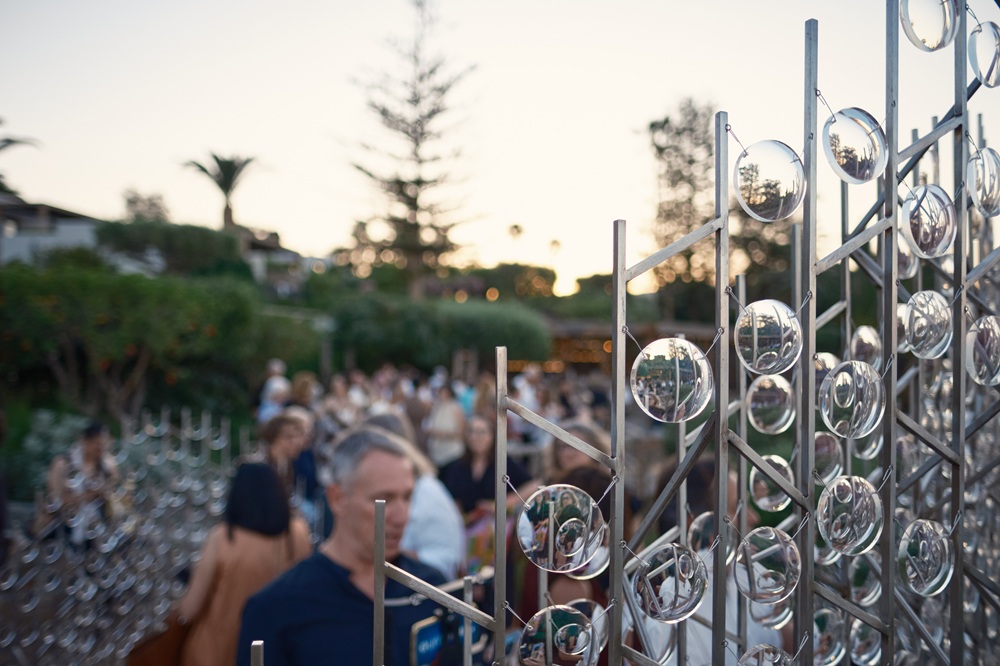
The artists had traveled from Canada a few weeks earlier to work on the installation of their piece, which consists of a sturdy metal structure resembling a lattice of branches and 1. 500 eyeglass lenses of varying strengths arranged in such a way as to form two arched “veils” of light that envelop the visitor. When the viewer is inside the installation, the lenses capture and focus distant images into hazy microcosms that shift depending on the conditions. They shift with the wind, change with the light, and are constantly being recomposed, without ever settling into a single, unified image. Outside the installation, each viewer’s body appears as a mosaic, an abstract phantom that becomes part of a different way of seeing.
As the artists explained during the presentation, the Mediterranean is a mythical and unfamiliar place for them, unlike anything they have encountered before. They were particularly inspired by the mythology and history of the region and were struck by the open, blue sea and its azure horizon. They clarified that this is the first time they have worked on a project intended for permanent installation; therefore, the issue of the project’s sustainability and durability over time and under various weather conditions, always in conjunction with an artistically sound result, was a challenge that was met through excellent collaboration and joint supervision by the Mamidakis Foundation team.
Chronotopia draws inspiration from the interactions between Crete, water, light, space, and time. The title of the work refers to the concepts of time (Chrono) and space or place (Topia). These two Greek words, when combined, suggest a condition in which time and place are interwoven and coexist, creating the familiar framework within which humans live. Moreover, although it is a large-scale installation, it always remains on a human scale—a fact that was a key consideration for the artists.
The blue horizon line of the Mediterranean, faintly visible through the scattered lenses but also more clearly between them, constitutes an image of linear time. However, when the viewer is inside Chronotopia, the lenses fragment and transform this linearity, sometimes shrinking it and sometimes expanding it, depending on their specific characteristics. In this way, they remind us that what we consider the “image” of the world is never direct, but always mediated, depending on our perspective and how we perceive the world.
Delving deeper into their reasoning, the artists emphasized how much they are interested in different perspectives, as well as the ever-changing experience created through different interpretations of the present, the past, and the future. They also highlighted how important proper lighting is for the artwork to function effectively at all hours of the day and night. As people particularly familiar with the wilderness, Caitlind & Wayne were thrilled by the interaction their artwork has in Agios Nikolaos—not only with the landscape and the people, but also with the birds and insects in the garden that have already made it their own!
The Artists
Caitlind Brown and Wayne Garrett are artists from Western Canada, specifically from Calgary, a city of nearly two million people in the province of Alberta. They were born and raised in a city with wide-open horizons, framed by the Canadian Rockies.
They have been collaborating since 2010. Their first joint projects began within the broader context of “expanded cinema” and gradually evolved into light sculptures, installations, and spatial interventions. Their shared artistic practice and interests focus primarily on non-traditional art spaces, such as public parks, forests, abandoned buildings, and parking lots, always seeking out the potential connections between people, places, and situations.
People are always the yardstick through which they conceive and develop their work—not as passive observers, but often as active participants in the work itself. Space plays an equally central role: the environment in which the work is situated and brought to life.
The Chronotopia project fits organically into this trajectory, distilling key questions that preoccupy the artists: the subjectivity of experience, the fluidity of time, and the ongoing negotiation between the individual and the collective.
Caitlind r.c. Brown is an artist and cultural organizer whose work ranges from experimental interventions in public spaces to collaborative projects. She graduated from the Alberta University of the Arts (2010) and was honored with the Alumni of Merit Career Award in 2019. She has founded and coordinated numerous collective and collaborative initiatives, including THE WRECK CITY, The Wandering Island, and The Hibernation Project, focusing on immersive and participatory practices.
Wayne Patrick Garrett is an artist and musician whose interdisciplinary work includes site-specific art installations, sculpture, sound, and performance. He trained as a mechanical technician at the Southern Alberta Institute of Technology and in jazz music at Mount Royal University. He entered the contemporary art scene through the Arbour Lake School (sic), an experimental artistic collective in Calgary, where he met Caitlind Brown, thus shaping their shared artistic journey.
More information about the artists and the project HERE


Leave A Comment