
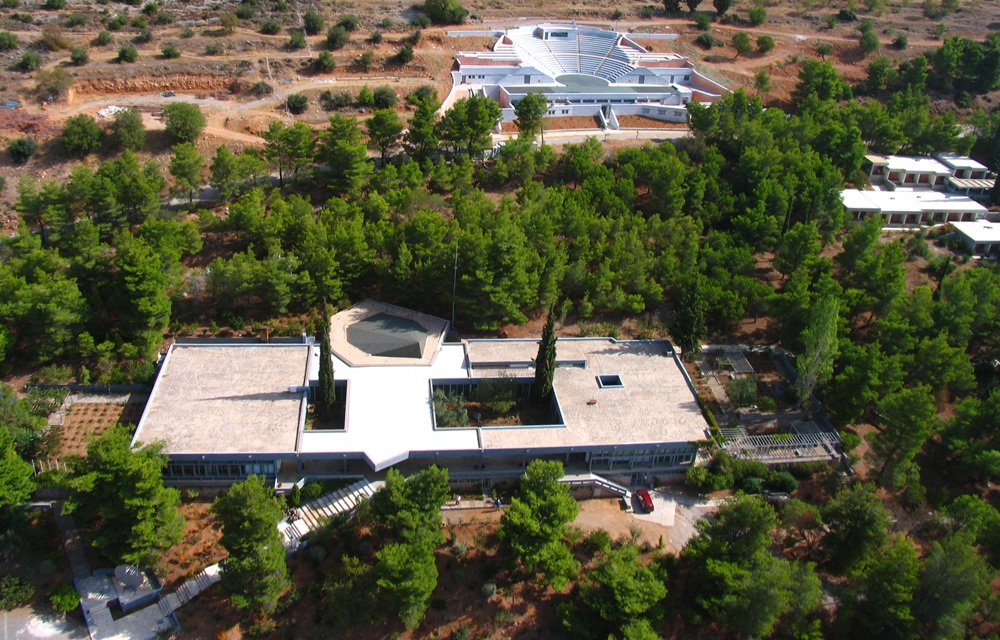
With the participation of internationally renowned, pioneering scientists from the fields of astrophysics and artificial intelligence, as well as from the humanities and social sciences, the Fourth Delphi Dialogues will take place in the “Phrynichos” Hall of the European Cultural Delphi Centre (E.C.D.C.) in Delphi on Friday 3 and Saturday 4 July 2026. The event will begin on 3 July at 17:30 and will conclude the following day with a round‑table discussion.
Delphi, one of the most emblematic sites of ancient Greek thought, retains its spiritual radiance to this day. The European Cultural Delphi Centre, whose statute aims to develop Delphi into a European and global intellectual hub, is a unique venue in Greece for the systematic exploration of the significance of the humanities.
Within this framework, the E.C.D.C. inaugurated the First Delphi Dialogues in 2023, which continued with the Second in 2024 and the Third in 2025. In 2026 the Fourth Delphi Dialogues will follow, under the theme “The Future of Humanity.”
From its inception the programme was placed under the patronage of Her Excellency the President of the Hellenic Republic, Mrs Katerina Sakellaropoulou, and it continues under the patronage of His Excellency the President of the Hellenic Republic, Mr Konstantinos A. Tassoulas.
The Fourth Delphi Dialogues are held with the support of the Kostopoulos Foundation.
Keynote:
Markus Gabriel, University of Bonn
Marcello Ienca, Technical University of Munich (TUM)
Ofrit Liviatan, Harvard University
Abraham Loeb, Harvard University
Helen Margetts, Oxford University
Lord Martin Rees, Cambridge University
Panagiotis Roilos, Harvard University
Lenart Skof, Science and Research Centre Koper, Slovenia
The President of the European Cultural Dephi Centre Harvard Professor Panagiotis Roilos, founder of the Delphi Dialogues and their scientific editor, states:
“The Fourth Delphi Dialogues serve as a prelude to a new, internationally significant cultural institution of the European Cultural Delphi Centre: the Contemporary Oracle of Delphi — The Future of Humanity. Pioneering and highly influential scientists from the fields of astrophysics, artificial intelligence, and medicine, as well as from the humanities and social sciences, will explore how advances in the so‑called hard sciences and in technology are shaping the future of humanity and its societies.”
In this way Delphi becomes a contemporary oracle which — thanks largely to its online incarnation — will broadcast worldwide not the divinely inspired and often obscure prophetic vision of the Pythia, but the scientifically grounded and intellectually processed knowledge of contemporary humanity across various fields of inquiry.
The Fourth Delphi Dialogues will examine a series of complex issues directly related to the new reality we are experiencing — a reality I have, for the past fifteen years, termed “neo‑medieval metacapitalism” — including the following questions:
- How is space policy taking shape today? What are the latest developments in the race to colonize space, and what does this mean for the future of humanity, the international geopolitical landscape, and planet Earth?
- How does modern science approach questions regarding the possibility of extraterrestrial life and intelligence? How can the boundaries between scientific rationality and fanciful conspiracy theories be preserved in a world inundated with false, fabricated news?
- How does artificial intelligence function as a modern oracle? How can the essence of humanity, as we have understood it until now, coexist with it?
- How does artificial intelligence influence governance mechanisms and objectives in modern states? How can it help promote citizen participation in important decision-making, but also what risks might it pose to democratic institutions and civil liberties?
- How does cognitive technology shape the future of political culture, as well as the terms and priorities of cultural policy?
PROGRAM
Friday, 3 July
17.30-17.45 Welcome Remarks
17.45-18.25 FIRST SESSION
Opening lecture
Panagiotis Roilos, Πανεπιστήμιο Harvard
On space politics and the future of humanity
Helen Margetts, Oxford University
AI and digital era governance
18.25-18.45 Discussion
18.45-19.00 Interval
19.00-19.40 SECOND SESSION
Lenart Škof, Koper Science and Research Center
The future soul of humanity
Marcello Ienca, Technical University of Munich
Humanity at the crossroads: Cognitive technology and the future of freedom and autonomy
19.40-20.00 Discussion
Saturday, 4 July
09.30-10.10 ΤHIRD SESSION
Abraham Loeb, Harvard University
The benefits of alien intelligence over AI
Markus Gabriel, University of Bonn
Being human in the age of AI – What AI’s magical mirror tells us about ourselves
- Discussion
10.30-10.45 Interval
10.45-11.25 FOURTH SESSION
Ofrit Liviatan, Harvard University
The case for regulation when machines are the new oracles
Martin Rees, Cambridge University
Our future in space
11.25-11.45 Discussion
11.45-13.15 ROUNDTABLE



Leave A Comment