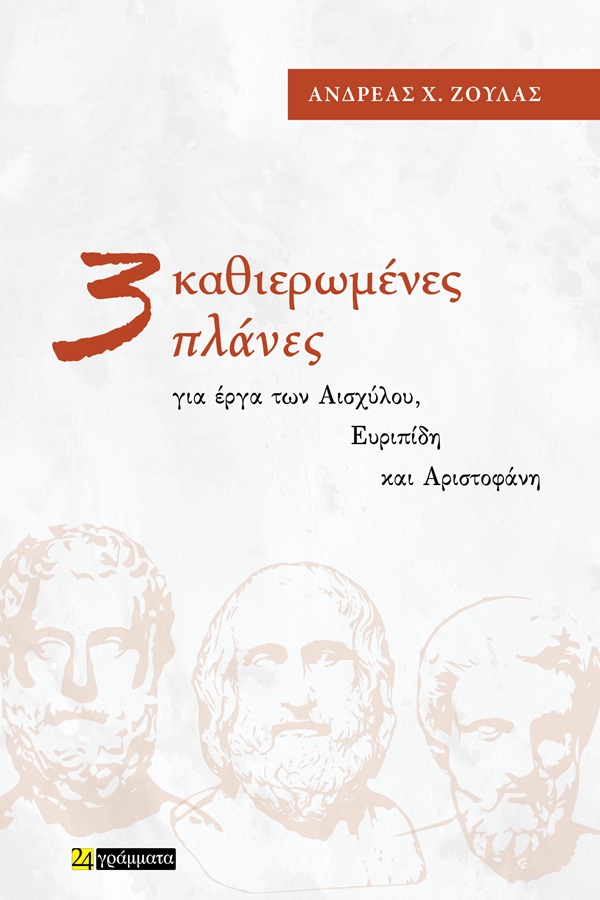
Title: 3 Common Misconceptions About the Works of Aeschylus, Euripides, and Aristophanes
Author: Andreas H. Zoulas
Publisher: 24 grammata
Subject: Αncient Greek Drama, Philology
Year: October 2025
Pages: 113
The author of this work, Andreas H. Zoulas, notes in his preface:
The subject of my research and the title of the book are…
THREE ESTABLISHED MISCONCEPTIONS
(regarding the works of Aeschylus, Euripides, and Aristophanes).
…whether from the very beginning or from long ago. Their common feature is their general acceptance, despite the fact that they distort the letter and spirit of the Text…
-Aeschylus in “Agamemnon” writes (in line 688):
ELENAS, ELANDROS, ELEPTOLIS. How and why did ELENAS become ELENAUS, and why has this—incorrect—”correction”/intervention been generally touted ever since?
-In The Bacchae, in the passage often considered “difficult to understand” (lines 402–411), Euripides neither writes nor implies that the Nile irrigates… Paphos. How and why did the opposite interpretation prevail, and what does Euripides actually say?
-Aristophanes in “The Clouds” does not satirize Socrates, as is generally believed… What and whom does he satirize?
The restoration of the “letter” in the first two cases—thorough and interesting—was certainly easier than the restoration of the “spirit” in the third case…
About the author
Andreas H. Zoulas was born in 1942 in Astakos, Aetolia-Acarnania. A journalist, he worked in the field from 1965 to 2010. He holds a degree in Political Science from Panteion University. He served as a reporter, political editor, commentator, and columnist for Athenian newspapers, as well as Editor-in-Chief of “Kathimerini” and the “Athens News Agency.” Producer of radio and television political programs. Married to Mary Lombardou, they have two sons, one daughter, and six grandchildren.
He has translated the complete surviving works of classical drama: Seven tragedies by Aeschylus, seven tragedies and one satyr play by Sophocles, nineteen plays by Euripides, eleven comedies by Aristophanes, and five comedies by Menander. He has also translated the works: ORPHIC HYMNS, HOMERIC HYMN TO HERMES, and THE BATTLE OF THE FROGS. All of his translations maintain perfect verse correspondence with the ancient text and isosyllabism (the number of syllables in the translated verse matches that of the corresponding verse in the ancient text).



Leave A Comment