“These new initiatives of international scope send a message to the whole world that Delphi today is the epicenter of global thought and cultural exchange, centered on the Delphic maxim ‘Know thyself,'” said the President of the European Cultural Delphi Centre, Harvard professor Panagiotis Roilos, during an event titled “The International Character of the European Cultural Delphi Centre,” held on Wednesday, May 27, at the Athenian Club.
The event featured opening remarks by Eleni Doundoulaki, Secretary General for Contemporary Culture at the Ministry of Culture, representing the Prime Minister; Ioannis D. Bougas, Deputy Minister of Justice and Member of Parliament for Fokida; the Mayor of Delphi, Panagiotis Tagkalis, and the Deputy Regional Governor of Fokida, Georgios Delmouzos, representing the Regional Governor of Central Greece, Fanis Spanos.
Panagiotis Roilos: Modernized infrastructure and new institutions with international standing
Panagiotis Roilos stated: “As soon as I assumed the presidency of the European Cultural Delphi Centre in August 2022, I made it my priority to strengthen and further develop the centre’s role as a truly international hub, a hub for the circulation and, as far as possible, the production—not merely the reproduction—of culture (and by culture I certainly include reflection) and for the promotion of dialogue among European and non-European countries alike. Culture (a fundamental component of which is reflection), understood as a means of bringing together different traditions—not as “soft” or of any other nature— power, not as an instrument of any form of hegemony, but of offering both individual and collective self-knowledge, in accordance with the ancient Delphic maxims, as well as the vision of Angelos Sikelianos.”
According to an announcement by Panagiotis Roilos, the inclusion of the energy upgrade and renovation of the Centre’s conference center in the recovery fund, thanks to the initiative and efforts of Minister of Culture Dr. Lina Mendoni, which will be completed by the end of the summer, guarantees the acquisition of exceptional, modernized infrastructure. Among the new initiatives, he mentioned the creation of the “International Cultural Network/ Delphi Forum,” which aims to foster cultural collaborations between various countries in Europe and beyond, promoting and showcasing aspects of the cultural output of a specific European country as well as a non-European one. As he also noted, the Fourth Delphic Dialogues, to be held on July 3 and 4, 2026, in Delphi, will serve as a prelude to a new, third international initiative called the Delphic Oracle Project: The Future of Humanity “The Modern Oracle of Delphi: The Future of Humanity.” Scientists primarily from the so-called hard sciences (artificial intelligence, astrophysics, biotechnology, medicine), as well as the social sciences and humanities, will gather in Delphi to present and analyze developments in their respective scientific fields and how these will impact humanity, the human species, and its societies. It should be noted that the first three Delphic Dialogues have been viewed online by over one million people from around the world to date, an unprecedented success, not only by Greek standards. “The Delphic Dialogues have been made possible thanks to a donation from EurolifeFFH. All of us at the Center are grateful to the Chairman and CEO of EurolifeFFH, Mr. Alexandros Sarigeorgiou. This donation ensured not only the realization of the Delphic Dialogues program, but also other Center initiatives, such as the remarkable Picasso exhibition held the year before last,” stated Panagiotis Roilos.
The President also announced the launch of another initiative called “Modern Delphic Amphictyony: International Community of Friends of the Delphic Idea and Εuropean Cultural Delphi Centre,” which, as he emphasized, was a long-held dream of his and is part of the activities of the “Delphi International Cultural Network/Forum.” He emphasized that an international Coordinating Committee has already been established, headed by the Center’s advisor on international relations, Honorary Ambassador Tassos Kriekoukis.
Andreas Gofas: The Centre is entering a new era, a time of renewal
“From Harvard and Oxford to international cultural and scientific organizations, people with genuine global influence are investing today in the new phase of Delphi. And this brings us to 2027. A year with double significance: 100 years since Sikelianos’ Delphic Festivals and 50 years since the founding of the European CulturalDelphi Centre. “For us, this is not merely an anniversary. It is a moment of renewal,” said Andreas Gofas, Director of the European Cultural Delphi Centre and Professor at Panteion University. “Every time the world loses its bearings, Delphi returns. It returned after the collapse of the ancient world. It returned after World War I, when Angelos Sikelianos and Eva Palmer sought to restore a spiritual gathering place for humanity. They returned in 1977, when the European Cultural Delphi Centre was founded,” he noted. “Perhaps today we are in a fourth moment of Delphi. In an era of artificial intelligence, geopolitical uncertainty, and a profound crisis of meaning, where societies communicate more than ever—but find it increasingly difficult to think together,” he also noted.
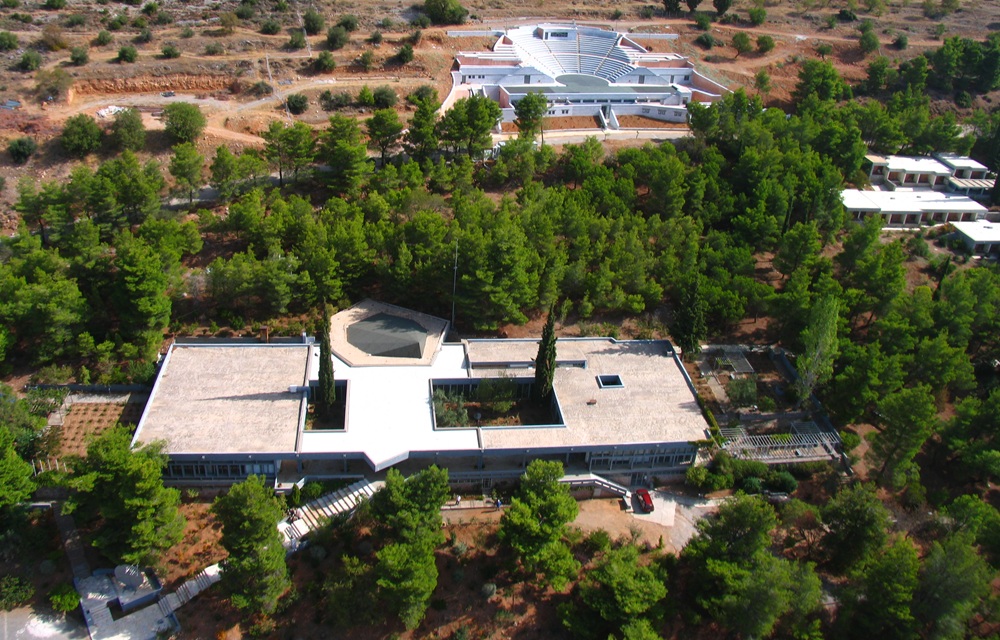
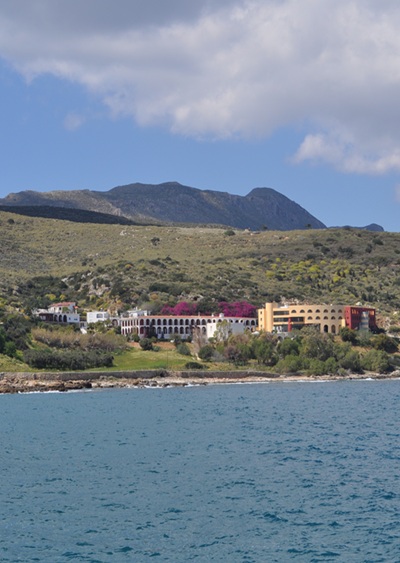
He continued: “The European Cultural Delphi Centre currently boasts a unique infrastructure: 100 acres in the Delphic landscape, a conference center, a guesthouse, an open-air theater, and a sculpture park. But the true significance of this place lies not only in its facilities. It lies in the fact that here, even today, people from all walks of life can step away—if only for a moment—from the usual rhythm of the world and come together in a different way. And right now, the Center is entering a new era. The energy upgrade and complete renovation of our conference center will be completed this summer. We are not simply modernizing a building. We are preparing a new platform for international encounters,” he emphasized.
And he concluded: “But such endeavors do not sustain themselves. Cultural institutions do not survive simply because they have a past. They survive when people decide that they have a future. The Delphic Dialogues became a reality thanks to a generous donation from Eurolife. Without it, they would have remained an idea on paper. Today, we are attempting to create something broader: a community of people and institutions that understand that culture is not a luxury. It is the infrastructure of democracy. The infrastructure of imagination. The infrastructure of the future. And that in an increasingly fragmented world, spaces for genuine encounter take on enormous significance.”
Tassos Kriekoukis: The world-renowned figures of the International Coordinating Committee of the Modern Delphic Amphictyony
“In recent years, the Center has invested heavily in expanding its international reach. It is now launching an additional international initiative. Inspired by the ancient institution of the Delphic Amphictyony, the Modern Delphic Amphictyony seeks to actively support and disseminate on an international scale the new Delphic Idea, as it has been shaped and promoted by the European Cultural Delphi Centre. “The main objective of the Modern Delphic Amphictyony is to disseminate, in both international and Greek cultural, educational, social, and political forums, the initiatives of the Center and the Delphic Idea it serves,” said Honorary Ambassador Tasos Kriekoukis in turn. As he further noted, in order to highlight the ambitious and particularly captivating trajectory of the Centre on the international stage, it was deemed necessary to establish the International Coordinating Committee of the Modern Delphic Amphictyony, a steering committee.
According to Tasos Kriekoukis, the members of the steering committee include international journalist Nikos Aliagas, distinguished British actor Simon Callow, Melani Cammett, Professor of International Relations at Harvard University; Marcia Covarrubias, former Chilean Ambassador to Greece; Maria Embeirikos, a member of the Board of Directors of the Friends of St. Catherine’s Monastery of Sinai in Switzerland; Professor of World History at Worcester College, Oxford, and Director of the Oxford Centre for Byzantine Research, Peter Francopan, the American Alice Goldet, a member of the World Monuments Fund and major patron of arts institutions, the Pulitzer Prize-winning Harvard University professor Stephen Greenblatt, the Israeli-American professor of natural sciences and chair of the Department of Astronomy at Harvard University from 2011 to 2020, Avi Loeb, the Byzantinist with roots in both the U.S. and Greece, Dr. Anne McCabe, the renowned German historian and archaeologist, Hermann Parzinger, the historian and ambassador, president of the National Library of France, Gilles Pécout, and the Chairman and CEO of the EurolifeFFH Insurance Group, Chairman of the Board of Directors of the Hellenic Association of Insurance Companies, and Vice-Chairman of Insurance Europe, Alexandros Sarigeorgiou.
The event, attended by representatives from the academic, political, cultural, and business communities, as well as many members of the media, was moderated by journalist Anna Grimanis.
Delphic Dialogues 2026
With the theme “The Future of Humanity,” the Fourth Delphic Dialogues will take place on July 3 and 4, 2026, at the European Cultural Center of Delphi in Delphi.
Speakers: Helen Margetts/University of Oxford, Abraham Loeb/Harvard University, Markus Gabriel/University of Bonn, Marcello Ienca/Technical University of Munich (TUM), Ofrit Liviatan/Harvard University, Lord Martin Rees/University of Cambridge, Lenart Skof/Science and Research Centre Koper, Slovenia,
Delphic Academy of European Studies – 8th Session
July 19–31, 2026
Theme: Technology, Society, and Politics
With funding
from the Region
of Central Greece
The Delphic Academy focuses on the diachronic and synchronic study of European history and culture, and on the ways in which Europe today responds to the multifaceted challenges of political, economic, and cultural globalization.
The program is supervised by Harvard Professor Panagiotis Roilos, President of the European Cultural Center of Delphi.
This year’s seminars will be taught by internationally renowned scholars: Timothy Campbell (Cornell University), Alex Csiszar (Harvard University), and Emily Dolan (Brown University).


Leave A Comment