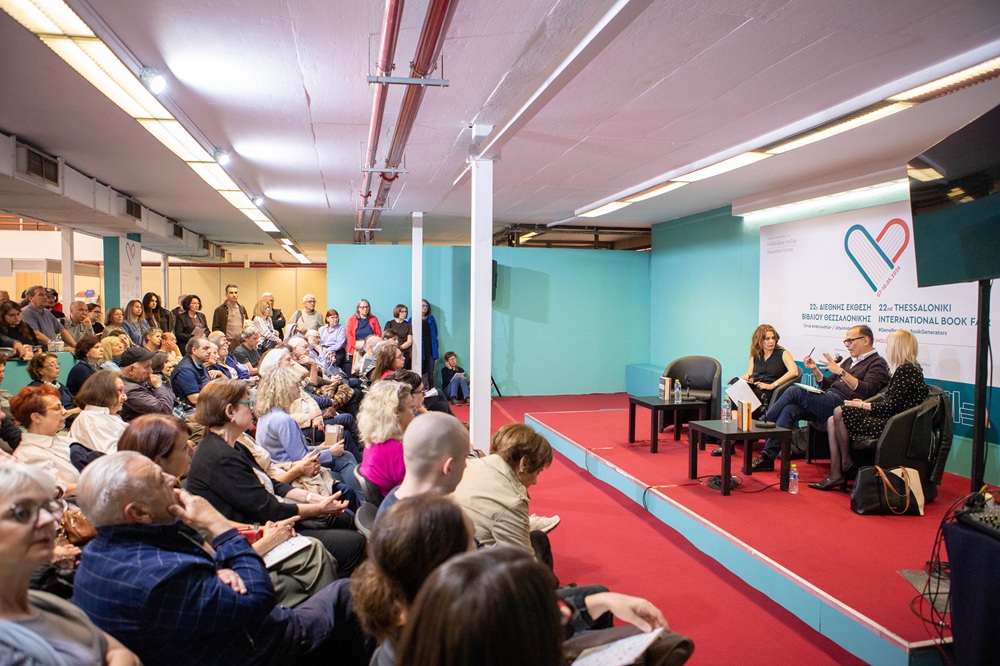
The first day of the 22nd Thessaloniki International Book Fair kicked off with a strong international, social, professional, and children’s presence, confirming the multifaceted nature of this year’s event and setting the tone for an event open to knowledge, collaboration, and outreach. Discussions on literary translation, inclusive language, and the power of culture as a medium for dialogue coexisted with activities, experiential workshops, and events that highlighted the role of the book as a tool for expression, communication, and creation.
With children’s laughter and a creative spirit, the children’s program of the 22nd Thessaloniki International Book Fair began early in the morning, as from the very first day, the venue was filled with students from schools in Thessaloniki and the surrounding prefectures.
Literary Translation: Pathways Between Greece and Bulgaria: The fair opened with an interesting discussion on the topic “Literary Translation: Pathways Between Greece and Bulgaria,” highlighting the role of translation as a cultural bridge between the two countries.
Our speakers reminded us that Bulgarian literature has always existed, but it often reached Greek readers via a circuitous route of translations, first passing through English, French, or other Western languages, and even the translated texts required “Western approval” before being presented to the Greek public. Publishing houses, translators, cultural events, and translation programs play a decisive role in the dissemination of literature, providing a space for the exchange of ideas and support—especially for small publishers—in the publication of new works, they said. Particular emphasis was placed on the need to support translators and strengthen funding programs, while the translator was characteristically likened to “an athlete of the mind who must train daily with his pencil.”
Gender-neutral and inclusive language in Greek production and translation: Of particular interest was the discussion organized by the Hellenic Society for Translation Studies, which opened a substantive dialogue on changes in language, inclusive expression, and its relationship with society.
The speakers discussed the various approaches to the use of non-sexist language, the resistance that still exists toward new linguistic forms, and the way in which language reflects and influences social change. At the same time, it was emphasized that any linguistic reform can only move forward when accompanied by broader social acceptance and a shift in mindset.
At an event on “Contemporary Bulgarian and Greek Literature,” author Teodora Dimova noted that she began writing as a child, feeling “the power of literature to immortalize moments,” while regarding her latest novel, she admitted that “when you write a historical novel, it’s like walking on thin ice.” For her, “the past is something we must heal; we must not avoid it; we must put our finger on the wound.” Author Lila Konomara noted that she was late to turn to literature, until she realized that “she couldn’t do anything else,” while she believes that “the more understandable you are as a teacher, the more you must avoid that as a writer,” so as to leave room for the reader.
Georgian author Dato Magradze, who visited Thessaloniki, remarked at an event held as part of the exhibition—which was also attended by the Georgian Consul: “I thank everyone who has made time for poetry. Poetry brought me to Greece. From my childhood, I remember the phrase: ‘Everything that moves begins in Greece.’ I am looking for companions in my poetry, and if I find companions in Greece, I will be very happy. What I want to offer through my art is to find the human being within the citizen. God created man, and the State created the citizen. The goal of poetry is to save the human being within the citizen.”
The Professional Program of the 22nd Thessaloniki International Book Fair began with a presentation of data on the Greek book industry by ELIVIP, as well as the Foundation’s strategic objectives, delivered by the Foundation’s President, Nikos Bakounakis, and Vice President, Panagiotis Kapos. ELIVIP’s GreekLit translation program was presented, with 86 titles translated to date into 25 languages, primarily in the field of literature. “English is the dominant language, and we need tools to promote other languages as well,” it was noted. Reference was also made to the platform for cataloging Greek publishing output, Vivlionet, and to ELIVIP’s reading campaign, Diavazoume. The role of independent regional bookstores was emphasized; these need support because they are hubs of culture and community engagement, however, it was noted that a prerequisite is their registration, with a broader observation that in Greece there is a strong need for more comprehensive and accurate data collection.
In addition, data was presented on the Greek book market and the prevailing trends in the publishing landscape. Print media accounts for the lion’s share at 97%, while the audiobook market in Greece is growing, though its full scale has not yet been fully captured. Currently, there are 800–1,000 publishers registered in the country. Self-publishing is a reality in the Greek publishing industry, especially with the boost provided by digital services. Marketing through social media is a very important tool for a book’s visibility, and there is a growing trend toward its use by the publishing world. Among younger generations, graphic novels and comics, self-help books, biographies, and autobiographies are dominant, while there is a significant output of high-quality children’s and young adult books.
The professional program also included an overview of the Bulgarian publishing market. During a discussion on children’s books in Bulgaria, it was noted that 1,500 children’s books are published each year, accounting for 25% of the market. “Adult readers turn children into future readers,” it was noted. The list of summer reading books that schools provide to students is helpful, while community cultural centers are also making a commendable effort with their libraries.
The discussion on the buying and selling of rights and literary agents also drew considerable interest. Representatives from major international publishing houses, such as Farrar Straus & Giroux (U.S.), Grupo Planeta (Spain), Editions Gallimard (France), Penguin Random House (UK), and Read & Right Agency (Greece) spoke about trends in the publishing industry. They highlighted the strong trend toward psychological thrillers and romance novels in countries such as France. Regarding the acquisition of book rights from countries like Greece, they noted that, since the market is rare, they want something very strong and need feedback from readers in their own country. Something that grabs attention but also has a clear, not vague, description. They also look for facts, figures, sales data, and campaigns, without, however, ruling out the element of chance, as happened with a book they discovered through social media.
Particularly interesting was the event on the “Spanish phenomenon,” a term which, as Faidon Kydoniatis, vice president of the Federation of European Publishers (FEP), explained, was coined by Enrico Turrin, the Federation’s deputy director. The phenomenon consists of the fact that Spain is the only international market with a consistently upward trend in publishing indicators. The consistent, supportive role of the government in promoting and providing access to books and libraries was highlighted, as well as the role of networking and good cooperation. As José Manuel Anta, CEO of the Spanish Book Publishers Association, noted, new strategies and plans are developed annually, and there is excellent cooperation between the private sector and the government. In Spain, as of 2024, there are 3,000 publishers, 3,000 bookstores, and 4,300 book retail outlets. In 2024, nearly 90,000 new titles were published, mainly in print but also as e-books, while the domestic market generated 3 billion euros in revenue. The pandemic benefited books and reading, as was emphasized, while mention was made of major book festivals and fairs, such as those in Madrid or the Sant Jordi celebration in Barcelona with its popular campaign featuring roses and books. The fair takes place in early April, and on the first day alone, revenue of 27 million euros was recorded.
Finally, the role of the education system—which varies by region but generally promotes reading—was highlighted, as was the proactive policy of local governments, while mention was made of the Parix School for the book industry.
Official opening of the Bulgarian National Pavilion:
A highlight of the first day of the Thessaloniki International Book Fair was the official opening of the National Pavilion of the guest of honor, Bulgaria, by Deputy Minister of Culture Victor Stoyanov, in the presence of invited Bulgarian authors and translators, who also spoke at the event. The Deputy Minister emphasized that the event represents an important opportunity for dialogue and outreach, bringing together authors, translators, and publishers from different countries.
Emphasizing the power of literature and culture as “bridges” between peoples, he noted the steadily growing presence of Bulgarian literature on the international stage, pointing out that an increasing number of Bulgarian authors are being translated and published worldwide, gaining recognition from international audiences.
He made special mention of the role of translators, whom he described as “true cultural ambassadors,” since, as he said, “they build bridges between languages and people.” At the same time, he expressed his pride in the presence of important “voices” of contemporary Bulgarian literature at the Thessaloniki International Book Fair, noting that Thessaloniki is evolving into a vibrant hub of cultural cooperation between Greece and Bulgaria.
The Deputy Minister also referred to his meeting with the Greek Minister of Culture, highlighting their shared proposal to strengthen relations between the two countries and take them “to the next level.”
A special mention in his speech was reserved for the closing concert on Sunday evening at the Rotunda, the result of a collaboration between musicians from Thessaloniki (KOTH) and Sofia under the direction of the internationally renowned violinist Svetlin Roussev. As he noted, this collaboration serves as a shining example of how culture and mutual understanding can function during times of war and uncertainty.
In closing, he revealed that the historic violin used in the concert belongs to the Bulgarian Ministry of Culture and is considered one of the most important musical instruments in the world.
Information about the concert can be found HERE.
Children’s Activities and Workshops
In total, 29 organized groups from preschools, elementary schools, middle schools, and special education schools participated in the activities on the first day of the event, with approximately 1,000 students taking part in book presentations, hands-on workshops, and meetings with authors and illustrators from Greece and abroad.
The day’s program also included a treasure hunt, mystery games, book parties, crafts, creative workshops, as well as theatrical and music-movement activities, transforming the fair into a colorful space of imagination and discovery for young and old alike.
A highlight of the first day was the presentation of the initiative “Giving Books a Voice: The Little Prince in Student Audiobooks.” Students from the 1st Elementary School of Kalochori and the 1st Elementary School of Thermi read, adapted, and reimagined the classic work, creating their own audiobooks, in an initiative that gave the children the opportunity to engage with literature in a creative and experiential way.
At the Central Municipal Library of Thessaloniki, children eager to play and create spent two hours participating in the hands-on workshop “Us and the World of Fairy Tales,” organized by the National Library of Greece with the support of ELIVIP. Through selected illustrated children’s books, the young participants journeyed into the world of imagination, utilizing theatrical play, visual arts, and creative writing.




Leave A Comment