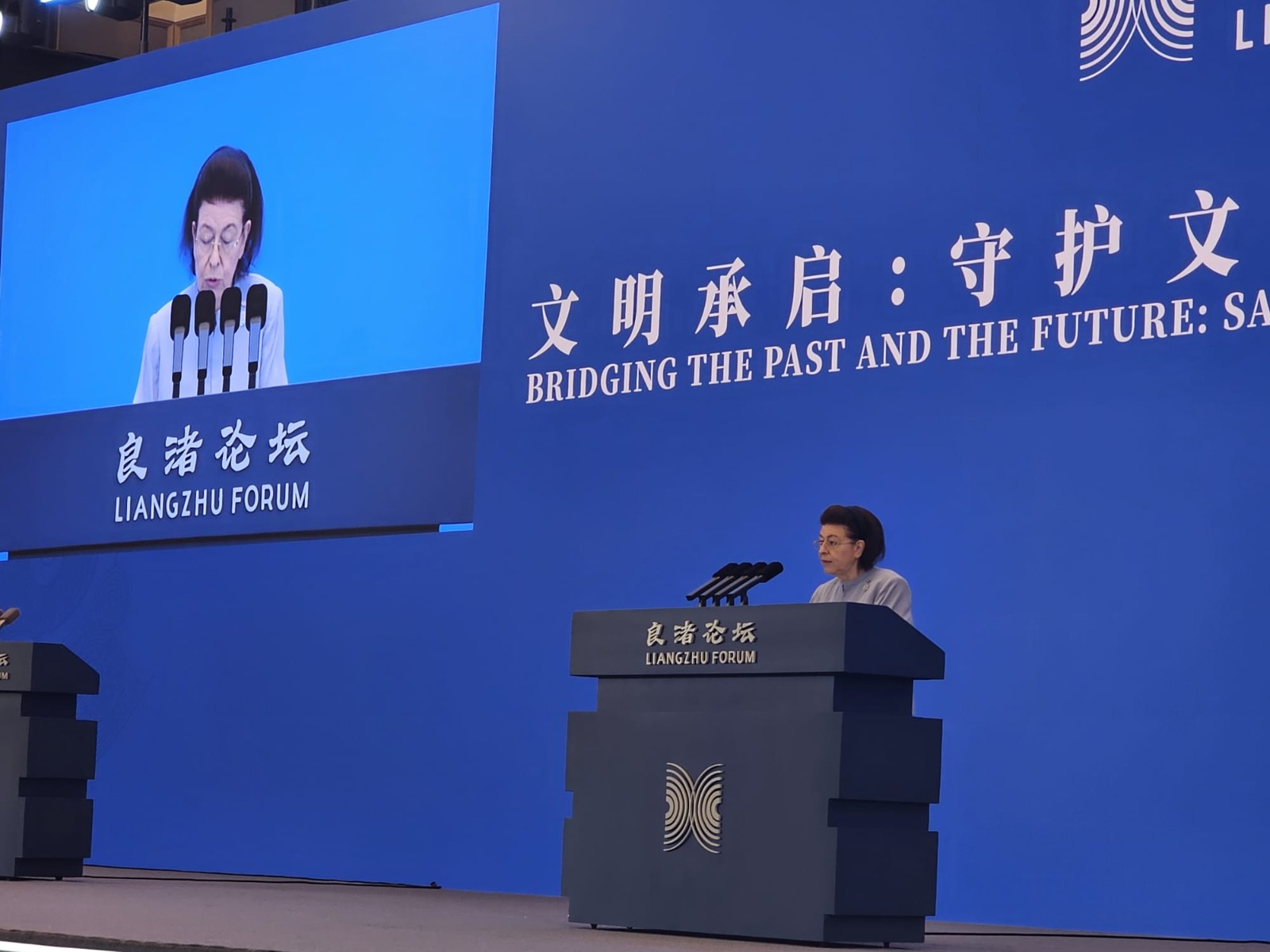
The Minister of Culture, Lina Mendoni, celebrated the opening of the 4th Liangzhu Forum in China, highlighting the strategic importance of cultural cooperation between Greece and China as a steadfast pillar of their bilateral relations. Greece’s participation in the Forum, dating back to its inaugural edition in 2023, reflects the ongoing strengthening of ties between the two countries. At a time of international upheaval and complex challenges, Greece and China are strengthening the cultural dialogue between East and West by further investing in relations based on mutual understanding and trust, and by promoting joint initiatives to protect the world’s cultural heritage.
Lina Mendoni highlighted the significant strengthening of cultural ties between Greece and China over the past seven years, with a focus on cultural exchanges, joint initiatives, and the organization of the World Congresses on Classical Studies, in Beijing in 2024 and in Athens in June 2026. He emphasized that the two ancient civilizations form the foundation of a stable framework for cooperation and can make a substantial contribution to contemporary dialogue by promoting mutual understanding and international cooperation. In this context, he referred to the operations of the Chinese School of Classical Studies in Athens, which has already established cooperation with Greek archaeologists and is conducting its first archaeological survey in Greece, expressing the hope for a corresponding presence of Greek experts, as well as joint research initiatives, in China.
She also placed particular emphasis on international cooperation in the fight against the illicit trafficking of cultural property and counterfeit works of art, as it is linked to terrorism and international organized crime. The Minister of Culture proposed that the Liangzhu Forum adopt a common code of principles for researching the provenance of collections, in collaboration with experts and international organizations, as well as the adoption of a common principle regarding the need to reunite fragmented monuments at their place of origin, the most notable example being the Parthenon Marbles. He emphasized that heritage protection requires a shift from traditional conservation and restoration to a comprehensive strategy of prevention and resilience, leveraging scientific knowledge, expertise, and new technologies—including artificial intelligence—and proposed utilizing the Liangzhu Forum as a platform for expertise and collaboration.
On the sidelines of the 4th Liangzhu Forum, Minister of Culture Lina Mendoni met with Xie Bing, Executive Secretary-General of the Alliance for Cultural Heritage in Asia (ACHA) (Alliance for Cultural Heritage in Asia), Xie Bing, to discuss ways to promote their cooperation in protecting cultural heritage from the impacts of the climate crisis. Emphasis was placed on the exchange of scientific knowledge and expertise, as well as on the possibility of Greek scientists participating in archaeological research alongside their Chinese colleagues.
During her visit, Lina Mendoni visited key institutions dedicated to promoting and preserving China’s cultural heritage, with a focus on the history of silk production and the ancient culture of Liangzhou. The Minister of Culture visited the China National Silk Museum in Hangzhou, which is dedicated to the history of silk, traditional weaving, and the preservation of the cultural heritage of weaving. The Minister was accompanied by the museum’s director, Ji Xiaofen. The collections showcase the historical development of Chinese silk production, ancient textiles and garments, as well as the role of silk in commercial and cultural exchanges between the East and the West. Lina Mendoni also visited the Liangzhu archaeological site, one of the most important archaeological complexes for the study of early urban development and the formation of complex societies in prehistoric China. The site dates to the Late Neolithic period (5,000) and is inscribed on the UNESCO World Heritage List. The findings attest to the existence of an organized society with a hierarchical structure and an economy based on rice cultivation. The Minister was later given a tour of the Archaeological Museum dedicated to the Liangzhu culture. The museum serves as a key institution for the study, preservation, and exhibition of the region’s archaeological finds, with collections consisting primarily of jade objects, pottery, and stone and bone tools. As part of broader cultural exchanges and cultural dialogue between the two countries, the Liangzhou Archaeological Museum hosted, through the end of September, an exhibition organized by the Ministry of Culture, “A Journey to Ancient Greece,” which featured 170 ancient artifacts of great historical and aesthetic value, many of which were displayed outside Greece for the first time. The exhibition received an exceptionally warm reception from the Chinese public, with visitor numbers exceeding 500,000.


Leave A Comment