
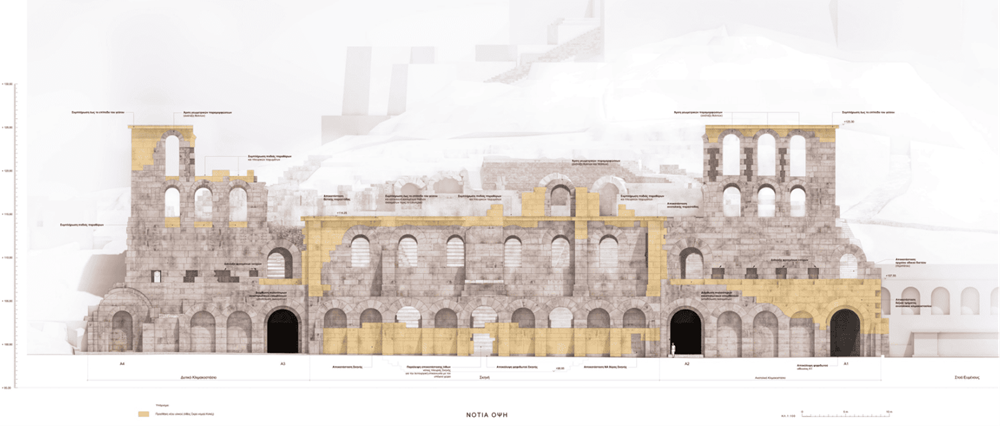
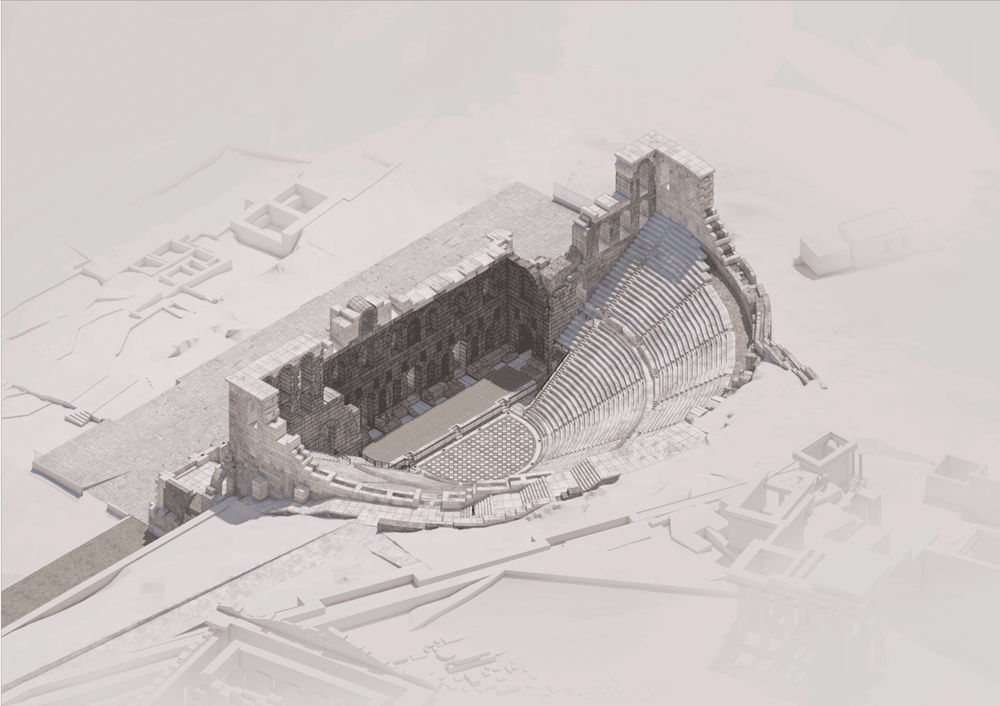
The preparation of interdisciplinary studies for the protection and promotion of the Odeon of Herodes Atticus, on the southern slope of the Acropolis, was the subject of a research project commissioned by the Directorate for the Restoration of Ancient Monuments of the Ministry of Culture to the National Technical University of Athens in July 2025. The Ministry of Culture’s goal is to completely restore the monumental complex of the Odeon of Herodes Atticus and upgrade its operating infrastructure so that it blends harmoniously into the natural landscape and the wider built environment.
The Minister of Culture, Lina Mendoni, stated: “The Odeon of Herodes Atticus is a major cultural asset for the city of Athens, of great historical significance and with supra-local value. These characteristics also govern the framework of studies and any contemporary intervention on it. The proposed interventions are in line with internationally recognized principles for the protection of monuments, as well as the contemporary operation of a monument for viewing and listening. As we have already announced, the maintenance, restoration, and upgrading of the Odeon will take at least three years from the start of the works, during which time the monument will remain closed. Today, the Odeon of Herodes Atticus has structural problems that need to be addressed. It shows signs of deterioration, mainly in the upper arch of the facade, loss of mass and cracking of stones, minor deformations, as well as localised signs of instability. In addition, biodeterioration is observed, caused by the growth of microorganisms in areas where cavities are formed and water accumulates, the development of root systems, mainly in the joints, but also the failure of previous interventions. Our goal is that, upon completion of the works, the monument will be adequately protected against natural and man-made damage, improved in terms of its legibility, and fully upgraded to support the functional requirements of contemporary cultural events, with the Athens Festival being the most prominent of these. In parallel with the restoration and archaeological work, a set of operating regulations for the monument will be drawn up by a team of scientists and artists, which will soon be appointed for this purpose. The regulations will take the form of an institutional text to ensure the high quality of events and maximum protection of the monument.”
The general idea of restoration is based on preserving all existing structural and architectural elements, as well as applying absolutely necessary reinforcements, additions or replacements of lost parts, in order to ensure the long-term protection, stability, solidity, functionality, legibility, and educational value of the monument. The following studies were carried out: Architectural restoration study, structural adequacy study, structural restoration and reconstruction study, architectural study of other interventions (modern interventions in the area of the stage building, infrastructure for the “Hellenic Festival,” renovations to dressing rooms, sanitary facilities, interventions in the square, ticket office, refreshment bar, etc.), structural design of architectural interventions, mechanical study (external water supply and sewerage networks) and acoustic study.
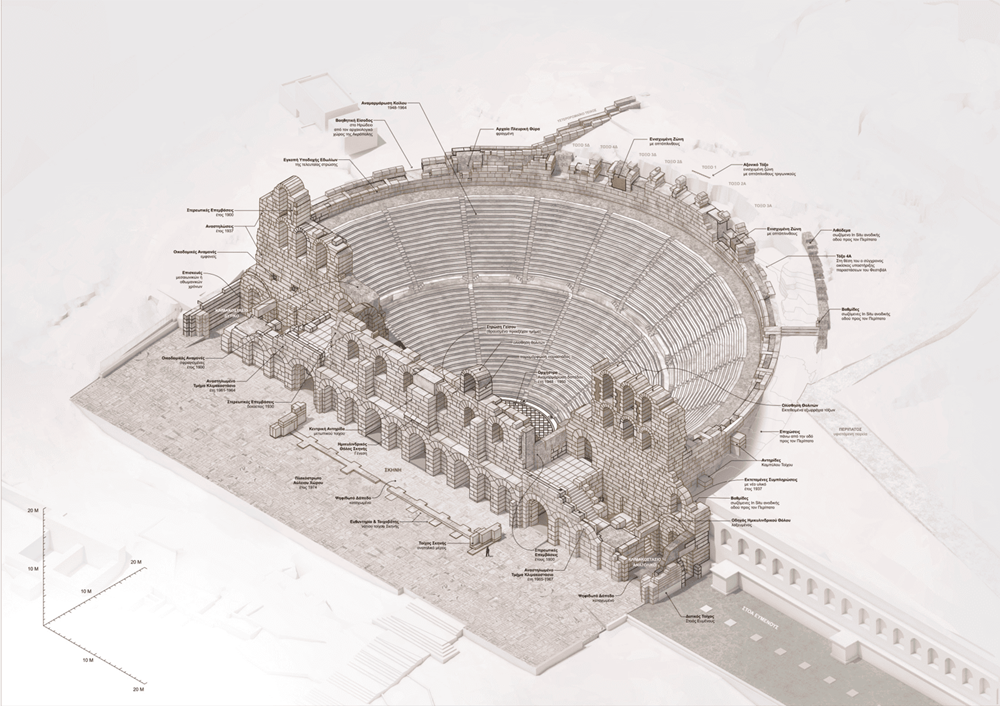
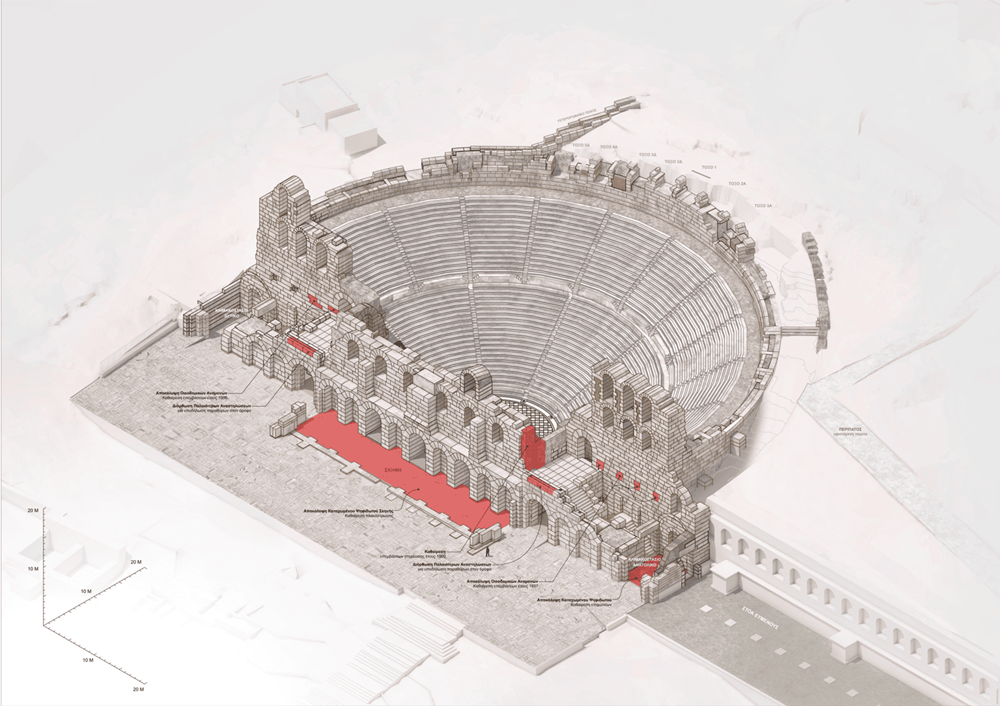
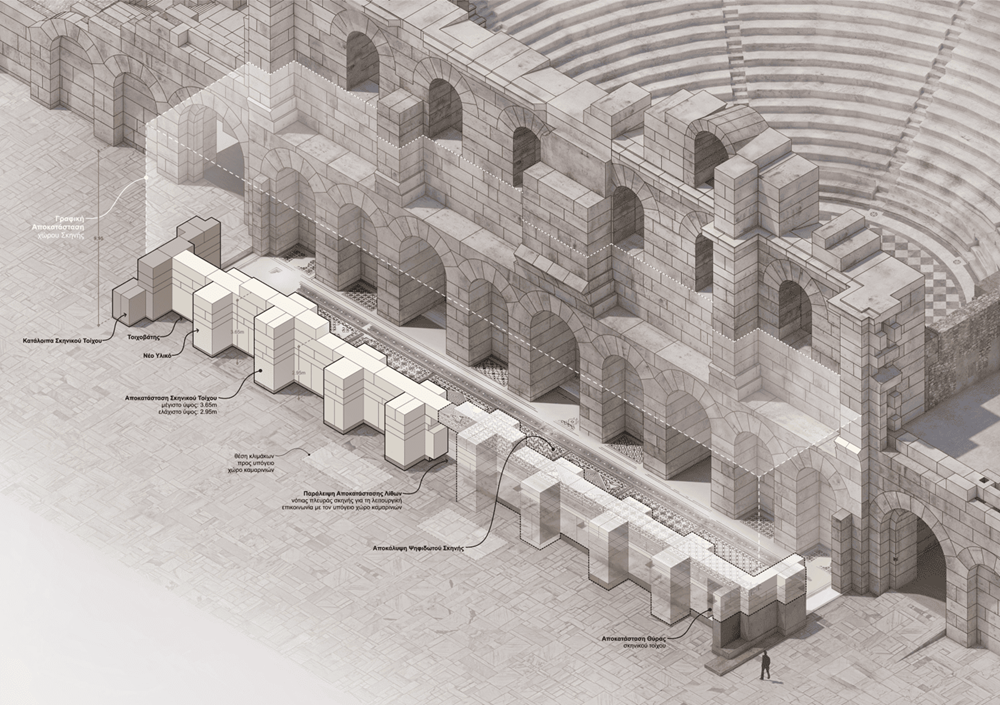
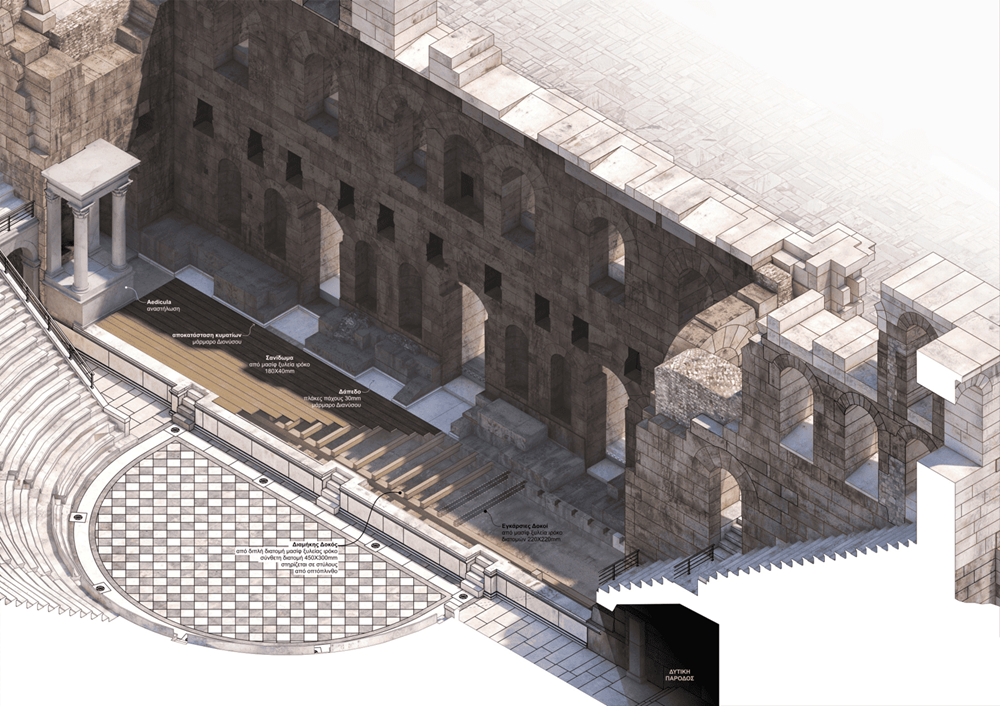
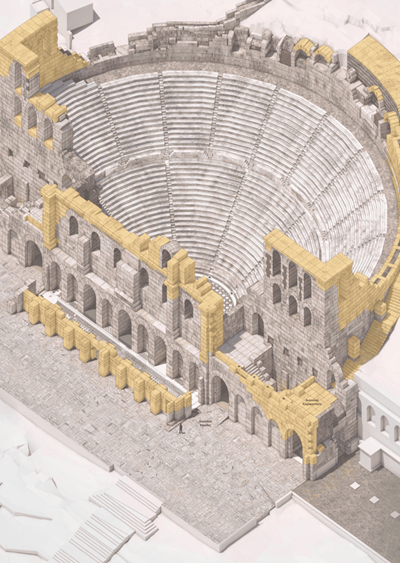
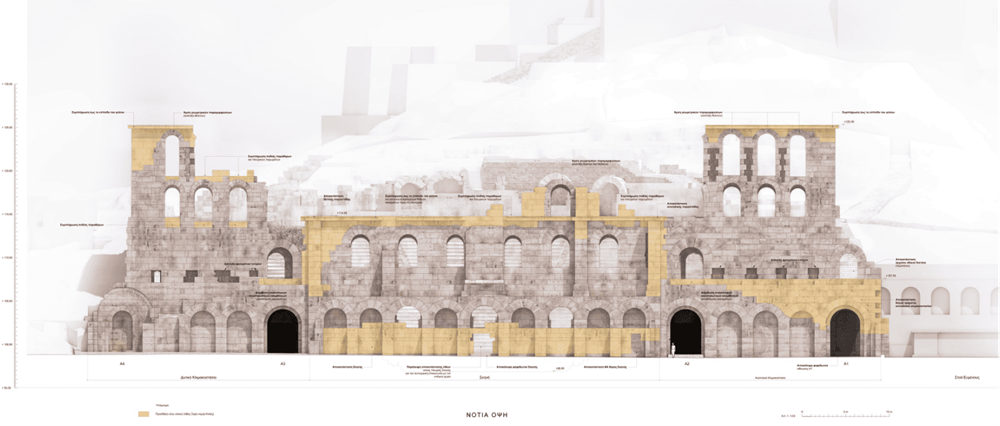
Structural restoration work includes the removal of incompatible newer materials, the fixing and bonding of stones, the replacement of worn elements, the filling of gaps, and the correction of deformations. Restoration work is also planned, including: Restoration of walls and structural elements, restoration of the dome and staircase, restoration of architectural members, fixing and restoration of the south wall of the stage, reconstruction of the logeion and its perimeter wall. In addition, the structural adequacy of the restored parts of the 1950s restorations and their repairs will be checked. Of particular interest is the uncovering and highlighting of the stage building and its mosaic floors, which are currently hidden from view. At the same time, the stress on the monument from sound loads will be studied and assessed. For the monument as a whole and its surrounding area, rainwater drainage is being addressed, the electrical and mechanical networks are being redesigned, and the fire protection of the monument and the upgrading of the drainage system are being studied.
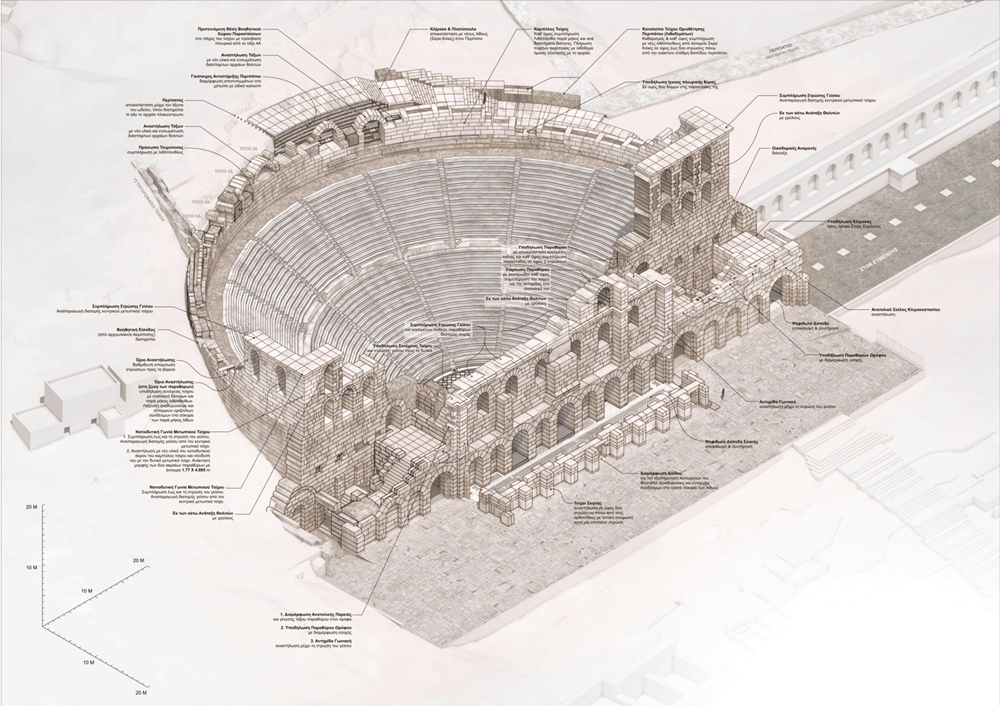
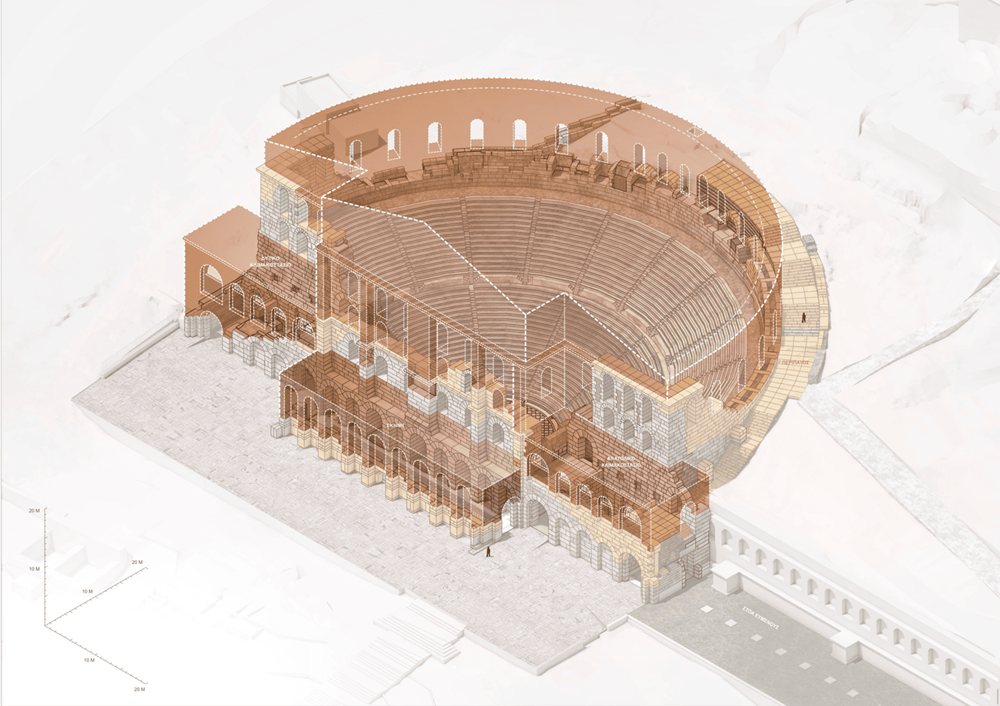
The architectural study focuses on the necessary additions to the stonework and the reconstruction of parts of the monument, with the aim of revealing its architectural structure and restoring its functionality.
The interventions concern:
1. The Stage Hall, where its outline will be restored to a height that will highlight its third dimension, but also serve the installation of temporary structures for the operation of performances.
- In the foreground (proscenium), in order to make the space safe and accessible, and its form clear, legible, and educational.
- On the arches of the passageways.
- On the central front wall, where additions are proposed to protect the wall, as well as to unify and restore the fragmentary surviving elements of the façade.
- On the east and west front walls.
- On the east staircase, where the restoration work aims to restore movement from the Herodion and the Stoa of Eumenes to the ascending road towards the Peripatos.
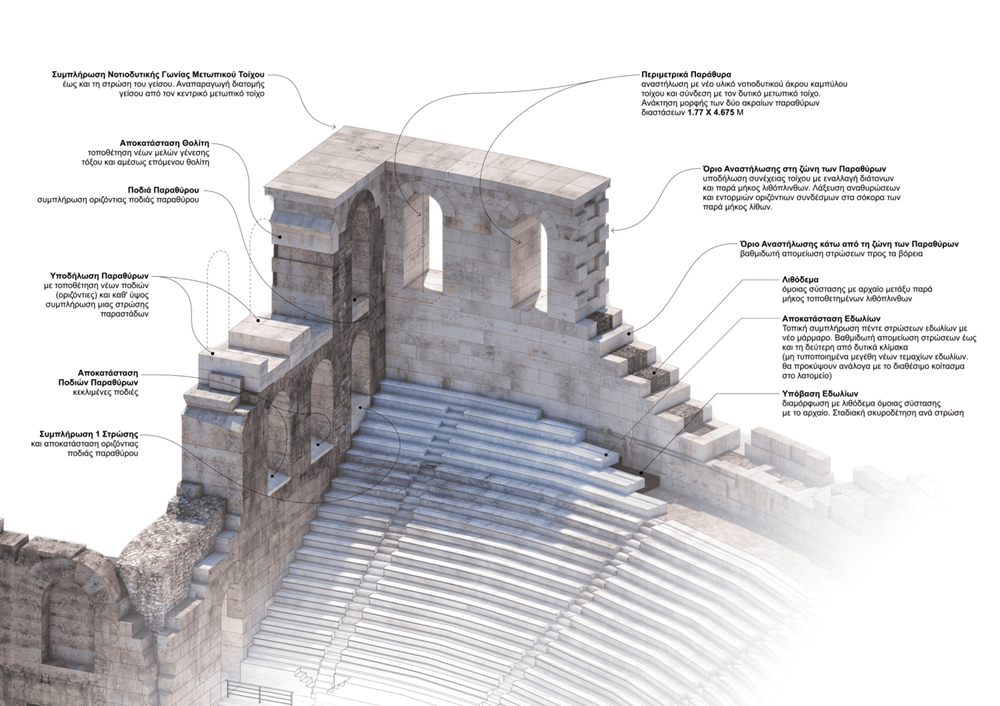
- On the curved wall, to restore the original outline and, in general, the geometry of the monument, highlighting authentic elements of its architecture and structural design, which contribute to the revival of movement along the Peripatos and facilitate the functioning of events.
- In the cavea, where the maintenance of the original marble members and the completion of the seats will continue, as these are worn down by public use during performances.
- The restoration of the Peripatos aims to relieve the archaeological remains west of the Asklepieion from the damaging passage of visitors.
- The restoration of the eastern staircase and the ascending road to the Peripatos restores the original functional connection between the Herodion and the Stoa of Eumeneus.
The architectural interventions in the courtyard and the park area surrounding the Odeon aim to free the square from ancillary uses and improve its functionality and aesthetics. This includes the extension of the courtyard with the creation of a raised platform and an underlying covered area for a refreshment bar, ticket offices, and electrical and mechanical installations. It also includes the reconstruction of sanitary facilities at the western end, the redesign of the Herodion’s side streets, and the creation of new stone structures and covered spaces within the park to support events. The study focuses on the coexistence of functionality, aesthetics, and respect for the monument and the natural environment, with reversible interventions and discreet integration of mechanical installations.
The studies also include the installation of a new, self-contained, semi-circular lighting and support structure, replacing the existing scaffolding, combining aesthetic harmony with the monument and rational lighting organization. At the same time, a complete upgrade of the water supply infrastructure and connection to the dressing rooms and sanitary facilities of the Odeon is planned, while the external drainage network will be completely rebuilt. The acoustic study examines the extent to which the south wall of the Odeon of Herodes Atticus is affected by the natural and amplified sound of events. Due to the lack of established methodologies and commonly accepted safety limits for the “acoustic” behavior of the space, an original, customized research methodology was developed and applied for the objective and reproducible assessment of the effects.


Leave A Comment