
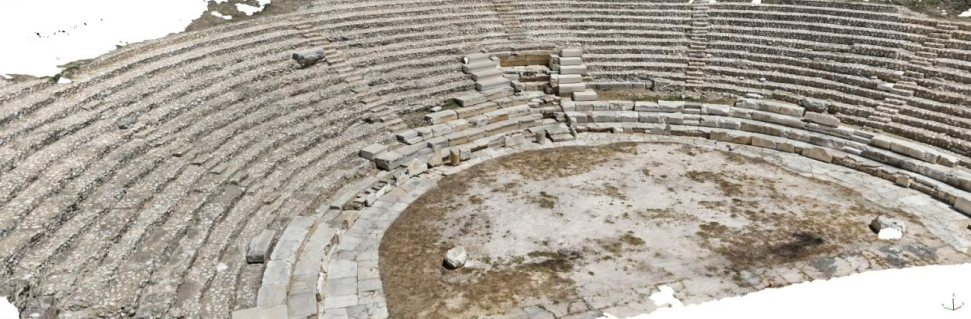
The Ministry of Culture is proceeding with the restoration of the lower cavea of the Great Theater of Ancient Nicopolis, following the completion of the restoration study for this part of the monument. The intervention forms part of the third phase of the project for the protection, conservation, and restoration of the Great Theater. This phase involves the procurement and installation of limestone seats in the lower cavea and marble slabs for the orchestra floor. The project is funded by the Regional Operational Programme “Epirus 2021–2027” and continues the works completed during the second phase of the project, which was funded by the Regional Operational Programme “Epirus 2014–2020.”
Specifically, during the second phase of the project, the cast structural supports for the seats and stairways were consolidated and completed; surviving stone seats were repositioned and conserved; fractures were repaired and areas of deterioration were supplemented; part of the passageway at the base of the cavea was restored through the repositioning of paving slabs and the reconstruction of the parapet; and, on a pilot basis, 16 new limestone seat supports were installed. These interventions, which were primarily remedial in nature, contributed to preserving the surviving architectural members and structural supports.
The third phase of the project provides for the completion of the surviving seating, so that each wedge-shaped section—or kerkís—will comprise five rows in total. The construction and installation of 167 new seat supports is planned, together with the reconstruction of the corresponding steps of the stairways. The new elements will be made of compatible limestone and installed using reversible techniques, in accordance with the principles of monument conservation. They will be distinguishable from the original material while remaining fully compatible with it. The installation will be carried out with due respect for the surviving elements. Where necessary, minor rearrangements of the existing seat supports and discreet supplementary additions will be undertaken to ensure structural and aesthetic continuity. These interventions, which will be implemented with all the necessary measures to protect the monument, will improve the legibility of the theater’s original form, highlight the functional relationship between the orchestra and the cavea, and provide visitors with safer conditions for movement.
The Great Theater of Ancient Nicopolis is one of the most iconic monuments of the Roman city. In the second century AD, the theater underwent extensive reconstruction. The lower cavea was rebuilt over the remains of the original phase, acquiring a steeper gradient and a raised passageway leading toward the orchestra. Its semicircular cavea featured stone seats, a perimeter passageway, a portico, and a shading system. The theater’s initial construction dates to the Augustan period, while its later reconstruction reflects the monument’s development during the subsequent Roman era. Most of the stone seats were removed in later periods and reused as building material or for the production of lime. As a result, only limited sections of the first rows of the lower cavea survive today. This is evidenced by the presence of three lime kilns, which had already been recorded in the early nineteenth century by the British architect Thomas Leverton Donaldson. Today, only parts of the first three rows of the lower cavea survive, along with one seat support in the eleventh row and scattered fallen seats.
Nicopolis was founded by Octavian Augustus following his victory at the Battle of Actium (31 BC) over Mark Antony and Cleopatra VII. It developed into an important administrative, commercial, and military center, with a population drawn from Epirus, Aetolia-Acarnania, Lefkada, and Roman settlers.From the third century AD onward, the city began to decline as a result of the crisis of the Roman Empire and barbarian raids. Under Diocletian, however, it was designated the capital of the province of Epirus Vetus. In the mid-sixth century, Justinian I renovated its walls as part of his programme for fortifying cities.The spread of Christianity marked a significant turning point in the history of Nicopolis. The Apostle Paul preached in the city in AD 62–63. From the fifth century onward, Nicopolis developed into a powerful ecclesiastical center, with a metropolitan see under the jurisdiction of the Patriarchate of Rome until AD 732/733.


Leave A Comment