The exhibition For Our Time is the Time of Water does not offer answers, but poses a crucial question: who does water belong to? How can we rethink our collective responsibility towards the water systems that sustain life before they become permanently invisible? In an era of extreme floods, prolonged droughts, the “silent crisis” of the seas, and increasing conflicts over natural resources, the exhibition For Our Time is the Time of Water at TAVROS draws attention to water as a fundamental condition of life, memory, and politics. Through works by international artists, the exhibition examines how water is sometimes absent and sometimes overflowing, how it is controlled, privatized, or destroyed, but also how it remains a vehicle of knowledge, resistance, and collective responsibility. Water is not presented here as a natural given, but as a common good in crisis, and as an urgent call to rethink our relationship with it.
Opening: 5 March 2026, 19:00-22:00
Duration: 6 March 2026 – 27 June 2026
Opening Hours: Wednesday-Thursday-Friday 16.00-20.00, Saturdays 12:00-17:00
Address: TAVROS, 1st floor, Anaxagora 33, 177 78 Athens, Tavros
Accessibility:The venue is accessible by elevator, and there is parking at the entrance of the building.
Admission is free
At a time when floods, droughts, and rising sea levels are now an everyday experience, For Our Time is the Time of Water at TAVROS brings water to the forefront as an issue of life, politics, and collective responsibility. The exhibition brings together works by international artists and research collectives that examine water bodies as common goods in crisis: resources that sometimes dry up and sometimes overflow, that are controlled, exploited, and privatized, but remain carriers of memory, knowledge, and resistance.
The hydrological cycle (water, rain, evaporation, and natural water systems: rivers, lakes, seas, and oceans), as well as drought and desertification, are all interconnected, reminding us that we live in an “Ocean of Wetness” (a term borrowed from landscape architect Dilip da Cunha), where what happens in one place affects everything, from cities to the sea and beyond. A complex system of balances that is now clearly out of control, reminding us that what happens in one place affects everything else, from the city to the sea and beyond. From Athens and the Attica Sea to Central Asia, Iraq, and the Indus River delta, the works in the exhibition map the consequences of human interventions in water systems (river diversions, drainage, infrastructure, and mining) and their impact on communities and landscapes. At the same time, the exhibition proposes other ways of thinking about our relationship with water, not as something to be controlled, but as something with which we coexist.
In the project Taming Waters and Women (2024) by the DAVRA research collective (Saodat Ismailova, Madina Joldybek, Zumrad Mirzalieva), we return to the period of Soviet hegemony in Central Asia, linking water control to natural resource extraction and women’s labor. Jumana Manna, in her sculptural work Water Arms (2019), uses ceramic elements that refer to fragmented irrigation systems, commenting on failed infrastructure and forms of water control.
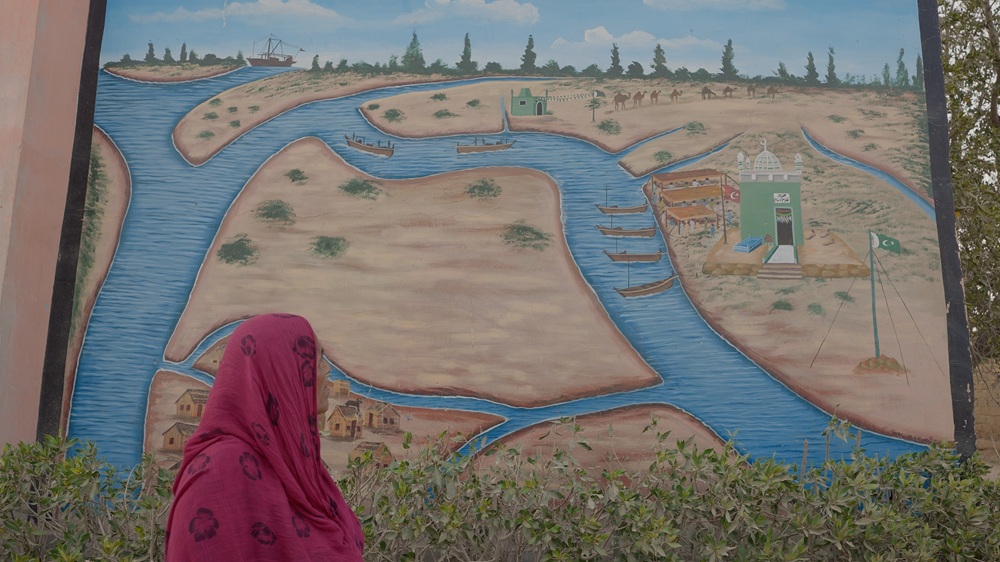
In the film Chibayish (2022), Alia Farid focuses on the marshes of southern Iraq, documenting the daily lives of communities experiencing the effects of state intervention, war, and climate change. Shahana Rajani, in Four Acts of Recovery (2025), works with communities in the Indus River delta, inviting the audience to participate in a process of memory recall and imaginary reconnection with lost water landscapes.
Daphne Lianantonaki’s walking practice (Beyond the Mountain, 2023–26) focuses on the rivers and mountains around Athens, highlighting the coexistence of humans and aquatic ecosystems. In Stranded (2021), Rossella Biscotti presents glass forms shaped by time and the tides, treating the coastline as a fragile archive of environmental and industrial memory. The exhibition concludes with Ayesha Hameed’s cinematic letter Ilemuria (2023), a poetic work about water as an existential and collective condition.
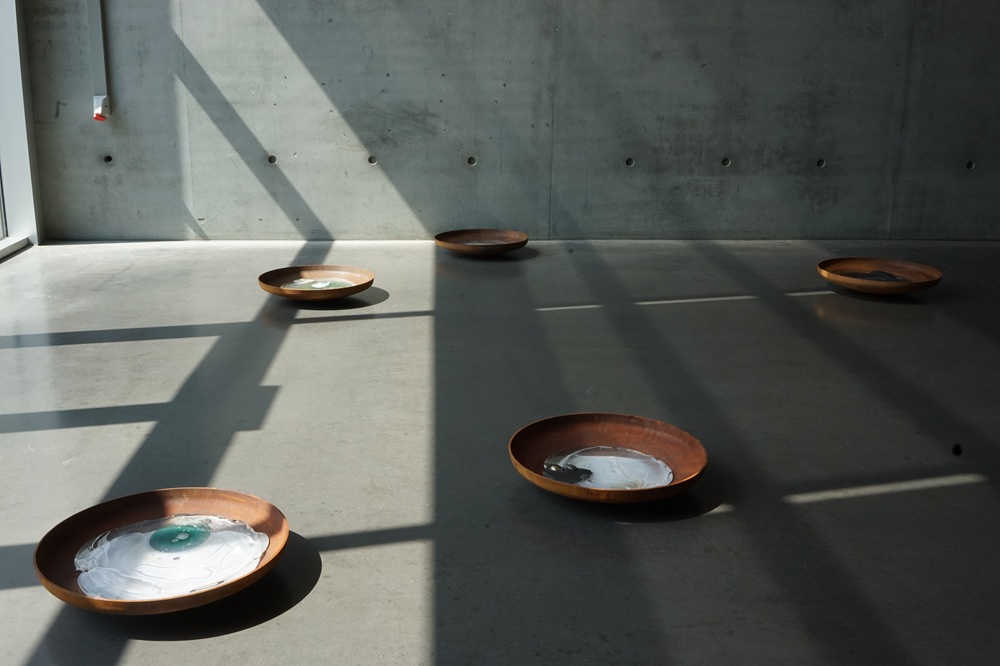
Rosella Biscoti, Stranded, 2021. Series of glass sculptures placed inside rusted metal bowls. Variable dimensions. Courtesy of the artist and mor charpentie gallery.
The exhibition also features Eleni Papaskrianou’s illustrated map Athens – Polis Ydatini, which makes the city’s invisible water networks visible and is aimed at children and families. At the same time, Navine G. Dossos’ Horizon (2026) transfers the image of the sea horizon onto fabrics and work clothes, connecting water with everyday life and spreading art beyond the exhibition space.
For Our Time is the Time of Water invites the public to reflect on their relationship with water by asking a simple but crucial question: how can we live with it and not against it?
Short Bios
Rossella Biscotti (born 1978, Molfetta, Italy) lives and works between Brussels and Rotterdam. In her multimedia practice, which spans film, performance, and sculpture, she uses montage to highlight individual narratives and their relationship to society. She reconstructs recent socio-political moments through subjective experiences, creating informal stories on the margins of mainstream discourse. She often weaves conflicting testimonies into new visual narratives, connecting past and present. She studied in Naples and at the Rijksakademie in Amsterdam and has participated in major international events such as documenta 13 and the Venice Biennale. She has been honored with important international contemporary art awards.
Alia Farid (born 1985) lives and works in Kuwait and Puerto Rico. She is a graduate of La Escuela de Artes Plásticas de Puerto Rico and holds an MSc from MIT and an MA from MACBA in Barcelona. In 2023, she was honored with the Lise Wilhelmsen Art Award and served as a David and Roberta Logie Fellow at the Harvard Radcliffe Institute (2023–24). She has presented solo exhibitions at major institutions such as Kunsthalle Basel, Portikus, Chisenhale Gallery, and Contemporary Art Museum St. Louis, and has participated in international events including the Whitney Biennial, the São Paulo Biennial, and the Gwangju Biennale.
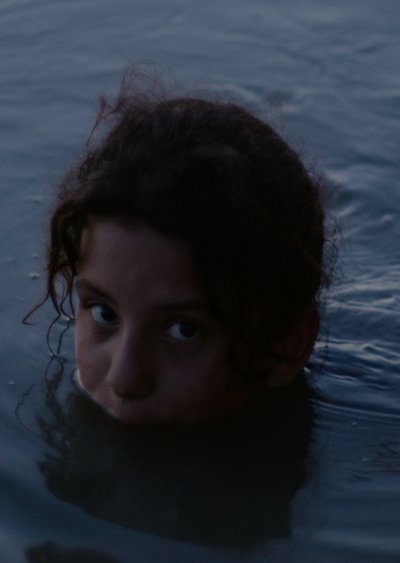
Alia Farid, Chibayish, 2023 (still), UHD video, color, with sound, 15’03” Production: The Vega Foundation and Doha Film Institute. Filmed in the southern marshlands of Iraq with Riad and Farima Bahrani. Courtesy of the artist and Sfeir-Semler Gallery, Beirut/Hamburg
Ayesha Hameed (London, UK) explores the legacies of indentureship and slavery through the forms of the Atlantic and Indian Oceans. Her Afrofuturist approach combines performance, sound essays, video, lectures, and poetry. She teaches in the MFA in Art program at Goldsmiths, University of London, and is Professor of Artistic Research at Uniarts Helsinki. She was a Research Fellow of the Kone Foundation from 2022 to 2026 and recently served as Artist in Residence at the Camden Arts Centre.
Daphne Lianantonaki was born in Athens and grew up in Agia Paraskevi. She studied painting at the Athens School of Fine Arts and graduated in 1986. In the same year, she organized the Children’s Art Workshop in the municipality of Agia Paraskevi, which she was responsible for until 2001: to this day, one of the main pillars of her practice relates to understanding and framing children’s creativity. Her personal work focuses on exploring and attempting to articulate her relationship with the geography of landscapes (Legrena 2008, Rematia Halandriou 2014-2024, Kimolos 2016-2017, Erasinos River 2022-2025, Mesogeia from 2023-present).
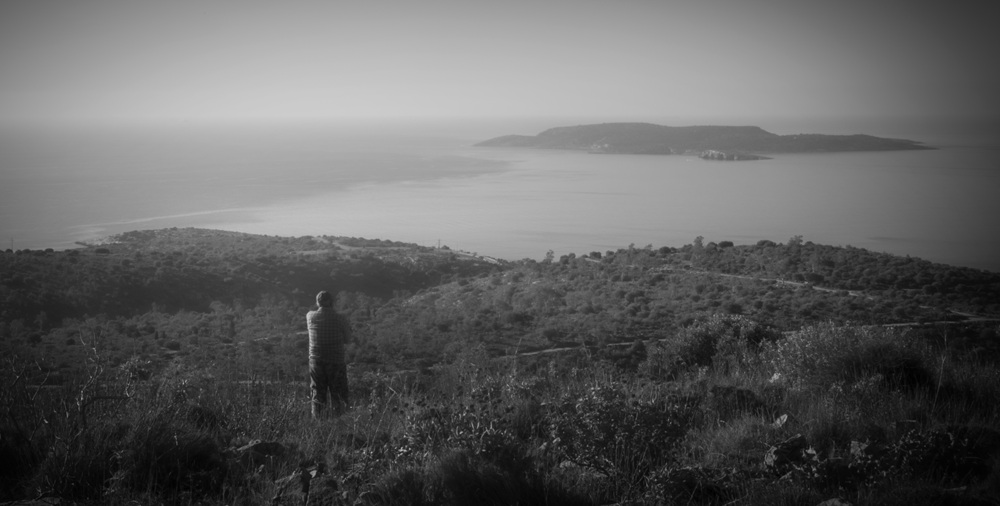
Daphne Lianantonaki,
Behind the Mountain. Digital prints on paper
Sheet metal
dimensions 2.32 m x 42 cm, 2023-2025 (in progress)
Jumana Manna (born 1987) is a Palestinian visual artist and filmmaker who lives and works between Jerusalem and Berlin. Her work examines how power is inscribed in the body, land, and matter, in relation to colonial legacies and histories of place. Through sculpture and film, she explores the paradoxes of preservation in architecture, agriculture, and law, highlighting the tension between modernist classification and the living process of decay and regeneration. He has held solo exhibitions at major institutions such as MoMA PS1 (New York), Wexner Center for the Arts (Columbus), Kunsthall Stavanger, Matadero (Madrid), M HKA (Antwerp), Malmö Kunsthall, among others, and has participated in international events such as the Venice Biennale, Manifesta 14, and the Liverpool Biennial. In 2025, she completed the public work Sebastia for the New Government Complex in Oslo, designed in 2022 for the open “city floor” space in Johann Nygaardsvoll plass, one of the largest public art spaces in Norway. She has been honored with international awards and her works belong to important collections, such as those of MoMA and the Whitney Museum.
Shahana Rajani is an artist who explores the visual cultures, landscapes, and infrastructures of “development,” militarization, and ecological resistance in Pakistan. Community-based and collaborative forms of research are at the heart of her practice. Through moving images, installations, and print materials, she activates counter-narratives, genealogies, and practices of representation and relation. She is co-founder of Karachi LaJamia (with Zahra Malkani), an experimental project focusing on eco-pedagogical approaches to land and water struggles in Karachi. She lives and works in Tkaronto (Canada). She recently presented the exhibition Lines That World a River at Nottingham Contemporary (February 7–May 10, 2026), in collaboration with Ustad Abdul Aziz, Abdul Sattar, and Aziza Ahmad.
The DAVRA research collective was founded in 2021 with the mission of connecting and developing the Central Asian art scene, prioritizing the dynamic exchange of knowledge and experiences within the region. It focuses on studying and redefining contemporary Central Asia through public programs, research, commissions, and other activities. DAVRA presented a public event as part of Saodat Ismailova’s participation in documenta fifteen and published the book Chilltans, which highlights contemporary voices from Central Asia. It has produced two experimental films, Tashkent: 58–88 by Zumrad Mirzalieva and Whose Voice Is It? by Dana Iskakova. The collective installation Taming Waters and Women of Soviet Central Asia was presented at the Matter of Art Biennale in Prague in 2024 and subsequently at the Lahore Biennale and elsewhere. She has curated film programs at the Eye Film Museum, the Centre Pompidou, the GoEast Film Festival, and elsewhere. She emphasizes educational programs and workshops in Central Asia, and currently focuses on water issues through research, publications, workshops, and new commissions.
Maria-Thalia Karra is a curator, director of the TAVROS space, and writer based in Athens, a graduate of Cambridge University and the Courtauld Institute. In 2005, she co-founded the non-profit organization locus athens, which has organized more than 50 exhibitions and public projects with an emphasis on new productions in urban spaces. In 2019, she founded the TAVROS space, developing international collaborations and programs with a social and political orientation. In 2023, she curated the main exhibition of the 8th Thessaloniki Biennale (Being as Communion). Her work focuses on the politics of public space, ecology, and cross-disciplinary artistic collaborations.
Mayssa Fattouh is an independent curator, artist, and writer based in Barcelona. She has collaborated with numerous institutions across Europe and the Middle East, both in the public and private spheres, undertaking and developing a range of projects that focus on pressing environmental and social issues. She is co-founder of the public art organisation Tandem Works and the improvisational music platform Pristine Folds, and most recently served as Director of the Ab-Anbar Gallery in London.
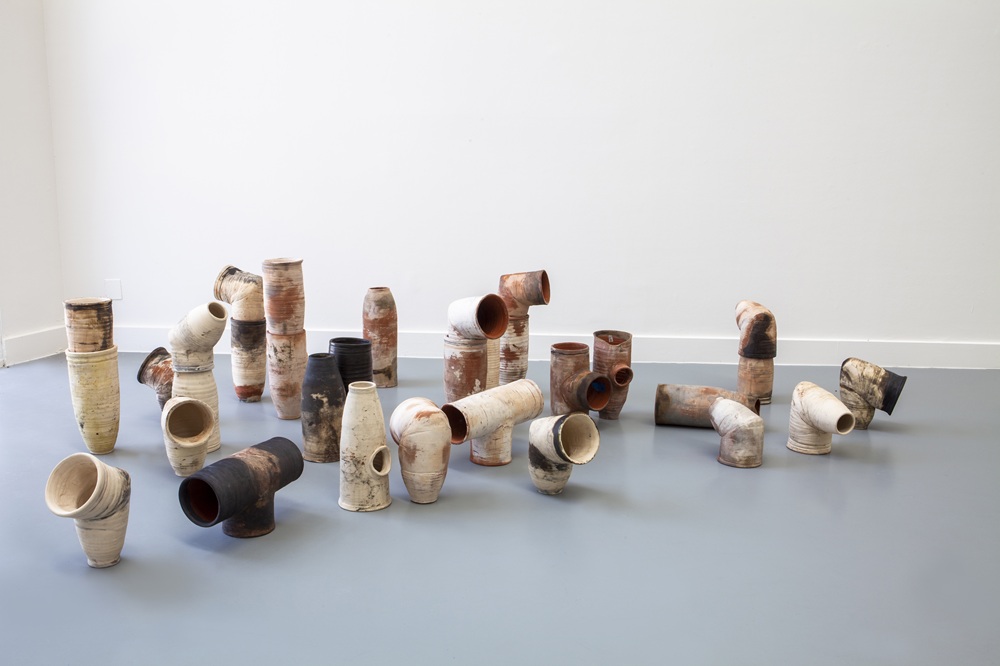
Jumana Manna,
Water-Arm Series, 2019, ceramics © Jumana Manna.
Courtesy of the artist and
Hollybush Gardens Gallery, London Photo: © We Document Art
The Artists and Crew
Female Artists: Daphne Lianantonaki, Rosella Biscotti, Alia Farid, Ayesha Hameed, Jumana Manna, Shahana Rajani, DAVRA research collective
Curators: Maria-Thalia Κarra, Mayssa Fattouh
Architectural Design: Εvita Fanou
Production manager: Danae Parlama Pertejo
Production Assistant: Sotiris Vougiatzis

Leave A Comment