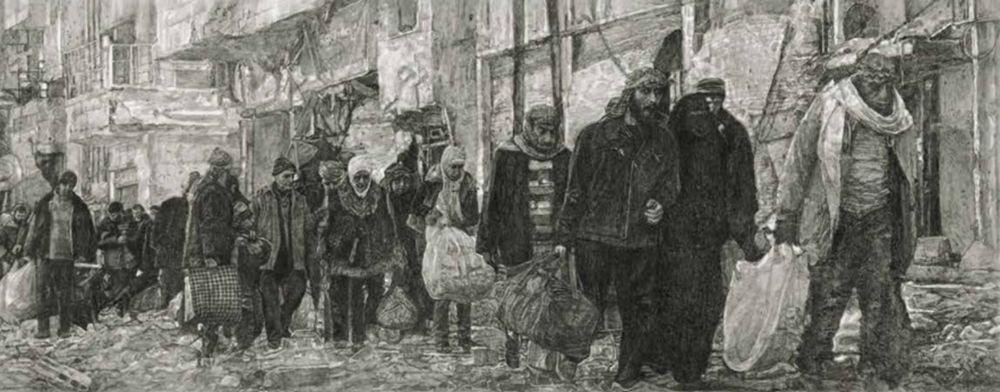
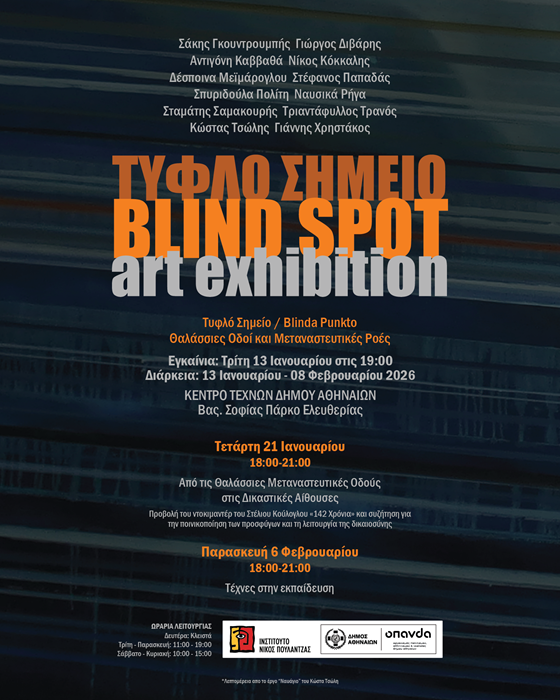
The Nikos Poulantzas Institute presents the exhibition by a group of artists entitled “Blind Spot: Sea Routes and Migrant Flows” at the Athens Municipal Arts Center, from January 13 to February 8, 2026.
The exhibition is a record and a call for social justice through art, with a central theme of migration, the sea routes that migrants are forced to take in order to survive, and the deterrence policies that weaken democracy.
The exhibition opens its doors with an official opening on Tuesday, January 13, at 7:00 p.m.
THE THEME OF THE EXHIBITION
The exhibition focuses on the sinking of the Adriana (June 14, 2023) off the coast of Pylos, one of the deadliest shipwrecks in recent history, which occurred within the Greek search and rescue (SAR) zone in the Mediterranean. The boat, which was carrying hundreds of migrants bound for Italy, sank in the Oinousses Trench—the deepest point in the Mediterranean—forming a natural and symbolic “blind spot.”
According to Maria Repousi, historian and director of the Nikos Poulantzas Institute, the art presented in the exhibition is not neutral. On the contrary, it functions as a field where the mechanisms of power become visible, where invisible lives are highlighted, and where the universality of rights is asserted. It is a form of resistance against the normalization of violence that characterizes the political practices of many European governments, with the Greek government at the forefront.
THE ART GROUP
The Group was formed as an open field of visual and theoretical research, with artists Sakis Gkountroumpis, Nikos Kokkalis, Triantafyllos Tranos, and Yannis Christakos at its core. Four creators with distinct but converging paths, who come together around their interest in exploring the relationship between art, education, thought, and social intervention. This collective venture, now in its third year, functions as a laboratory of ideas and actions. Each exhibition or project of the group constitutes a new chapter of research: a meeting point where visual practices and theoretical readings coexist, converse with each other, and transform into a new body. Depending on the theme of the exhibitions, artists whose work essentially dialogues with the respective research direction are invited, broadening the dialogue and enriching the dynamics of the whole. The group’s journey includes exhibitions such as: “Under the Iron Sky” at To Pikap Kato, Thessaloniki (2024), “Under the Heavy Sky” at the old elementary school of Kardamyli (2024), “Dark Mirror” at Back to Athens, Athens (2025), and “Warning Signs” at PAr Co By the river, Larissa (2025).
Participants / Artists
The exhibition brings together works by a group of artists whose practice essentially engages with its central themes:
> Sakis Gkountroumpis (visual artist, public education teacher)
> Giorgos Divaris and Nafsika Riga (visual artists)
> Antigone Kavvatha (visual artist)
> Nikos Kokkalis (lecturer in the Department of Audio and Visual Arts, Ionian University) and Stefanos Papadas
> Despoina Meimaroglou (visual artist)
> Spyridoula Politi (visual artist)
> Stamatis Samakouris (visual artist)
> Triantafyllos Tranos (visual artist, lecturer at the Department of Visual and Applied Arts, Aristotle University of Thessaloniki)
> Kostas Tsolis (visual artist)
> Giannis Christakos (visual artist, associate professor, National and Kapodistrian University of Athens)
Their works—paintings, sculptures, installations, video art, and mixed media—form a network of visual ethnography and critical reflection. They constitute a “redistribution of the sensible,” to borrow the phrase coined by theorist Jacques Rancière: they transform the field of the visible and the audible, allowing new political and ethical relationships to become intelligible.
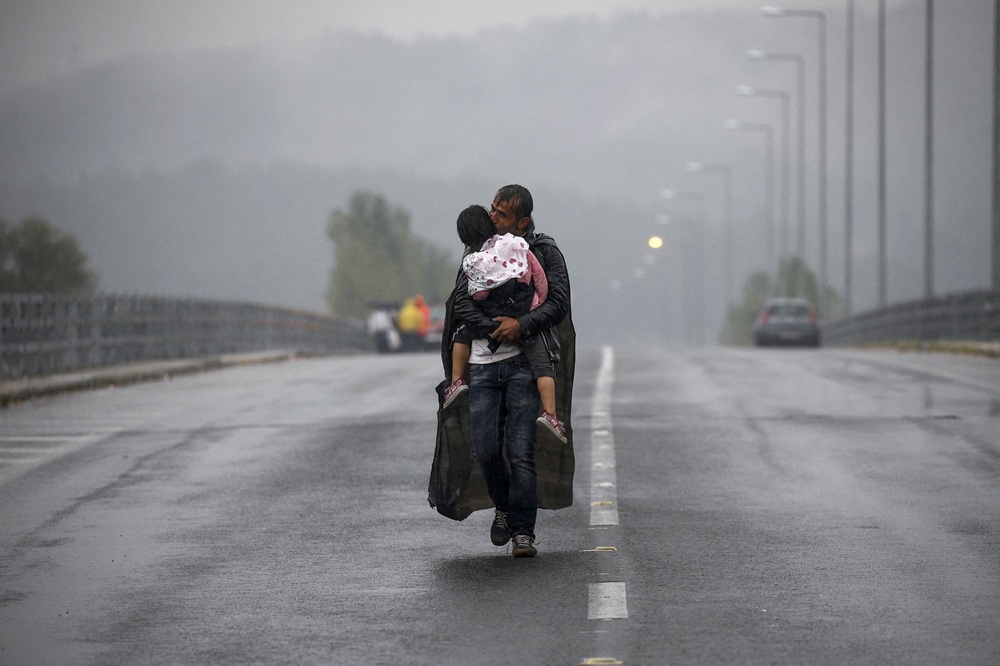
The exhibition will also feature Yannis Behrakis’ Pulitzer Prize-winning photograph from 2016, which depicts a Syrian refugee kissing his daughter as they walk through a storm toward the Greek border with North Macedonia, near Idomeni. Until now, the photograph has been housed at the Stavros Niarchos Foundation Cultural Center.
PARALLEL EVENTS:
Wednesday, January 21, 6:00-9:00 p.m.
“From Sea Migration Routes to Courtrooms”
Screening of Stelios Kouloglou’s documentary “142 Years” and discussion on the criminalization of refugee flows and the criminal prosecution of refugees.
Friday, February 6, 6:00-9:00 p.m.
“Arts in Education”
Discussion on the crucial role of art in shaping critical education and renewing schools and teaching subjects.
THE SYMBOLISM OF THE VENUE
The choice of the Athens Municipal Arts Center is not accidental. The space is located in an area with strong symbolism, adjacent to the monumental site of the old detention centers of the EAT-ESA Headquarters—a space that bears the memory of the overthrow of the democratic regime and the resistance to the dictatorship. The exhibition thus places itself in historical continuity with those who resisted authoritarianism, many of whom were artists and intellectuals.
THE MISSION OF THE NIKOS POULANZAS INSTITUTE
For the Nikos Poulantzas Institute, the exhibition is not merely a cultural undertaking. It is part of the Institute’s broader commitment to contribute to a public discourse that opposes authoritarianism, defends rights, and promotes democratic internationalism. It is an intervention against policies that are turning the Mediterranean into a space of repression and death, and a reminder that the struggle for justice and human rights begins with the recognition of these crimes.
INFORMATION
Dates: 13 January– 8 February 2026
Venue: Athens Municipal Arts Center, Eleftherias Park (Vas. Sofias, Athens)
Opening Night: Tuesday, 13 January, 19:00
Opening hours:
> Mondays: closed
> Tuesday- Friday: 11:00 – 19:00
> Saturday- Sunday: 10:00 – 15:00
Exhibition curators: Sakis Gkountroumpis, Giannis Christakos
Co-organized by: The Nikos Poulantzas Institute, Visual Arts Group


Leave A Comment