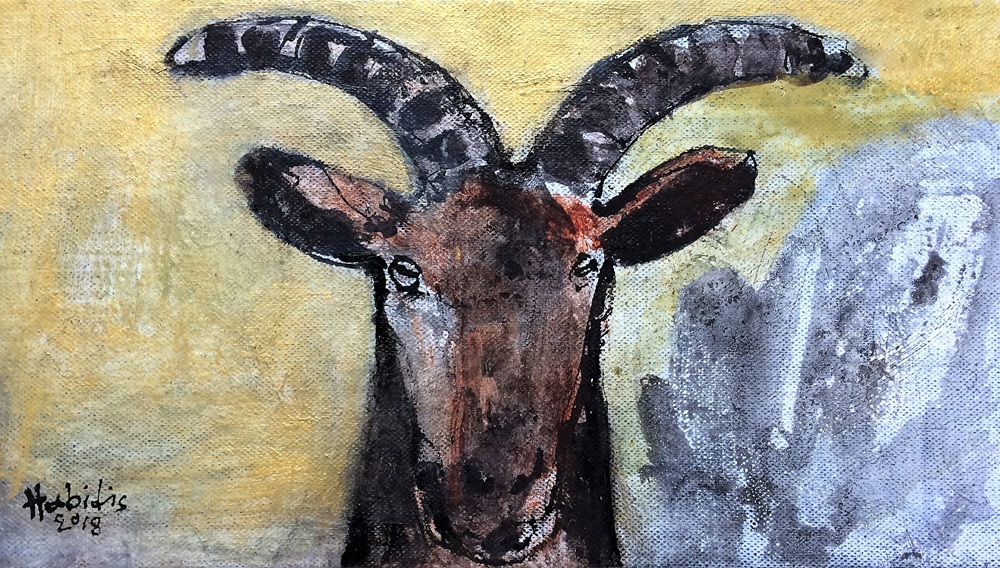
One knows a work of art is good not only when one sees it, but also when one hears it. Pavlos Hambidis’s goats make a racket! They munch and bleat. They run proudly, climb, and jump while you hear their bells ringing!
Goats appear in prehistoric cave paintings in France and southern India, and it seems they have captivated artists for millennia. Chambidis has been painting goats for decades, but some of them (mainly in his smaller works) have recently reached a new level. They have gradually become more and more lifelike, and at the same time more delightful and endearing. From simple goat-like figures, they have become distinct beings. Their characters are stronger than ever before. Connoisseurs of the genre can distinguish not only their gender and species, but also their breed. The contrast in the rendering of the animal’s form and that of the human is more pronounced than ever before (we are by no means looking at a specific face or portrait), which is why it is surprising that they “blend” together on the same canvas with such harmony.
Goats—which were among the first domesticated animals on Earth—coexist peacefully with humans and are an integral part of our collective consciousness. We have coexisted for about 10,000 years. It is evident that a work from the Archaic period, one of the most powerful and remarkable ancient Greek sculptures, the Moschophoros, has inspired Hambidis. As a result, the tenderness and immediacy of the work—depicting the young man carrying the goat on his shoulders—are just as familiar—especially to Greeks—as they are original.
There is something magical, almost unsettling, about the horizontal pupils in goats’ eyes, and because their irises are pale, we can see them more clearly than those of other animals. Some of the works capture this uniqueness perfectly. That’s why I love them all. From the one with the goat being carried on the shoulders to the small one with the goat bleating with its head and upper lip raised.
Wonderful goats by a wonderful Hambidis.
Clark Lawrence
Art Historian, Curator of the Reading Retreat in Rural Italy



Leave A Comment