
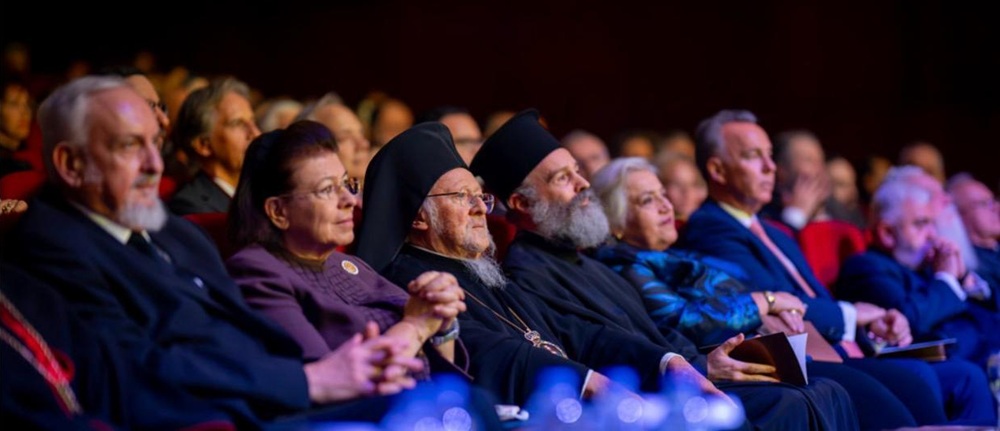
The 35th anniversary of the blessed ministry of His All-Holiness Bartholomew in the Holy and Great Church of Christ in Constantinople was celebrated at the Fener not only with the appropriate ecclesiastical splendor, but also provided an occasion for people of all ages to express their love for the Ecumenical Patriarch and their unwavering faith in the Orthodox Christian Tradition.
The Ecumenical Patriarchate of Constantinople, first in rank among the ancient churches, is a living repository of memory, faith, and culture. Beyond its spiritual, pastoral, and ecclesiastical role, it has historically been one of the most important institutions for the preservation and transmission of the cultural tradition of Hellenism. The Great Church of Constantinople is the ecclesiastical institution that has survived for seventeen centuries, linking Ancient Greece, Byzantium, and modern Greece across the vast span of Hellenic history.
“The significance of today’s anniversary,” noted Minister of Culture Lina Mendoni in her speech, “lies not only in the duration of his patriarchal ministry. It lies, above all, in the multifaceted work, the initiatives, and the enduring legacy of Ecumenical Patriarch Bartholomew—a figure who, through his international presence, its prestige, and its influence, the global role of the Ecumenical Patriarchate, while at the same time maintaining his unwavering commitment to the historical tradition and the ecumenical mission of the Mother Church.”
Lina Mendoni, referring to the Ecumenical Patriarch’s immense contribution to raising global awareness about environmental protection, emphasized that “Concern for the protection of the natural environment holds a special place in the Ecumenical Patriarch’s ministry. Long before climate change emerged as one of the greatest challenges of our time, Patriarch Bartholomew placed the protection of creation at the center of public discourse, linking it to humanity’s moral responsibility, social justice, and our duty toward future generations. His international recognition as the “Green Patriarch” reflects the significance of his pioneering approach, which highlighted environmental protection not only as a scientific and political issue, but also as a fundamental moral and spiritual obligation for humanity, as the steward and manager of nature before its Creator. As an unceasing prayer for the sustainability of the planet and the future of humanity.”
Referring to the Patriarchate’s cultural mission, Lina Mendoni stated: “In our churches, monasteries, manuscripts, and relics; in Byzantine art and music; in ecclesiastical literature; and in the language and traditions of our people—a unique synthesis of faith, history, and culture is reflected. A tradition that evolves and renews itself, keeping historical memory and the continuity of generations alive. Hagia Sophia and the Chora Monastery, two of the world’s most significant cultural heritage sites, stand as the most invaluable testaments to the heights of Byzantine art and the great spiritual tradition of Constantinople. “The protection of their authenticity, integrity, historical identity, and—through constant and multifaceted commemoration—their religious character is a duty we owe to the world’s cultural heritage and to future generations.”
It is a fact that His All-Holiness Bartholomew, for thirty-five years—from his election to the Patriarchal throne to the present day—has never forgotten Imbros, the island where he was born. “Imbros,” said the Minister of Culture, “the birthplace of the Ecumenical Patriarch, holds a special place in this long patriarchal journey. A place with deep historical roots and a strong Greek cultural identity, which, despite the trials and tribulations of past decades, has kept its memory and tradition alive. Thanks to the personal interest and constant care of Patriarch Bartholomew, Imbros is now experiencing a new era of hope and renewal, serving as the most striking example of the power of historical memory, as well as of education and culture. It highlights the ability of Hellenism to preserve its roots and identity, even under difficult circumstances, while remaining open to the world, to cooperation, and to peaceful coexistence. It is precisely this synthesis of commitment to tradition and a universal perspective that Patriarch Bartholomew expresses through his work and his personality.”
The emotion felt by the hundreds of attendees and church officials was heightened by the presence of about 100 children who had traveled from Sydney and Melbourne, Australia, to Istanbul. The children presented a well-planned cultural and ecclesiastical program, which was superbly organized by the Archdiocese of Australia, demonstrating the strong roots of Hellenism on the other side of the world, in the Antipodes, through high-quality and spiritually enriching dialogues, songs, and dances.
The splendid celebration, which was deeply moving as it marked the Patriarchate’s last 35 years of operation with reflections on the Patriarch’s life and work, was organized and presented by the youth of the Archdiocese of Australia in the presence of His All-Holiness Bartholomew, Minister of Culture Lina Mendoni as a representative of the Greek Government, Deputy Minister of Foreign Affairs Alexandra Papadopoulou, the Archbishops of Australia, the United States, and Canada, Metropolitans of the Ecumenical Patriarchate and the New Lands, clergy and monks, as well as official Turkish authorities and hundreds of Greeks from the Diaspora, who traveled from three continents— Australia, America, and Europe, to honor the long ministry of their Father and Shepherd.



Leave A Comment