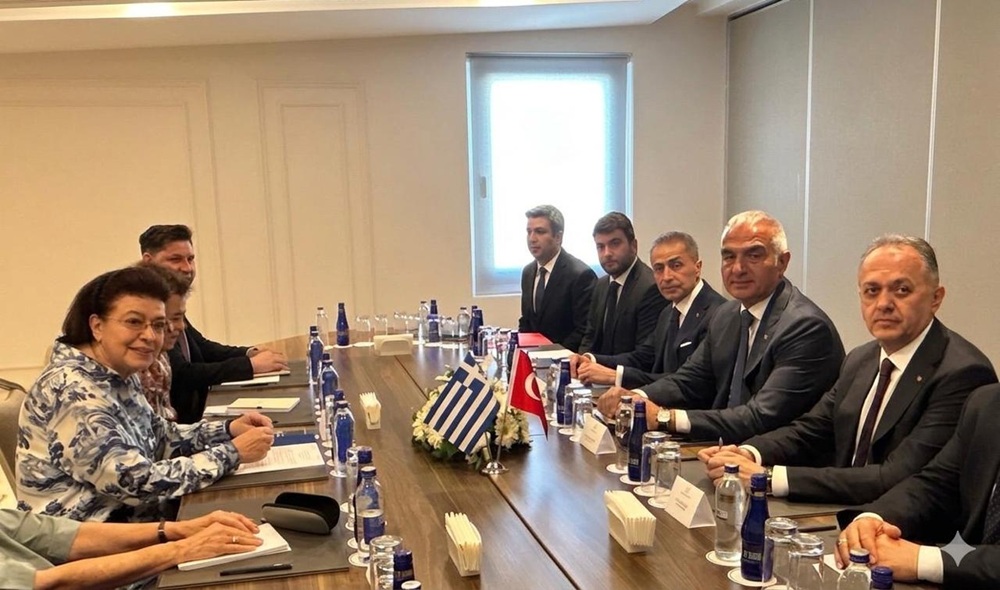
In the presence of Greek Minister of Culture Lina Mendoni and Turkish Minister of Culture and Tourism Mehmet Nuri Ersoy, the 1st Greece-Turkey Cultural Forum , inaugurating a new institutional framework for cultural dialogue and cooperation between the two countries.
The Forum is being held in accordance with the decisions of the Greece-Turkey High Level Cooperation Council –Turkey and is a concrete result of the cultural cooperation that developed following the signing of the Athens Declaration on Friendship and Good Neighborly Relations by Prime Minister Kyriakos Mitsotakis and President Recep Tayyip Erdoğan in December 2023. Cooperation in the field of culture was further strengthened with the signing, during the 6th Greece–Turkey High Level Cooperation Council in Ankara, of the Memorandum of Cultural Cooperation between the two Ministries of Culture by Lina Mendoni and Mehmet Nuri Ersoy, under which it was agreed to organize the first Cultural Forum in Cappadocia and to develop a permanent mechanism for cooperation in the fields of cultural heritage, museums, the exchange of know-how, and new technologies.
Before the Forum began, the two ministers held a bilateral meeting, during which they discussed prospects for further strengthening cooperation between Greece and Turkey in the field of culture, with particular emphasis on the protection and promotion of cultural heritage, combating the illicit trafficking of cultural property, cooperation between museums, and the use of new technologies.
In her speech, Minister of Culture Lina Mendoni noted: “The opening of the 1st Greece–Turkey Cultural Forum here in Cappadocia, a place of unique historical and cultural significance, where for centuries peoples, traditions, religions, and cultures have come together for centuries, leaving an exceptionally rich and multi-layered imprint on the history of the wider region, lends special symbolism to our meeting today. Today’s Forum represents the most significant and ambitious step yet on this shared journey. And that is precisely why it is of particular importance that we seek to give it a permanent and institutional character. The Joint Declaration we are about to sign provides for the establishment of a permanent Greece–Turkey Cultural Forum, which will meet periodically in both countries, serving as a permanent platform for dialogue, the exchange of expertise, and the development of joint initiatives.”
“Culture,” noted Lina Mendoni, “is not merely another area of bilateral cooperation. It is perhaps the deepest and most enduring field of communication between our societies. History has brought our two peoples together for centuries, creating interactions, exchanges, shared experiences, and mutual influences that have been imprinted in memory, art, architecture, language, and the very cities and landscapes of the Eastern Mediterranean. It is precisely this historical complexity that makes our shared responsibility toward cultural heritage all the more important. Its protection is not merely a national obligation. It is a universal responsibility. It is an act of respect for historical memory and future generations.”
The Minister then made special mention of Greece’s policy on the protection of cultural heritage, emphasizing that “Greece views the protection of cultural heritage as a universal, indivisible, and non-discriminatory obligation of the state. Greek legislation protects all of the country’s cultural assets, regardless of historical period, religious affiliation, or cultural origin. All of our monuments—ancient, Byzantine, Ottoman, post-Byzantine, and modern, are protected and promoted in the same manner, under the same institutional framework, while all are integrated into the networks of cultural routes and tours that we have organized throughout Greece.”
Referring to the fight against the illicit trafficking of cultural property, Lina Mendoni emphasized that: “Antiquities trafficking is not merely a form of criminal activity, but a complex and well-connected enterprise of global organized crime, directed against the collective memory of peoples. Greece and Turkey, on the basis of the 1970 UNESCO Convention and the bilateral Cooperation Protocol they signed in 2013, have developed substantial cooperation in this area. The exchange of information, cooperation between the relevant authorities, and the use of international mechanisms are critical tools for effectively combating the illicit trafficking of cultural property and ensuring its return to its place of origin.”
Highlighting the practical dimension of the Forum, he emphasized that “it is not limited to general declarations, but focuses on extremely important areas of cooperation.” The program includes presentations by experts from both countries on issues related to the restoration of Byzantine and Ottoman monuments, the conservation of decorative elements, historical research, and the management of cultural sites. “This is a true forum for the exchange of knowledge, experience, and scientific expertise.”
The Minister made a special mention of new technologies: “The digital age creates new possibilities for the documentation, study, preservation, and promotion of cultural heritage. The Joint Declaration underscores, precisely, the importance of digitization and digital accessibility of cultural resources. In this field, the Greek Ministry of Culture has developed a national strategy for the integration and utilization of Artificial Intelligence in the cultural sector, the implementation of which it is promoting in collaboration with the management body of the Greek Artificial Intelligence Factory PHAROS AI FACTORY, which is currently under development, and academic institutions.
Particularly innovative in this context are the pilot programs aimed at integrating artificial intelligence into the management and protection of cultural heritage, which include the development of knowledge bases and conversational interaction systems based on large language models and Retrieval-Augmented Generation architectures. In fact, one of the key pilot initiatives in this specific field focuses specifically on Christian and Ottoman monuments in Greece, with the aim of scientifically documenting, protection, and management, as well as their promotion for educational and tourism purposes, through enriched digital applications and GIS mapping platforms. I firmly believe that technology can serve not merely as a tool for preserving memory, but also as a new arena for cultural cooperation and mutual understanding between our societies. The Joint Declaration underscores precisely the importance of digitization and digital accessibility of cultural resources.”
Lina Mendoni expressed her gratitude to her counterpart for the neighboring country’s steadfast support within the relevant UNESCO Intergovernmental Committee regarding the request for the return of the Parthenon Marbles, noting that “Your explicit confirmation that there was never a sultan’s document legitimizing Lord Elgin’s removal of the sculptures restores the historical truth, fully vindicates the Greek argument, and decisively strengthens the international effort for their reunification in Athens.”
Concluding her remarks, Lina Mendoni emphasized: “Culture may not be able to resolve disputes on its own. However, it creates the necessary framework for societies to engage in dialogue, understand one another, and build relationships of trust and peaceful coexistence. This is precisely what this Forum serves. In a spirit of sincerity, mutual respect, and creative cooperation, we can build a stable platform for cultural dialogue, worthy of the history, significance, and responsibility of our two countries in the broader Eastern Mediterranean region.”
Lina Mendoni and Mehmet Nuri Ersoy then signed a Joint Declaration establishing the Türkiye–Greece Cultural Forum as a permanent mechanism for cultural dialogue and cooperation between Greece and Turkey. The Declaration provides for the regular organization of the Forum in both countries and the development of joint initiatives in the fields of cultural heritage, museums, research, education, and new technologies.
As part of the Forum’s academic program, thematic presentations were delivered by officials from the two Ministries of Culture with the aim of exchanging experiences and best practices on issues related to the protection of cultural heritage.
Olympia Vikatos, Director General of Antiquities and Cultural Heritage at the Ministry of Culture, presented Greece’s rich collection of Christian monuments, highlighting their geographical distribution and their significance as an integral part of the country’s cultural heritage. Special mention was made of the monuments inscribed on the UNESCO World Heritage List, as well as the extensive program of conservation, conservation, restoration, and promotion implemented by the Ministry of Culture, presenting the Greek experience and best practices applied in the management of Christian monuments.
Vasiliki Papageorgiou, Director of Documentation and Protection of Cultural Assets, presented the policies and tools implemented by the Ministry of Culture for the documentation, recording, and protection of cultural property, as well as opportunities for further cooperation in combating their illicit trafficking.
On the Turkish side, Zeynep Boz, Head of the Department for Combating Illicit Trafficking in Cultural Property at the General Directorate of Cultural Heritage and Museums, presented Turkey’s policies and actions to prevent and combat antiquities trafficking, while Egemen Batu Varol, Culture and Tourism Expert at the same General Directorate, discussed issues related to the documentation and protection of cultural property and the potential for strengthening cooperation between the two countries.
The proceedings continued with presentations by Greek and Turkish experts, who highlighted significant restoration and conservation projects involving Byzantine and Ottoman monuments. The presentations covered both landmark projects in Turkey and interventions on monuments in Greece, with a particular focus on Thessaloniki and Lesbos. At the same time, modern conservation methods, restoration techniques, and research approaches were presented, highlighting the importance of scientific collaboration and the exchange of expertise in the field of cultural heritage.



Leave A Comment