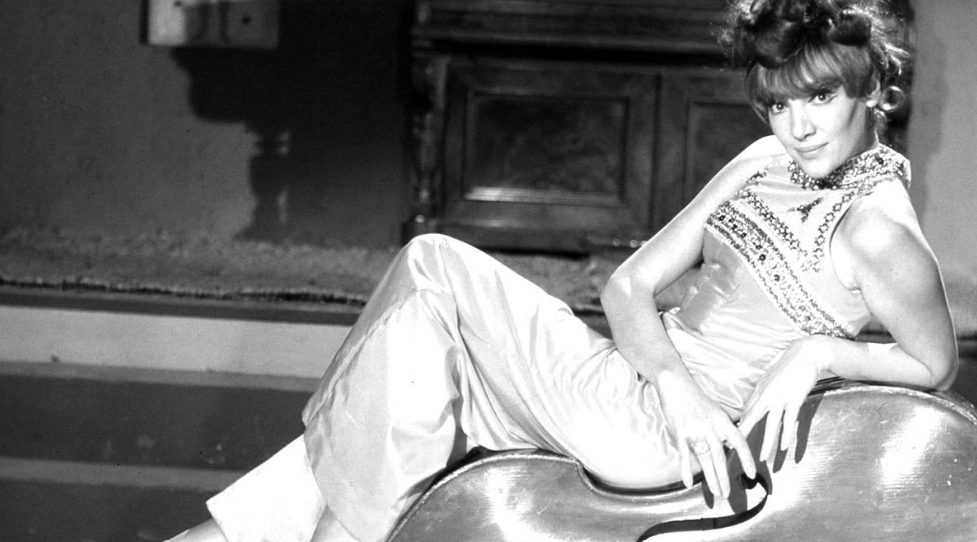
With the death of Maro Kontou (1934–2026), Greek cinema mourns yet another immense loss.
Born and raised in Koukaki, with family roots on the island of Psara, the dazzling actress studied at the National School of Dance. Her participation in the chorus of ancient tragedy productions at the National Theatre of Greece paved the way for a brilliant career, which reached its height during the “golden age of Greek cinema” (1958–1973). She gradually established herself in the public imagination as a seemingly inexhaustible talent, unconstrained by genre, character type, or medium.
Her acting range in the art form that made her a star-the cinema-extended from film noir (The Man on the Train, 1958; Murder in Kolonaki, 1959; Murder Backstage, 1960) and boulevard comedy (The Yellow Gloves, 1960; O filos mou o Lefterakis, 1963) to social comedies and character studies rooted in everyday Greek life (Woe to the Young, 1961; And the Woman Shall Fear Her Husband, 1965; Oikogeneia Horafa, 1968), tragedy (Antigone, 1961), and absurdist farce-most memorably in An Italian from Kipseli (1968).
Beyond her appearances opposite Dimitris Horn on both stage and screen, Kontou’s long-running partnership with comic actor Lambros Konstantaras will remain equally unforgettable. Their creative chemistry, strengthened by a genuine friendship, gave audiences 13 films. Among the most memorable were The Stern Man Who Became a Lamb (1968), Captain Fandis Bastounis (1968), What a Waste! (1970), Tis zileias ta kamomata (1971), and Labroukos the Wild Card (1981)-films that have remained perennial fixtures of rerun schedules on both public and commercial television.
Over the course of her career, Maro Kontou appeared in at least 90 stage productions and 60 films. In recent years, a new generation of viewers came to admire her through her role in the successful daily drama series The Land of the Olive Tree.
Kontou also shared a lifelong friendship with Giorgos Konstantinou, her co-star in Giorgos Tzavellas’s masterpiece And the Woman Shall Fear Her Husband. Their appearance together as “Elenitsa” and “Antonakis” in Christoforos Papakaliatis’s What If… (2012), reprising the roles that had made them immortal, remains one of the most moving on-screen reunions in contemporary mainstream Greek cinema.
Ever youthful and tirelessly active, Marianthe Kontou—as she was christened—also devoted herself to public life. She served as an Athens municipal councillor from 1994 to 2002 and as a Member of Parliament for Athens’s First Constituency with New Democracy. Her first parliamentary term ran from July 29, 1999, until April 2000. She was sworn in for a third time in January 2007, as the first alternate candidate in the 2004 elections, following the resignation of Nikitas Kaklamanis, who was then running for Mayor of Athens.
She also served as president of the municipal radio station Athens 9.84 from 1995 to 2002, while her tenure as president of the MITERA Infant Centre from 2004 to 2006 was marked by particularly significant work.
The stage lights have gone dark. And yet, whenever we turn our gaze towards the stars, we may still imagine hearing that celebrated “Black Ford” making its way across the night sky…
6+1 Landmark Films
The Man on the Train (1958)
Maro Kontou’s first major screen appearance placed her alongside Anna Synodinou, one of the most legendary tragediennes of the modern Greek stage. Based on the eponymous work by Yannis Maris, Dinos Dimopoulos’s film transposes the conventions of film noir onto Greek soil, at times recalling Alfred Hitchcock at his best. As for the film’s opening line, delivered by Synodinou’s Manto in praise of Jenny’s —Maro Kontou’s— dancing skills: “That lady dances wonderfully!”
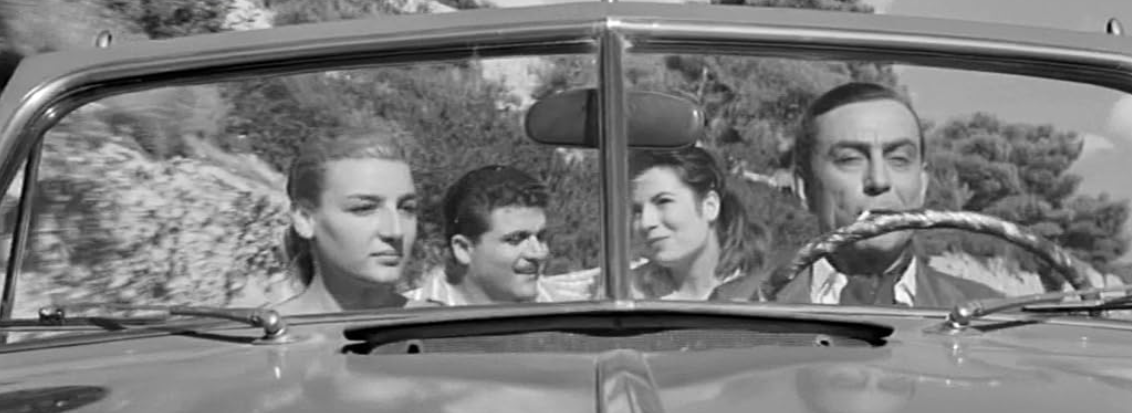
Maro Kontou (first from the left) in “The Man on the Train”
The Yellow Gloves (1960)
One of the most uproarious comedies by the writing duo Alekos Sakellarios and Christos Giannakopoulos, the film seems to communicate directly with the theatrical universe of Georges Feydeau. Rapid-fire dialogue, vividly drawn popular characters, the celebrated “orangeade” scene—a masterclass in comic interplay between Giannis Gionakis and Nikos Stavridis—and, of course, Maro Kontou as the elegant wife struggling to convince her incurably jealous husband that he alone holds her affections, while he peers suspiciously around every corner near their home in search of potential mustachioed suitors.
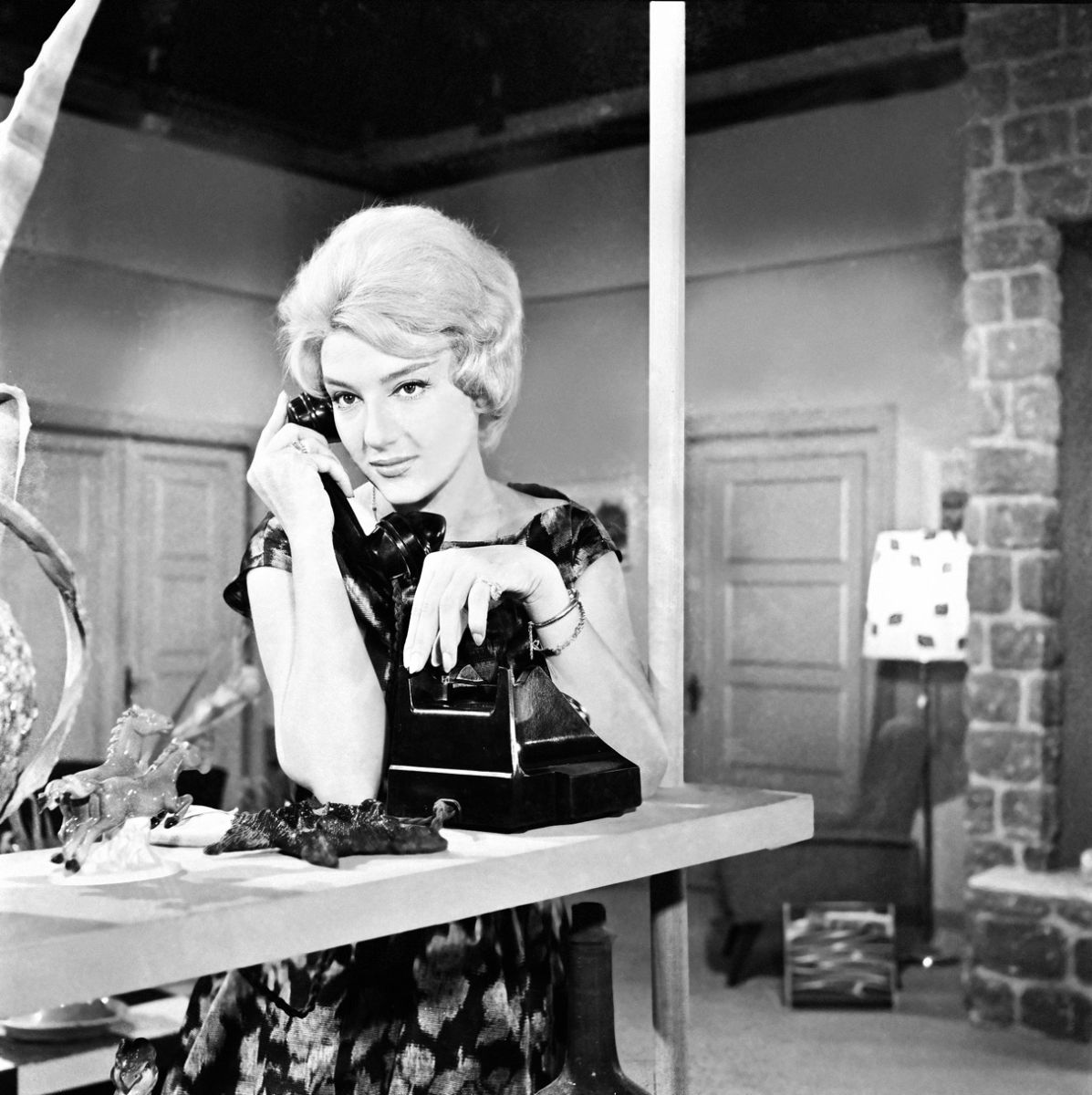
Maro Kontou as an elegant wife in The Yellow Gloves (1960)
Woe to the Young (1961)
A distinctly Greek reimagining of the Faust legend, starring the inimitable Dimitris Horn in his final dramatic film role. Reborn as a young man, Andreas vies with Agisilaos—played by another of the era’s great actor-managers, Spyros Mousouris—for the affections of Rita (Maro Kontou). A full decade before Mel Brooks’s celebrated parodies, Sakellarios and Giannakopoulos demonstrate how a familiar myth can be reinvented through comedy, while Manos Hatzidakis’s music lends the film an enduring quality. Horn and Kontou’s little waltz, accompanied by the song “Tell Me One Word—that one and only word…,” could encapsulate in just three minutes the cinematic spirit of an entire era.

Dimitris Horn, Maro Kontou, and Spyros Mousouris in the film “Woe to the Young”
Antigone (1961)
Giorgos Tzavellas undertakes one of Greek cinema’s first concerted attempts to bring ancient tragedy to the screen, adapting Sophocles’s play and guiding Irene Papas towards one of her finest performances—a lasting testament to her extraordinary talent. Alongside her, Maro Kontou appears as Ismene, filmed by Tzavellas under stark, unforgiving light that draws expressiveness from even her silences. His masterful handling of the camera is equally evident in the film’s studio-bound interior scenes. Antigone competed for the Golden Bear at the Berlin International Film Festival, while Papas received the Best Actress Award at the Thessaloniki International Film Festival.

Irene Papas and Maro Kontou in Antigone (1961)
And the Woman Shall Fear Her Husband (1965)
Every cinematic era has its defining masterpieces, and many consider Giorgos Tzavellas’s And the Woman Shall Fear Her Husband, which he both wrote and directed, to be one of the crowning achievements of Greek cinema. Despite its initially modest reception at the box office, this social comedy, tinged with neorealism, essentially satirizes the end of an entire era and the dawn of women’s emancipation, countering the unreasonable demands of the self-styled “lord and master” with the resounding declaration: “You shut up, Antonakis!” Moving with remarkable ease from farce to melodrama, the film reaches its emotional heights in the song performed at the window and its deeply affecting finale. These moments remind us that the effortless performances Tzavellas elicits from Giorgos Konstantinou and Maro Kontou as the Kokovikos couple will continue to resonate with audiences for all eternity.
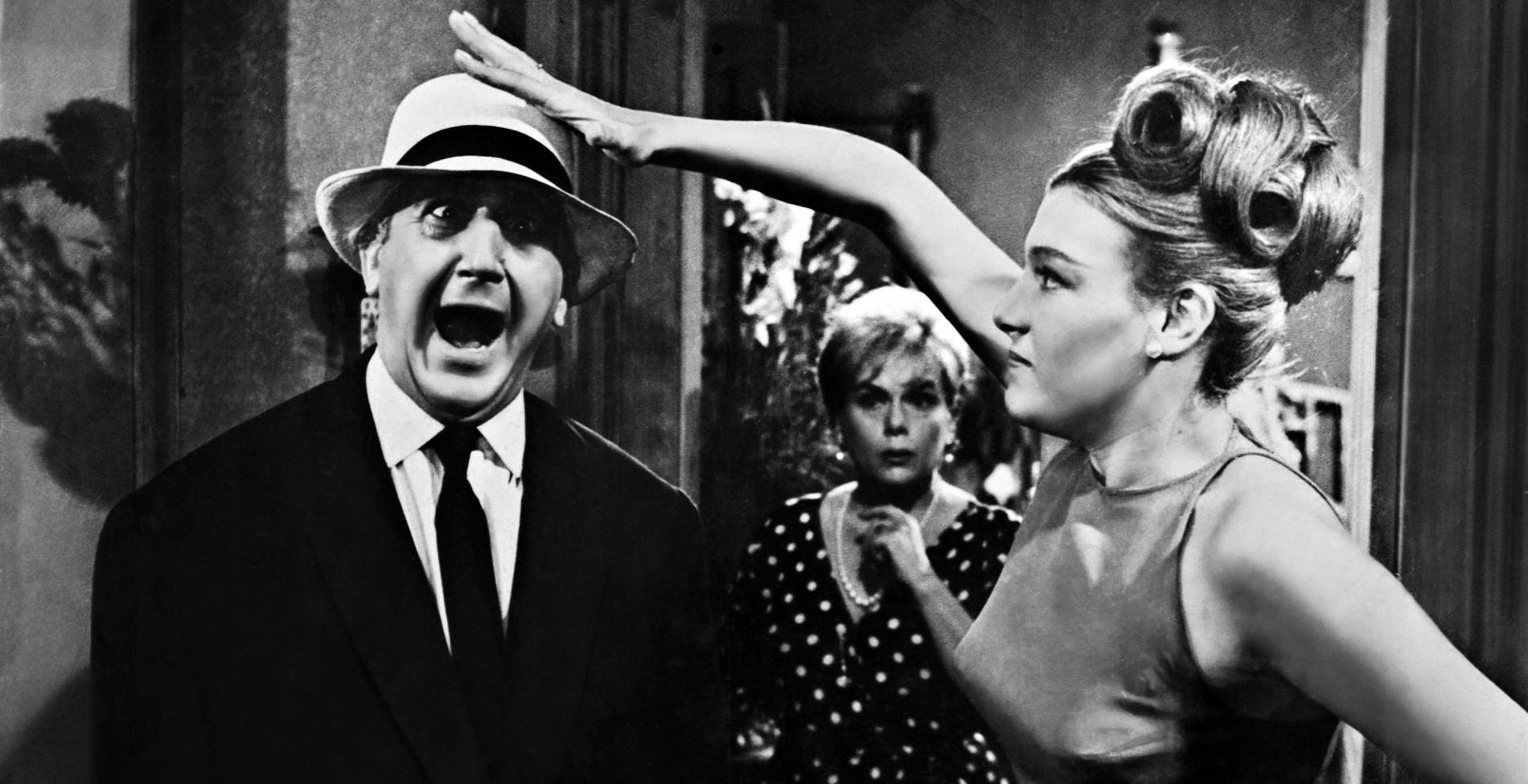
The Kokovikos couple (Giorgos Konstantinou-Maro Kontou)
The Stern Man who Became a Lamb (1968)
Alekos Sakellarios brings yet another theatrical success, co-written with Christos Giannakopoulos, to the screen. At its heart, the film is a Molièresque tale of transformation: a cantankerous widowed sea captain and authoritarian patriarch (Lambros Konstantaras) meets his new housekeeper (Maro Kontou), who sets about restoring order to a household thrown into chaos by his three unruly sons. Brisk pacing, moments of slapstick, and a characteristically dark strain of humour are balanced by the serenading spirit of Giorgos Katsaros’s music and duets such as “At the Old Tavern.”
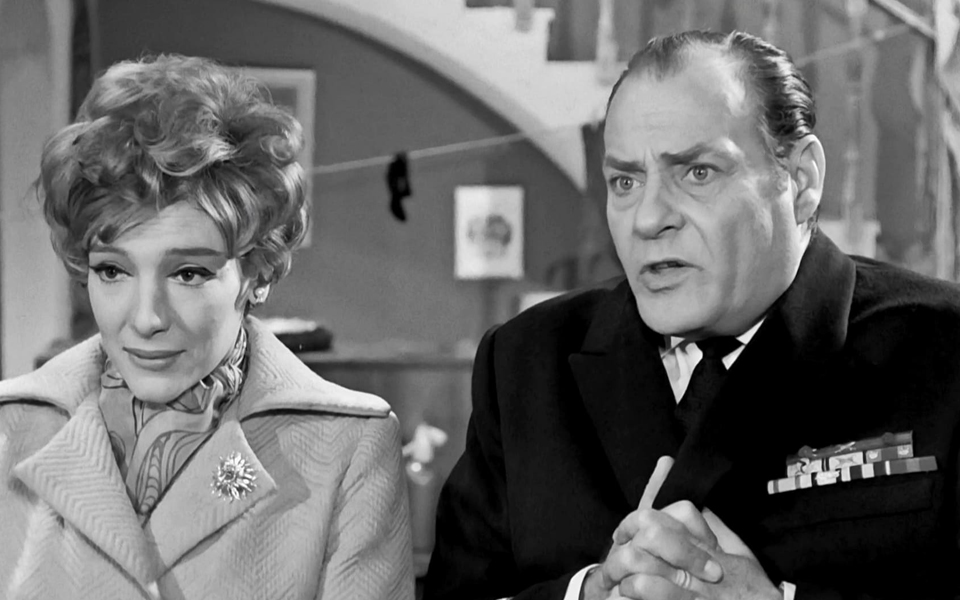
Maro Kontou and Lampros Konstantaras in The Stern Man who Became a Lamb
An Italian from Kypseli (1968)
Renowned for their distinctively surrealist brand of humour, Nikos Tsiforos and Polyvios Vasileiadis use An Italian from Kipseli to satirise the growing Greek fascination with all things foreign in the late 1960s. Bringing their stage play to the screen, director Dinos Dimopoulos pairs Alekos Alexandrakis with Maro Kontou in an absurd farce centred on a makeshift “Italian woman”: a flamboyant “tsiribim-tsiribom” lady who provides some of the film’s funniest moments through her inventive linguistic solecisms—at times remarkably risqué for the period.
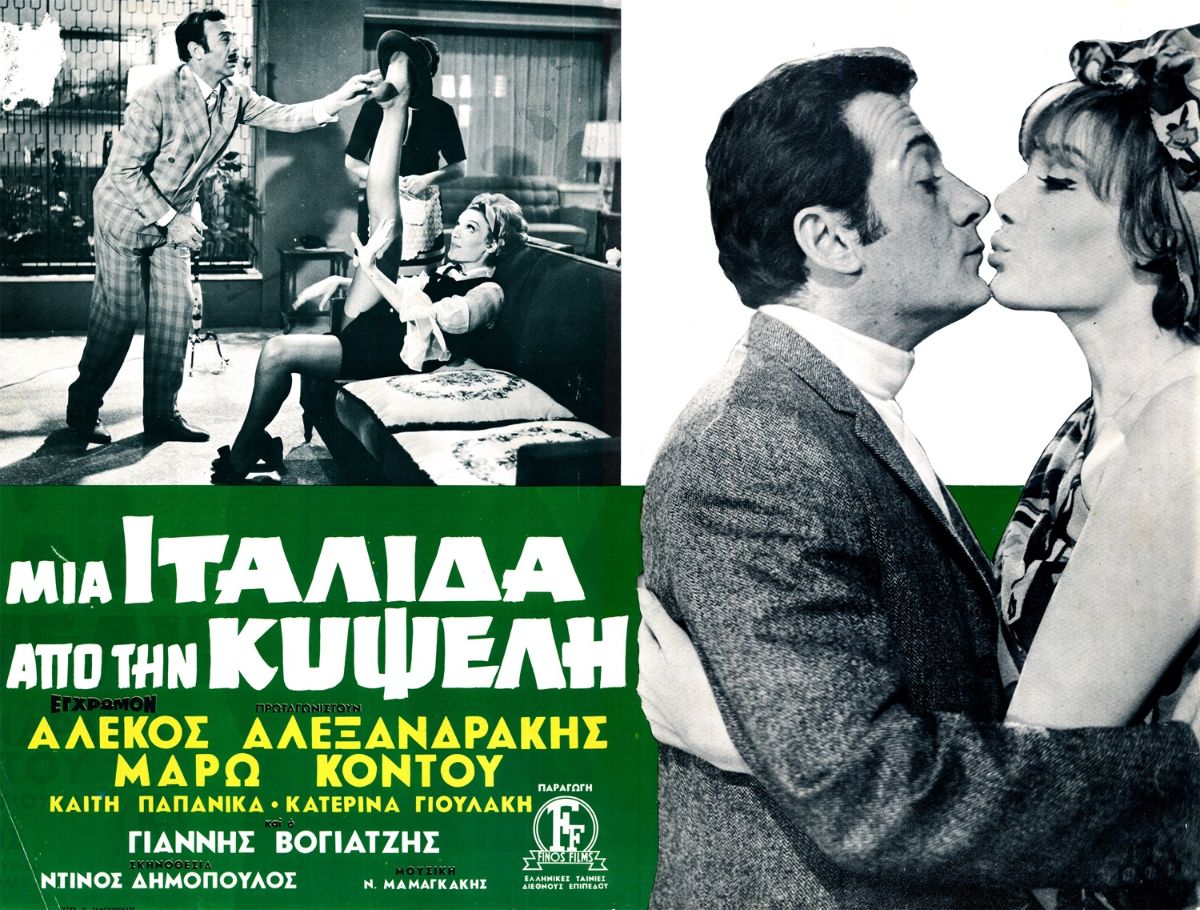
An Italian from Kypseli


Leave A Comment