On Sunday, the 22nd Thessaloniki International Book Fair was once again the place where young and old alike gathered for storytelling, adventures, activities, games, readings, and dialogue. With film screenings, workshops, and activities for children and parents that focused, among other things, on empathy and the relationship with animals, storytelling, interactive word games, images, and connections, the fourth and final day of the exhibition began, drawing thousands of people to every space, hall, and event.
With the participation of German author Carsten Henn, the interactive children’s event The Golden Typewriter took place, combining a mystery game with literature and imagination. Gamecraft’s creative game team invited the children on a lively adventure. The event unfolded as a large-scale interactive mystery hunt, with the children working together to solve the riddles and advance the story. The author, with the ongoing support of the Goethe-Institut Thessaloniki, also presented his book, The Book Postman, to an adult audience.
At the guest of honor country’s booth, in collaboration with the Thessaloniki Storytelling Club, translator Vaitsa Hani-Moisidou spoke about Bulgarian myths and folk tales in translation. As she noted, fairy tales serve to capture the reader’s interest, entertain them, and provide food for thought. As mentioned, fairy tales offer us the comfort we all need, no matter what circumstances we find ourselves in.
There was great interest in the presentation of the book *Letters from Omar to His Future Wife* (published by Metaixmio) by Rene Karabash, which took place in the packed “Dionysis Savvopoulos” Hall, with the support of the Bulgarian Ministry of Culture.
arabash spoke about her approach to writing and noted that both her new book and *The Sworn* were written in a stream-of-consciousness style with a strong poetic sensibility. At the same time, she emphasized that she writes primarily through images, “as if movie scenes were passing before my eyes,” describing the writing process as a cinematic experience.
The author, who is a nominee for the 2026 Booker Prize, also highlighted the deeply personal and emotional side of creation, linking writing to a creative energy that “gives life,” whether it leads to the birth of a book or a child. At the same time, she revealed that the novel “The Sworn” is set to be adapted for the big screen, while she also announced that she has had the images for her next novel in her mind for the past four years. Referring to the characters in her works, she noted that she does not view them as entirely good or bad. As she said, every person harbors both light and darkness within, and it is the circumstances, experiences, and moments of life that determine which side will come to the surface each time.
The political career and legacy of Yannis Boutaris were the focus of the event “Yannis Boutaris: Politics with a Difference,” featuring remarks by Evangelos Venizelos, Margaritis Schinas, and Leonidas Makris, author of the book of the same name.
Evangelos Venizelos noted that Boutaris’s first election coincided with the period following the adoption of the first memorandum, while his second election took place during the years of the deep economic crisis. Nevertheless, he described Boutaris’s mayoral tenure as “an oasis” in contrast to the pressures of the national political scene, where—as he noted—decisions centered on cuts to wages and pensions. “Yiannis Boutaris is now ingrained in the city’s memory,” he noted. For his part, Margaritis Schinas remarked that Boutaris “forced the city to face its history head-on.”
The internationally renowned Cuban poet Víctor Rodríguez Núñez presented his poetry anthology, published for the first time in Greece in a bilingual Spanish-Greek edition titled *Wild Algebra* (Eirini Publications).
The title is a kind of poetic statement, and the juxtaposition of logic and chaos runs throughout the collection. The poet uses memory as an active force that reconstructs the identity of a Cuban living in America but who is not American, and who experienced the revolution and exile. “I come from a country that talks a lot, so I won’t say anything else. Poetry needs nothing more than poetry,” the poet himself said.
The D. Savvopoulos Hall, which hosted the event “Thanasis Triaridis: Writing about the murdered migrants of today” (Kapa Publishing), was packed with a loyal, enthusiastic audience. Thanasis Triaridis defended the work and themes of his plays, responding to the question of why he insists on writing plays that deal almost exclusively with the refugee and migrant crisis. “We cannot remain silent,” he noted characteristically. As he stated at the Thessaloniki International Book Fair, “Those of us who loved books and grew up with them feel that the book is a part of, a ritual in, our lives. We feel that through the printed pages, our very selves expand and grow.”
Another beloved Northern Greek author met his large audience in Thessaloniki: Northern Greece’s connection to the Homeric world and the birth of a new literary universe were at the heart of the presentation of Isidoros Zourgos’s book *Bronze Thresholds*.
Thessaloniki during the crisis, family relationships, and small-town stories of everyday life were discussed at the presentation of Mi Delta’s new graphic novel, *Polykatoikies* (Apartment Buildings), inspired by the song of the same name by LEX.
The creator noted that the work includes many autobiographical elements connected to Thessaloniki and his frequent trips to the city. As he explained, the inspiration came in 2014, when he lost a close friend and traveled to Thessaloniki for the first time. “Since then, I’ve been there hundreds of times,” he noted, explaining that during these trips he took notes and recorded images and events from the city. Through these, he sought to compose an urban portrait of Greece during the crisis.
The event featuring Rea Galanaki and her book *Cake* also drew a large crowd. “Anyone who writes should strive to ensure that their writing has roots,” she said. “They should have read both modern and ancient texts. The Greek language is hundreds of years old. We cannot use words arbitrarily.”
During the discussion titled “The Future of Reading in 21st-Century Greece,” authors and members of the Board of Directors of the Writers’ Network spoke about policies to promote reading. Marija Dejanovic, who lives in Larissa, emphasized that, based on experience, expanding the audience also expands the network, providing incentives for the periphery to engage with contemporary literature. “The true decentralization of literature brings something from the center to the periphery and strengthens the effort toward participation, thereby also strengthening democracy,” she said.
The crowds that flocked to the exhibition actively participated and stayed until all the events had ended and the TIF doors closed late at night.
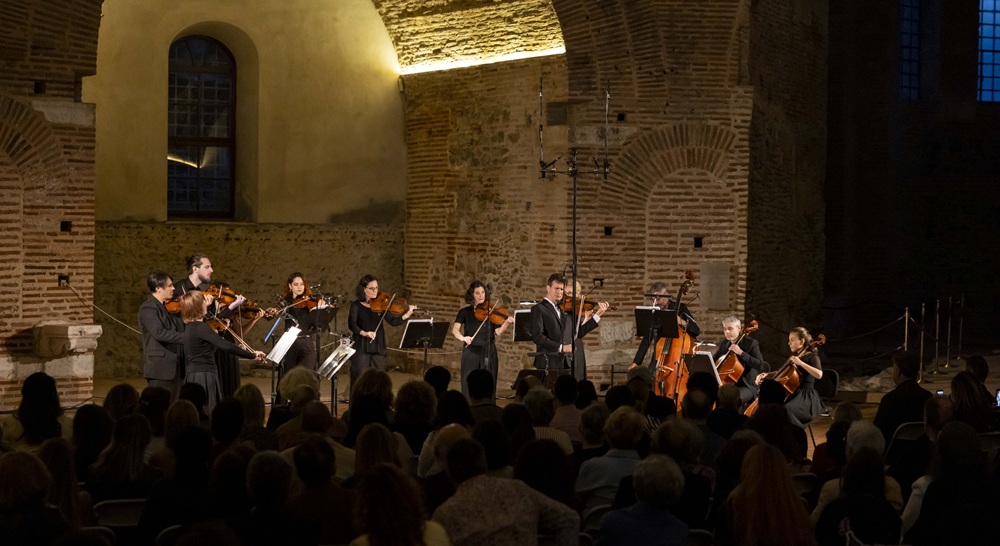
Meanwhile, on Sunday evening in the evocative setting of the Rotonda, the Thessaloniki State Symphony Orchestra joined forces with the Sofia Philharmonic Orchestra for a moving closing concert of the 22nd Thessaloniki International Book Fair, organized by the guest of honor, Bulgaria. The concert is taking place with the support of the Ministries of Culture of both countries and as part of the “Thessaloniki-Sofia: Balkan Bridge of Culture” program.
Musicians from both orchestras presented a wonderful program featuring works by Vladigerov, Skalkotas, Lampov, and Saint-Saëns, under the baton of the internationally renowned violinist Svetlin Roussev. The historic violin used in the concert belongs to the Bulgarian Ministry of Culture and is considered one of the most important musical instruments in the world.


Leave A Comment