
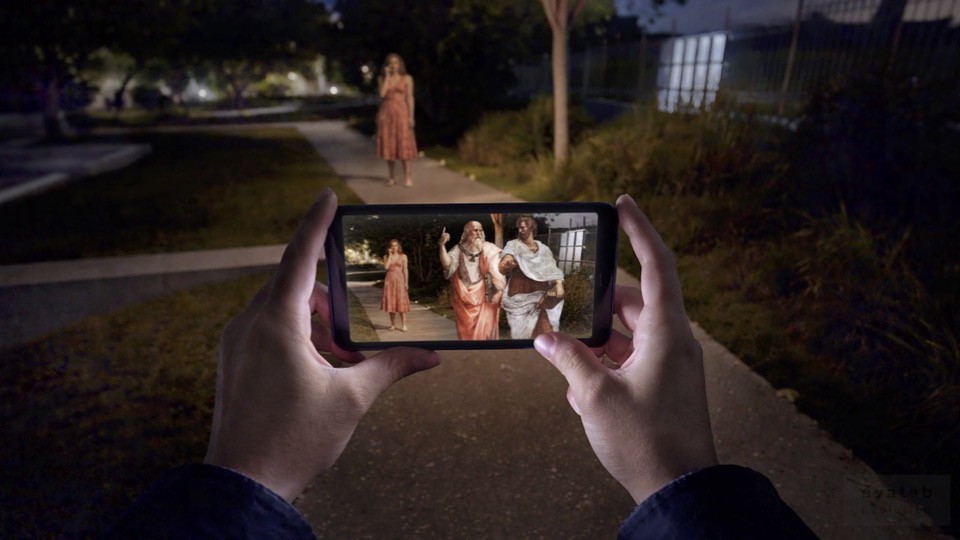
The Ministry of Culture is upgrading the infrastructure and services provided at the archaeological site of Aristotle’s Lyceum in Athens. The Ministry is planning two projects, which are included in the Integrated Territorial Investment “Lavrio-Athens-Elefsina.” Their inclusion is scheduled for the NSRF 2021-2027. The first project, implemented by the National Center for Scientific Research “Demokritos,” involves the installation of a digital information kiosk on the life and work of Aristotle.
The second, implemented by the Directorate for the Restoration of Ancient Monuments and the Ephorate of Antiquities of the City of Athens, concerns the construction of an entrance building to house the ticket office, the visitor service office, and restrooms. At the same time, mild, completely reversible, and non-invasive digital interventions enhance the visitor’s understanding, interpretation, and experiential experience.
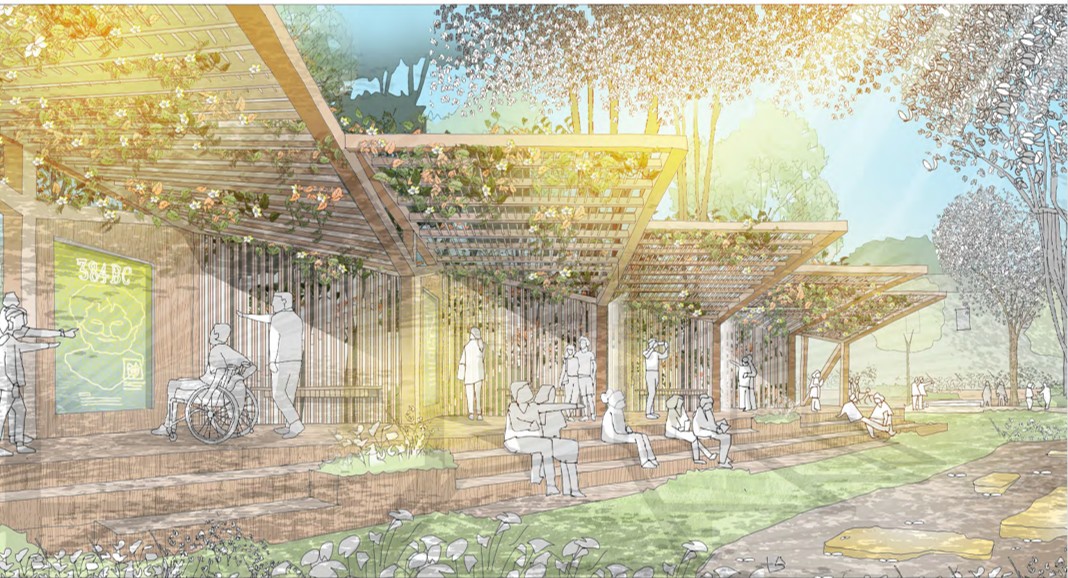
Proposed installation plan
The intervention implemented by the National Center for Scientific Research “Demokritos” involves the installation of a kiosk in the southern part of the archaeological site, which will house four interactive touch screens with access to multimedia information (texts, images, videos, representations, etc.). The composition includes four rectangular units covered by a corrugated roof. Access to the kiosk is via ramps at the ends. The project is the result of collaboration between the National Centre for Scientific Research “Demokritos”, the architectural firm Foster+Partners, the World Human Forum and the Ministry of Culture. The information has been selected by internationally renowned academics, scientists and artists. The digital installation allows for easy updating and enrichment of the information material, depending on the progress of research.
The project being implemented by the Ministry of Culture – for which the Athens City Archaeological Service collaborated with the School of Architecture of the University of Crete – involves the creation of a new main entrance on Rigillis Street, following extensive three-dimensional digital documentation of the site, combining aerial photogrammetry, static laser scanning, and mobile photogrammetry, thus ensuring high accuracy and scientific documentation. Next to the entrance, an elongated visitor reception building is located, running parallel to Rigillis Street. Part of the existing fence on Rigillis Street is being replaced, restoring direct continuity with the new entrance building. A secondary entrance will be created from the Conservatory (southern part of the archaeological site) to facilitate communication between the two areas. A semicircular bus stop for approximately 60 passengers will be constructed on the axis with the Conservatory.
The organized archaeological site of the Lyceum, accessible to people with disabilities, covering a total area of approximately ten acres, was opened to the public in June 2014. It operates under the responsibility of the Ephorate of Antiquities of the City of Athens. It has six conventional information signs, of the “analog” type, with information about the ancient Gymnasiums of Athens and the Lyceum, the life and philosophy of Aristotle, the palaestra and baths, and the work of promoting the archaeological site. There is also a small amphitheater for about 150 people, a fountain, and six benches for visitors to rest on.
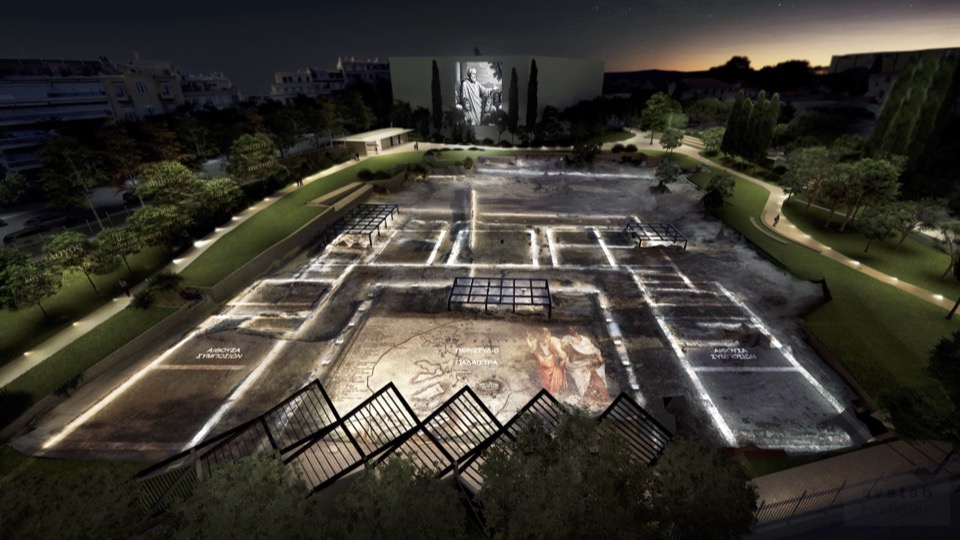
According to ancient accounts, Lyceum was a verdant suburb east of Athens, outside the Gate of Diocharus, between the Ilissos and Eridanus rivers. The area where the Gymnasium was founded in the 6th century BC probably took its name from the Sanctuary of Lyceum Apollo, which predated the Gymnasium and has not yet been located. The Lyceum’s palaestra, a training ground for wrestling, boxing, and pankration, was founded in the second half of the 4th century BC. It was maintained, with various repairs, for about seven centuries, until the beginning of the 4th century AD, when it was finally abandoned. It consists of an inner courtyard surrounded on three sides by colonnades, behind which symmetrical, spacious, rectangular rooms are arranged. In the 1st century AD, a cold bath reservoir was built for the athletes. During the same period, the baths, which probably replaced the earlier baths of classical times, were incorporated with perfect symmetry into the northeast and northwest sections of the palaestra.


Leave A Comment