
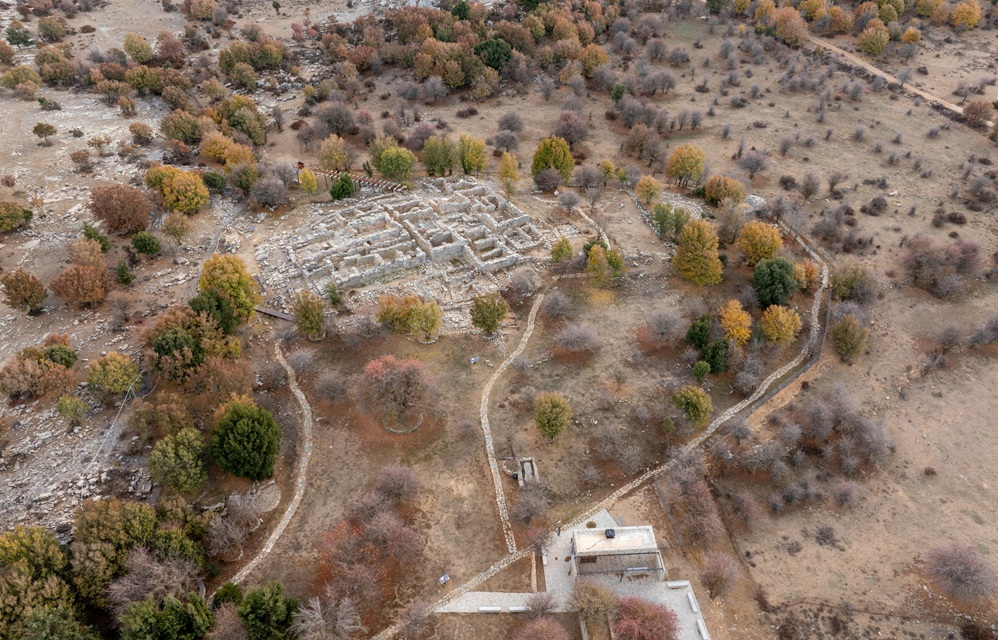
An unorthodox architectural practice of the Minoans, unusual given the particular attention they paid to their constructions, but ultimately proof of their technical ingenuity came to light during the excavation carried out at the palace of Archanes in 2025.
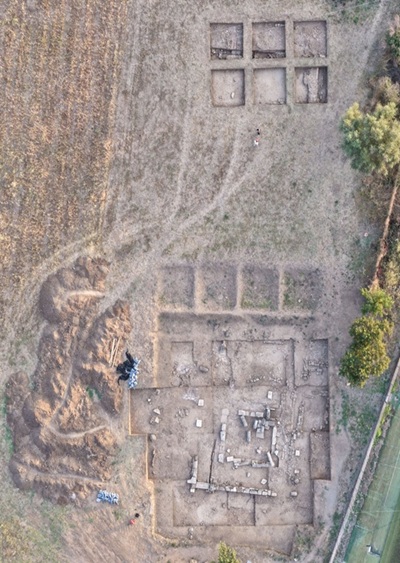
Under the direction of Dr. Effie Sapouna-Sakellaraki, the archaeological research, which began – or, to be more precise, restarted – in 2023 aimed to complete the picture of the three-story building of the Archanes megaron, which flourished in the form now revealed as early as 1450 BC.
This year’s excavation focused on investigating a slanted double wall that had closed off a large part of the palace courtyard in a paradoxical way, while at the same time not being carefully constructed, as it was made of rough stones, a condition that raised many questions, this year’s excavation focused on this. However, systematic archaeological research and the assistance of specialist scientists proved that its existence was very important for the building, as its purpose was to protect it from natural disasters, and in particular from the landslide of the rock above it. This was also the reason why the southern part of the wall was not carefully constructed, as this side was not visible.
However, the intelligence and experience of the Minoan architects, as well as their aesthetic sensibility, would not allow for such cacophony, so they proceeded to build a second wall attached to the first one so that it would be visible from the courtyard of the palace. Particularly meticulous and aesthetically pleasing, this wall is constructed of beautifully carved limestone blocks, similar to those used in the rest of the palace.
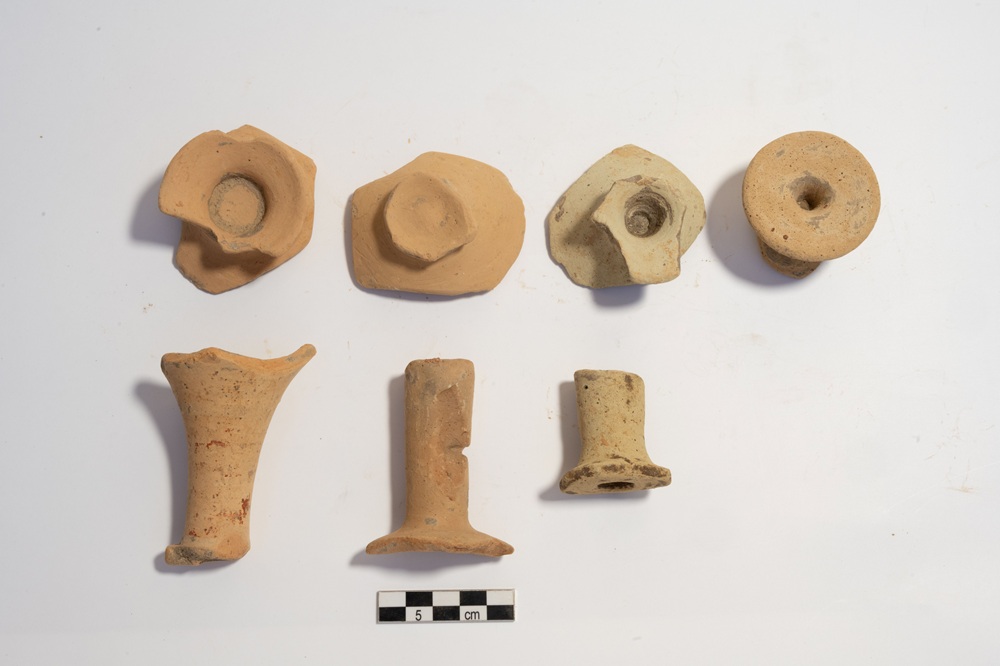
Above this wall, the usual layers of the Mycenaean period were also uncovered, with numerous pottery shards and finds from historical times. Findings from the Hellenistic period, such as a three-handled wine jug with two relief heads (3rd century BC) and a clay head that was apparently attached to some object, are characteristic of the diachronic use of the space.
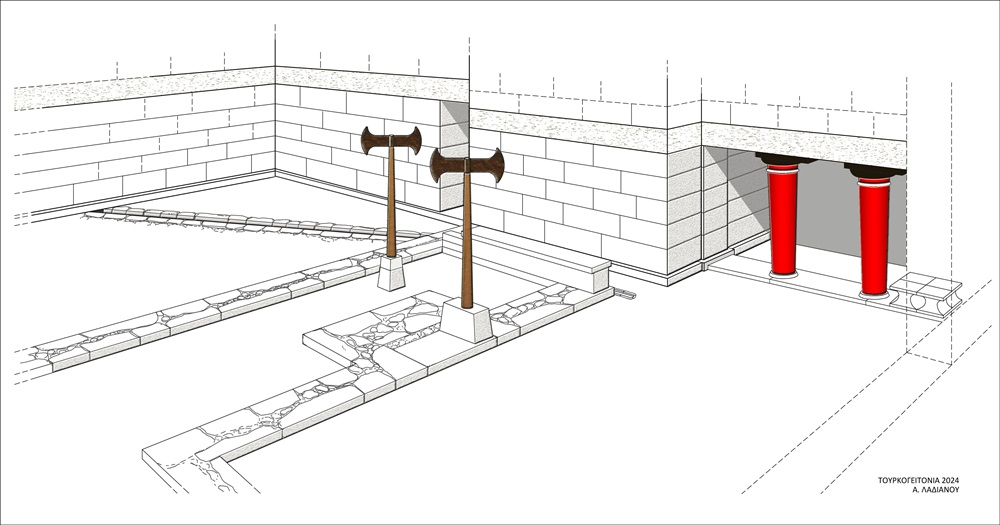
However, important discoveries were also made in the southeastern part of the excavation, in an area where (Area 28) revealed an opening from the central courtyard to the easternmost part of the palace, while stone slabs divide this area into two sections. A large trapezoidal stone with toruses was added on top of the latter, indicating the existence of a parapet, which was destroyed by a wall from the Mycenaean period. A natural stone bearing some anthropomorphic features is an interesting find from this area. The object had fallen from the upper floor and is probably related to the existence of a “fetish shrine,” similar to that of Knossos.
More generally, the new excavation season in 2023 and 2024 yielded important new information about the functioning of the palace. In the northernmost section uncovered so far, two- and three-story rooms were discovered, forming an elite wing of the palace: luxurious rooms connected by corridors, with numerous plaster moldings, fragments of wall paintings, plaster-covered walls, schist floors, etc. In situ, the usual dividing/decorative mortar strips, which surrounded the floor slabs, were also found in almost all areas of the palace.
The palace of Archanes is located in the center of the modern city, in the area known as Tourkogeitonia. It was destroyed by an earthquake around 1700 BC but was rebuilt and flourished until 1450 BC, when it was finally destroyed. However, excavations have shown that the site was continuously inhabited.
Sir Arthur Evans was the first to mention Archanes, due to important finds (now in the Asmolean Museum), which apparently came from the Minoan cemetery of Archanes on Fourni Hill, which was later excavated by Yannis and Effie Sakellaraki and yielded five vaulted tombs, many burial buildings, and box-shaped tombs from the Mycenaean period.
In the town itself, Evans had noticed large wall surfaces while excavating a circular aqueduct in an area that is part of the palace. However, Yannis Sakellarakis, conducting a surface survey and investigating the basements of modern houses in the center of the town, discovered that they were built on top of strong Minoan walls. This was something that many previous researchers (such as Marinatos and Platon) had not noticed, even though they were searching for Evans’ famous “summer palace,” according to his Victorian ideas. They had focused their research on areas that, as it turned out, were outside the palace area.

However, the mapping of all the aforementioned remains by Yannis Sakellarakis led to the selection of a site where, as it turned out, the center of the palace of Archanes was located, which yielded a wealth of architectural and luxurious movable finds. In addition, the palace’s archive and theater were found in a neighboring area.
The excavation for the period of 2025 was carried out by the Archaeological Society and this year it was attended by the same distinguished scientific staff, consisting of archaeologists Dr. Polina Sapouna-Ellis, Dimitris Kokkinakos (MA), and Persephone Xylouri, designer Agapi Ladianou, conservator of antiquities Veta Kalivianaki, and photographer Kostas Maris. Dr. Charalambos Fasoulas made a special contribution to clarifying the role of the “sloping wall” in the palace courtyard.
The inclusion of Zominthos, which was discovered on Psiloritis by Yannis Sakellarakis and excavated by Efi Sapouna-Sakellarakis, to the UNESCO World Heritage List is a recognition not only of the uniqueness of this monument but also of the value and Minoan identity of Crete in general. Work and improvements were carried out at the archaeological site and in the wider area, such as the creation of a car park, a guardhouse, toilets, information signs, etc. As is well known, the inclusion was made together with five other Minoan palaces: Knossos, Phaistos, Zakros, Malia, and Kydonia.
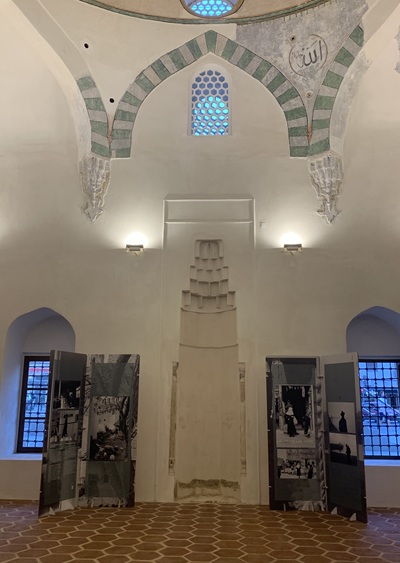
It should be noted that both Archanes and Anogia have created small museums/information centers, exclusively with findings from the excavations of Archanes, Zominthos, and Idaion Andron, respectively.


Leave A Comment