
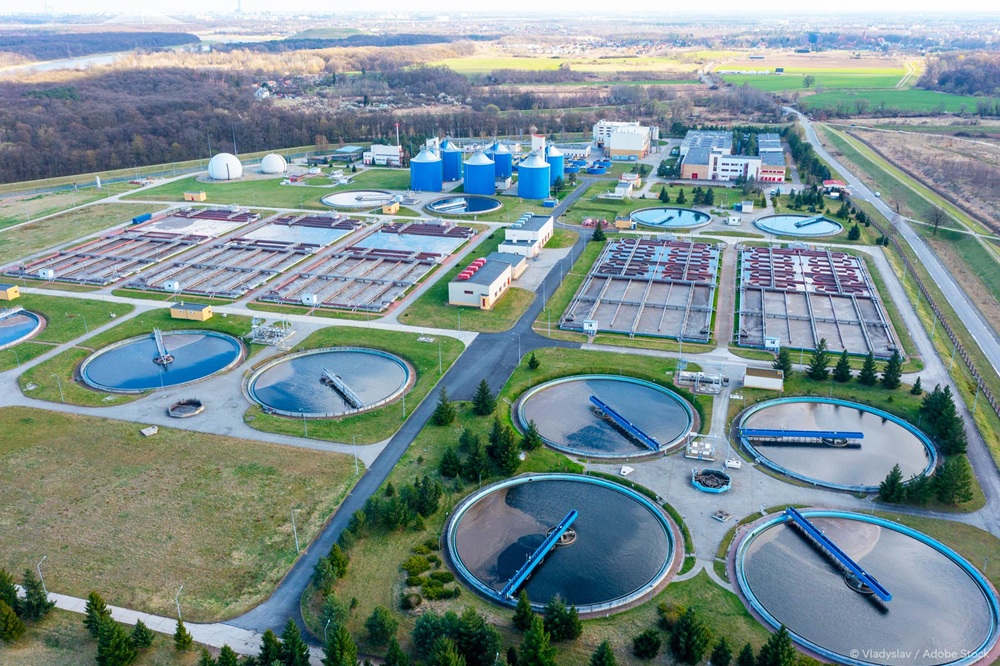
Research collaboration between the Gaia Laboratory of Environmental and Technical Processes and Water Systems at the University of Cyprus and the Cyprus Addiction Treatment Authority
Today, understanding the habits and trends of a population no longer relies solely on questionnaires and statistical surveys. One of the most innovative applications in public health, wastewater epidemiology, utilizes a source of information that until recently was considered mere waste: municipal wastewater. By analyzing it, scientists can gather valuable data on medication use, illicit substance use, and the presence or spread of diseases throughout the population.
The process involves sampling wastewater at the inflows of treatment plants, where substances that are naturally excreted by the human body after use or consumption, as well as their metabolites, are detected. This yields a representative chemical profile of daily life in a city. Urban wastewater thus serves as a particularly revealing mirror of society, as it records collective patterns of consumption, behavior, and lifestyle among the residents of a region, a city, or even an entire country.
The latest findings from Europe’s largest program in the field of urban wastewater analysis and epidemiology are presented in a report titled “Wastewater analysis and drugs — a European multi-city study.” The report is being published today by the SCORE research network (SCORE Network – Bringing together experts and knowledge on wastewater-based epidemiology) in cooperation with the European Union Agency for Drugs (EUDA, EUDA home page | The European Union Drugs Agency (EUDA)). The 2025 urban wastewater analysis study covered 115 cities in 25 countries, including Norway and Turkey. Samples were collected on a 24-hour basis and analyzed for the presence of amphetamine, methamphetamine, cocaine, MDMA, ketamine, and cannabis. The findings indicate that drug use shows marked geographical variations across European cities. From 2024 to 2025, the concentration of cocaine metabolites in wastewater increased by a total of 22%, with the highest levels recorded in western and southern Europe. In contrast, levels of amphetamine and methamphetamine remained generally stable, although significant variations are observed from region to region. At the same time, in some cities in central and northern Europe, there are signs of a gradual increase in use.
The SCORE project research team has been conducting annual monitoring of municipal wastewater in European cities since 2011, with the aim of documenting patterns of drug use at the population level. SCORE is the European network of scientists and organizations that coordinates and standardizes wastewater analysis for the study of drug use. Its full name is Sewage analysis CORe group Europe, and it was created with the aim of harmonizing sampling, analysis, and data interpretation methods so that results from different cities and countries are comparable. Cyprus has been actively participating in the network since 2012 through the Gaia Laboratory of the Department of Environmental Civil Engineering and the Nereus International Water Research Center at the University of Cyprus, under the supervision and coordination of Professor Dr. Despo Fatta-Kassinou.
As part of this initiative, samples are collected and analyzed from the country’s largest urban areas (Nicosia, Limassol, Larnaca, Paphos, Ayia Napa/Paralimni) for substances such as amphetamine, methamphetamine, MDMA (ecstasy), benzoylecgonine (the main human metabolite of cocaine), ketamine, cannabis, and others. These data provide valuable insights into drug use patterns in Cyprus, and with the support of the Cyprus Anti-Addiction Authority (CAA) (Dr. Christos Minas, Ms. Maria Savvidou), the research has now become systematic, creating a comprehensive national profile.
Sampling follows the standard protocol of the SCORE network: daily samples of municipal wastewater inflow are collected for one week each year. Analysis is performed using advanced techniques, such as ultra-high-performance liquid chromatography coupled with tandem mass spectrometry (UHPLC-MS/MS). The detected concentrations are then converted using specific algorithms into estimates of substance use per 1,000 inhabitants, providing an accurate picture of drug use trends at the population level.
The Gaia Laboratory team participating in the research includes Dr. Magda Psychoudaki, Ms. Rafaela Panagiotou, Dr. Kostas Michael, and Dr. Despo Fatta-Kassinou.
The research is being conducted in collaboration with Dr. Christos Minas (President of the Cyprus Addiction Treatment Authority) and Ms. Maria Savvidou (Officer of the Monitoring Department of the Cyprus Addiction Treatment Authority).
Key Findings 2025
MDMA: Between 2024 and 2025, Europe saw an overall decrease of nearly 16% in the levels of MDMA detected in urban wastewater. The highest levels in Europe are found mainly in cities in Belgium (≈350–450 mg/day/1,000 inhabitants), the Netherlands (≈400–500 mg/day/1,000 inhabitants), and Spain (≈200–300 mg/day/1,000 inhabitants). In Cyprus, variations are observed by region: the largest decrease is recorded in Limassol (by 63.2%), with 2.5 mg/day/1,000 inhabitants in 2025 compared to 6.8 mg/day/1,000 inhabitants in 2024, while the largest increase is recorded in Larnaca (by 157.1%), with 3.6 mg/day/1,000 inhabitants in 2025 compared to 1.4 mg/day/1,000 inhabitants in 2024. It is worth noting that MDMA levels in Cyprus remain very low compared to other European cities, as the recorded values are approximately 100–150 times lower than those observed in the cities with the highest levels in Europe.
Cocaine: At the European level, cocaine use is most prevalent in cities in western and southern Europe, particularly in Belgium, the Netherlands, and Spain. From 2024 to 2025, concentrations of the cocaine metabolite (BE) in European urban wastewater increased by a total of 22%. In Cyprus, variations are observed between regions: in Limassol, a significant decrease (by 65.9%) is noted, with 33.2 mg/day/1,000 inhabitants in 2025 compared to 97.3 mg/day/1,000 inhabitants in 2024, while most other regions show an increase, with the largest observed in Larnaca (by 92.5%), from 38.8 to 74.7 mg/day/1,000 inhabitants. Compared to European cities with the highest levels, Cyprus shows significantly lower values, approximately 20–75 times lower.
Amphetamine: The highest levels of amphetamine in Europe are found mainly in cities in northern and central Europe, such as Norway, Sweden, Denmark, Belgium, the Netherlands, and Germany. Compared to these countries, the concentrations recorded in Cyprus remain significantly lower, by a factor of approximately 10–40. At the local level, increases are recorded in several regions of the country, with the largest in Limassol (by 261.2%), from 6.7 to 24.2 mg/day/1,000 inhabitants, followed by Ayia Napa (by 258.8%), from 8.0 to 28.7 mg/day/1,000 inhabitants. The remaining cities also show smaller but notable changes.
Methamphetamine: Methamphetamine use in Europe remains generally limited and has historically been concentrated mainly in the Czech Republic and Slovakia, although it is also detected in other countries, including Cyprus. Compared to regions where the substance is recorded at higher levels, the levels observed in Cyprus remain low—specifically, several dozen times lower. For 2025, the largest increase is observed in Ayia Napa (by 286.4%), with 17.0 mg/day/1,000 inhabitants compared to 4.4 mg/day/1,000 inhabitants in 2024, followed by Larnaca (by 115.7%), with 35.8 mg/day/1,000 inhabitants compared to 16.6 mg/day/1,000 inhabitants in 2024. In contrast, a downward trend is observed in other areas, with Limassol showing the largest decrease.
Ketamine: In Europe, ketamine concentrations in wastewater increased by 41% from 2024 to 2025, with the highest levels recorded in cities in Belgium, Germany, and the Netherlands. Compared to these countries, levels in Cyprus remain significantly lower—several dozen times lower—yet drug use in Cyprus is comparable to that in several Central European countries. At the local level, the largest decrease is observed in Limassol, by 62.9%, with 2.6 mg/day/1,000 inhabitants in 2025 compared to 7.0 mg/day/1,000 inhabitants in 2024, while in Larnaca, an increase of 277.8% is recorded, with 3.4 mg/day/1,000 inhabitants in 2025 compared to 0.9 mg/day/1,000 inhabitants in 2024.
Cannabis: Cannabis use is particularly widespread in Europe, with the highest levels of the THC-COOH metabolite found mainly in cities in the Netherlands, Germany, and Slovenia. At the European level, from 2024 to 2025, THC-COOH concentrations in urban wastewater remained stable overall. In Cyprus, during the 2024–2025 period, an increase was observed in several areas, with the largest rise recorded in Nicosia and Limassol, a smaller rise in Ayia Napa and Larnaca, while Paphos remained stable. Concentrations in Cyprus ranged from 4.8 to 5.7 μg/day/1,000 inhabitants in 2024 and from 4.4 to 8.2 μg/day/1,000 inhabitants in 2025, remaining several dozen to about 200 times lower than those in European cities with the highest pollution levels.
*The above results for Cyprus are based on a normalization methodology; therefore, any comparisons with other results should be made with caution.
Announcement of EUDA Results: EUDA home page | The European Union Drugs Agency (EUDA)





Leave A Comment