
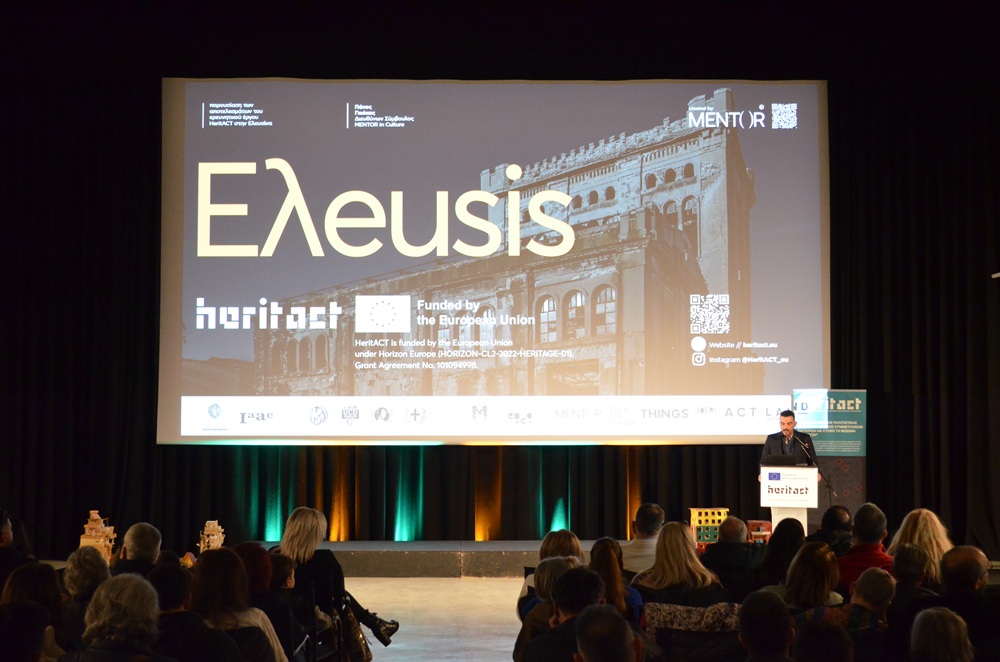
The three-year European research project HeritACT will come to an end in late February, after a three-year journey that has highlighted new ways of activating cultural heritage through participatory practices and with a focus on sustainable development.
Focusing on the industrial cultural heritage and public space of Eleusis, and prioritizing participatory design, HeritACT attempted to bridge the past with the future of the city through the use of nine (9) specially designed digital applications and the creation of seven (7) innovative digital and architectural solutions. These solutions intervene in a gentle and sustainable way in the urban fabric, serving the real needs of citizens and strengthening their relationship with heritage sites.
Events presenting the project results in Elefsina (January 29–31, 2026)
As part of the closing events held in Elefsina (January 29–31, 2026), at the Eleusis Cinema and in public space activities, the main results of the project were presented and the digital applications and architectural solutions designed with the participation of the community were piloted. The three-day event highlighted both the research aspect of the project and its impact on the city through meetings, presentations, and participatory activities, with the aim of honoring and promoting the active involvement of the local community, to enhance the exchange of views and good practices with experts and researchers from the HeritACT international network, and to present to the public the solutions that were installed in the city as part of the project.
January 29 | Final General Assembly Meeting
The first day was dedicated to the Final General Assembly Meeting of the partners, where the overall progress of the project, the development of the work packages, and the main results were presented. At the same time, the next steps for exploiting the legacy of HeritACT and continuing its impact after its completion were discussed.
January 30 | Open NEB Day – Pan-European Hybrid Meeting
The second day hosted the Open NEB Day event, a pan-European hybrid meeting that brought together policymakers, researchers, cultural organizations, and local communities to explore how the New European Bauhaus philosophy can guide the revitalization of cultural heritage sites in a practical way. Approximately 40 participants attended the Cine Eleusis, while 80 participated online. The program included speeches and three thematic round tables on the values of NEB:
-
Sustainability
-
Inclusion
-
Aesthetics
January 31 | Student awards ceremony & presentation of results
The third day was dedicated to the community and the public presentation of its participation in all phases of the project, as well as the results that emerged from this collective engagement. The day began with a celebration and open presentation of the project results, with the participation of schools, partners, and local organizations. As part of the event, an award ceremony was held for all students who actively participated in the HeritACT participatory workshops, in recognition of their creative contribution.
At noon, the program continued on the seafront with a themed walk, highlighting the complex and multi-layered history of Eleusis, with the participation of residents and invited project partners. The event concluded at the Refreshment Room with a presentation and participatory co-installation of mobile furniture placed in its courtyard, with the aim of reactivating it.
The three-day event concluded in the evening with a projection mapping installation at the Greek Pontian Genocide Square, which was projected onto the architectural solution installed at the site as part of the project. The projection featured a short animated film inspired by the participatory workshops held in two of the three HeritACT pilot sites —Elefsina and Balina—highlighting common themes and paths that connect the history and identity of the two cities.
HeritACT exhibition| Cine Eleusis
During the above events and until Thursday, February 5 (9 a.m. – 5 p.m.), Cine Eleusis will host a comprehensive exhibition highlighting the project:
- the results of participatory engagement from all pilot cities,
- examples of heritage activation through sustainable and inclusive practices,
- the application of the New European Bauhaus principles in practice,
- the set of digital and architectural solutions developed in the project.
A European legacy with local impact
The three-day events confirmed that HeritACT is not simply coming to an end as a European project, but is leaving Eleusis with a substantial legacy: methodology, tools, and a collective experience that can continue to activate places, people, and collaborations. During this journey, we met with residents of the city, exchanged views on the present, opened discussions about the future, created shared experiences, and developed real bonds through the actions in which we participated.
The European partnership & methodology
The HeritACT project was implemented in collaboration with 14 partners from five countries (Italy, Greece, Ireland, Spain, and Belgium), with pilot implementation in three cities: Balina (Ireland), Milan (Italy), and Elefsina. Universities, local authorities, cultural organizations, and architectural firms from the above countries contributed their expertise and unique know-how, working with local communities through workshops and participatory methods to ensure that residents’ perspectives were effectively incorporated into the design and implementation. Greece was represented by University of Patras , University of Aegean, ο Municipality of Elefsina and the cultural management and production company MENTOR, who was responsible for organizing the events.
Aligned with the principles of the New European Bauhaus, HeritACT was developed in three distinct phases: co-identification of environmental and social issues, co-visioning the future of society and the city, and co-designing digital and architectural non-intrusive solutions with community participation. A central pillar of its approach was the active participation of local communities in the design and decision-making processes through digital tools and participatory methods from the HeritACT toolkit.
More about HeritACT here: https://www.heritact.eu/

Leave A Comment