
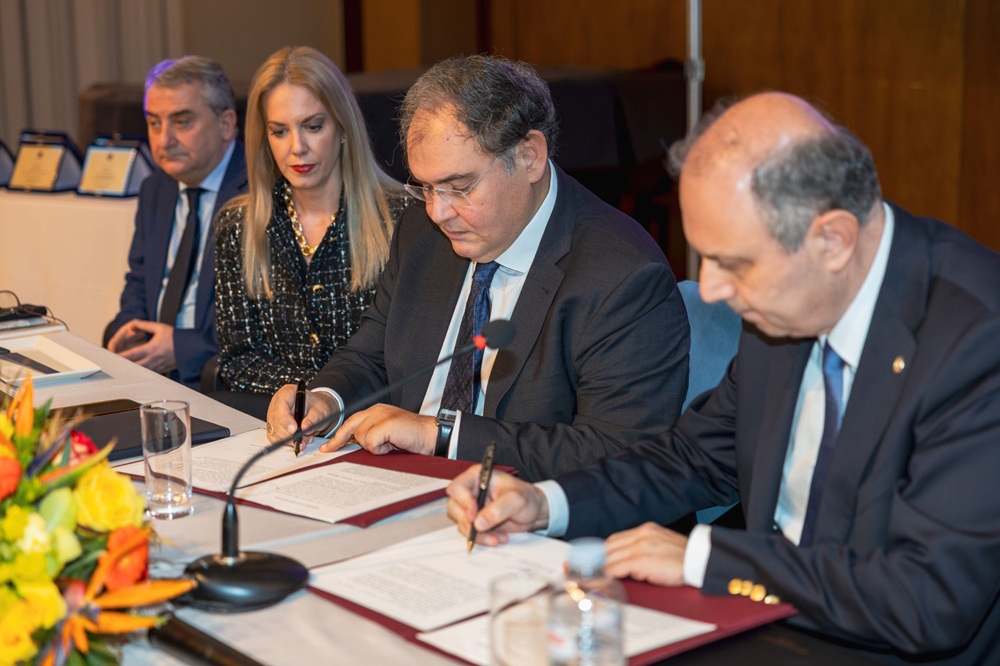
A memorandum of strategic cooperation was signed by Aristotle University and the National Hellenic Research Foundation (NHRF) on Monday, February 9, 2026, in Athens, laying the foundations for a broad and multi-level partnership in the fields of research, science, and education.
The Memorandum was signed by the Rector of Aristotle University, Professor Kyriakos Anastasiadis, and the Director of the National Hellenic Research Foundation and Chairman of the Board of Directors, Professor Demosthenes Sarigiannis, confirming the willingness of both institutions to strengthen their cooperation with a view to excellence and cognitive development.
Immediately afterwards, the Rector of Aristotle University, Professor Kyriakos Anastasiadis, gave a keynote speech on the topic: “Research: the present and future of Greek universities,” which naturally included commentary on current events.
In his opening remarks, Mr. Anastasiades referred to recent events at Aristotle University, noting that he was faced with the dilemma of whether to limit himself to the academic content of his speech or to comment on the developments of recent days. Referring to incidents in the courtyard of the Polytechnic School, the dissemination of inaccurate information about an alleged permit from the Rector’s Office, and premature public pressure on the institution’s administration, he emphasized that the competent authorities had already taken up the matter.
“I am referring to the slanderous dissemination of alleged information by the Ministry that we had given permission for the party that became a rallying point for the alleged defenders of freedom, as well as the hasty publication of an ultimatum to the Rector’s Office to provide explanations for what the prosecuting authorities, the preliminary investigation authorities, and the public prosecutor’s office should already be investigating—and indeed are investigating,” Mr. Anastasiadis emphasized, adding that Aristotle University is making a systematic and painstaking effort to make up for lost time and transform the largest public university in the country and in Southeast Europe into a truly international, digital, modern, and open to knowledge institution.
As he pointed out, the goal is for Aristotle University to become a model public university, noting that the success of this endeavor concerns not only the academic community, but the entire country. “It will happen because we all need it and because Greece needs it if it wants to claim a place at the forefront of the world stage,” he said, adding that this effort will go ahead “despite the reactions of reactionaries of all stripes and colors.”
The Memorandum of Cooperation was signed at the Athens Conservatory, at a special event organized by the National Research Foundation, in the presence of the Vice-Rectors: Research and Innovation, Professor Ioannis Rekanos, Academic Affairs and Development, Professor Nikolaos Mangioros, and International Relations, Extroversion, Lifelong Learning and Student Welfare, Professor Iakovos Michailidis.
The Memorandum
The Memorandum of Cooperation with the National Research Foundation provides, among other things, for the establishment of strategic cooperation in all areas of common educational, scientific, and research interest, the participation of both bodies in information, education, training, and research activities, as well as close cooperation between researchers, executives, and their units. education, training, and research activities, as well as close cooperation between researchers, executives, and their units. Particular emphasis is placed on the organization of lectures, seminars, workshops, and conferences, the joint use of infrastructure and know-how, and the creation of a framework that will strengthen research in areas of special interest.
At the same time, scientific cooperation is to be strengthened through the exchange of publications, educational material, data, and know-how, with full respect for intellectual property protection rules, as well as the submission of joint research proposals to national and European funding programs. The cooperation also focuses on the exploitation of the scientific work of the two bodies for the direct benefit of society, through the dissemination of knowledge, the provision of advisory services, and the exchange of good practices with local communities and national bodies.


Leave A Comment