An exhibition based on archives, documents, and official reports is one that requires the visitor’s time to read the texts and view up close the artifacts that, both figuratively and literally, make history.
At the heart of the exhibition: “In the Glorious Field. Missolonghi 1826, The Exodus,” co-organized by the National Library of Greece (NLG) and the General State Archives (GSA), are archival documents from the GSA pertaining to the siege of Mesolonghi, along with works of art, photographs, topographical maps, and weapons from the period.
The exhibition, divided into sections, traces the course of the Exodus. The texts bring to life the city of Missolonghi from the time it became a destination for philhellenes, Souliotes, and revolutionaries. How did the city prepare to face the Ottoman attacks, and what was life like within the city during the two sieges? In Missolonghi, printing presses were in operation—something by no means common for the time—there were provisions for the supply of weapons and food, and a police force had been organized with the dual purpose of ensuring security and tracking down and arresting spies.
As the Turkish siege tightened and the city’s problems grew ever more severe, the archives reveal the anguish of the city’s defenders as they appealed to the government for reinforcements and assistance.
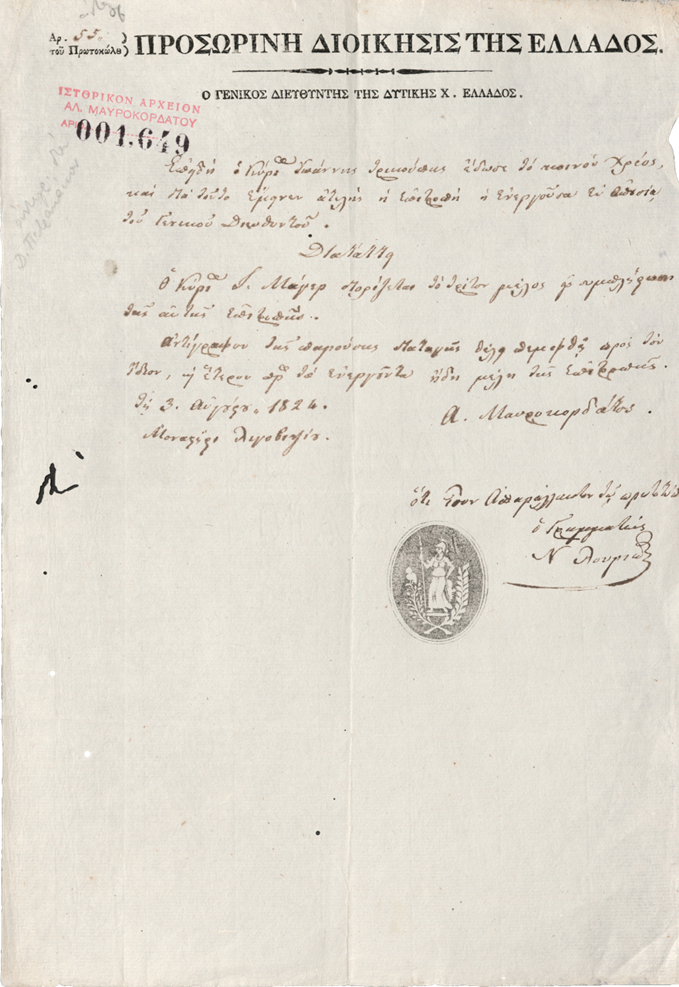
Order of the Provisional Administration of Greece appointing Ioannis-Iakovos Mayer as the third member of the Committee following the departure of Ioannis Trikoupis from it.
Ligovitz Monastery, August 3, 1824, GAK–Central Service, Alexander Mavrokordatos archive (K278), f.4a
The maps, designed specifically for the exhibition, complement the “narrative” by documenting the layout of the city walls, the places where many of the inhabitants met their deaths, and the locations to which they were sent as prisoners. The Kapodistrias government took special care of the latter, undertaking the difficult task of locating, freeing, and repatriating them.
This exhibition succeeds in shedding light on the difficult days of the siege through the wealth of archives held by the General Archives of the State (GSA) and the National Historical Archives (NHA). There is no single exhibit that takes center stage in the display cases. One visitor might pause at the Hymn to Liberty, the last book printed at the Missolonghi press; another at Ioannis Papadiamantopoulos’s letter to his family; another on the marriage contract for the wedding of garrison commander Dimitrios Makris to Eupraxia Razikotsika in February 1925, while Misssolonghi was already under siege.
These are small chapters of history that make up a great historical moment…


Leave A Comment