In 1925, Greece continued to manage the arrival and integration of refugees from Asia Minor, while thousands of new refugees continued to arrive after the Treaty of Lausanne.
In the country’s political affairs, the imposition of the dictatorship of Theodoros Pangalos on June 26, 2025, following the resignation of Prime Minister Andreas Michalopoulos, stands out. Eleftherios Venizelos, having resigned from the Liberal government in 1924, was in Paris working on a translation of Thucydides.
The population of Greece, according to estimates, was just over 6,000,000 and that of Athens less than 500,000, including, of course, thousands of refugees.
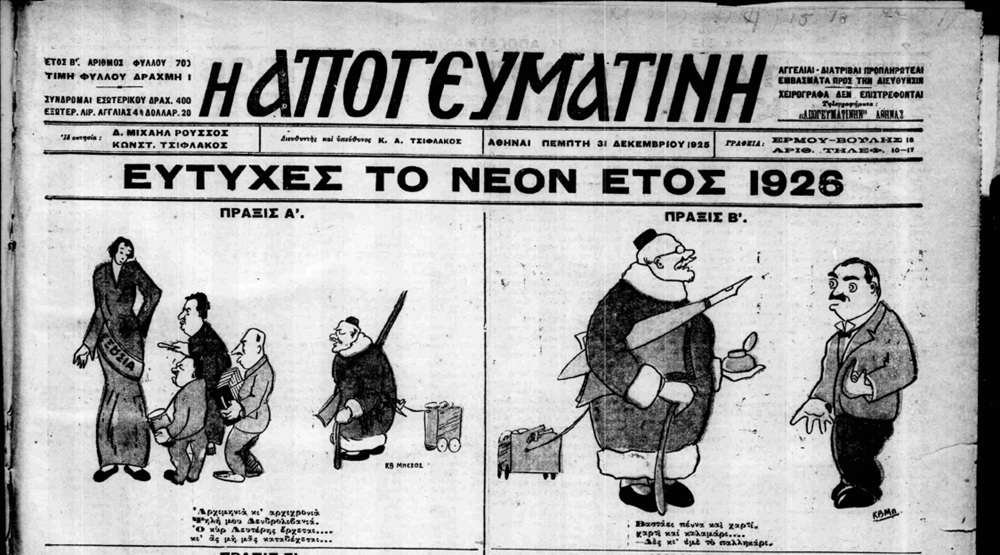
During the last days of December, newspaper headlines focused on the upcoming senatorial elections, the stance of the parties, the renewal of membership cards, etc. However, in the first days of 1926, the elections were postponed “indefinitely.” There is also extensive coverage of the outcome of the trial of student N. Tsetsas, who murdered Judge Nikitopoulos over an eviction.

There are also daily reports on issues concerning Bulgaria and the activities of komitadjis. Just a few months ago, in October, an unknown and “strange” Greek-Bulgarian war took place. A Greek soldier chasing his dog crossed the Greek-Bulgarian border at the border guard post. This was followed by an exchange of fire, the invasion of the Greek army, and the burning of Bulgarian villages. Although the Greek Army, after the Asia Minor disaster, was not in a position to wage a general war. The Bulgarian government appealed to the newly established League of Nations, which demanded the cessation of hostilities and the payment of compensation by Greece to Bulgaria.
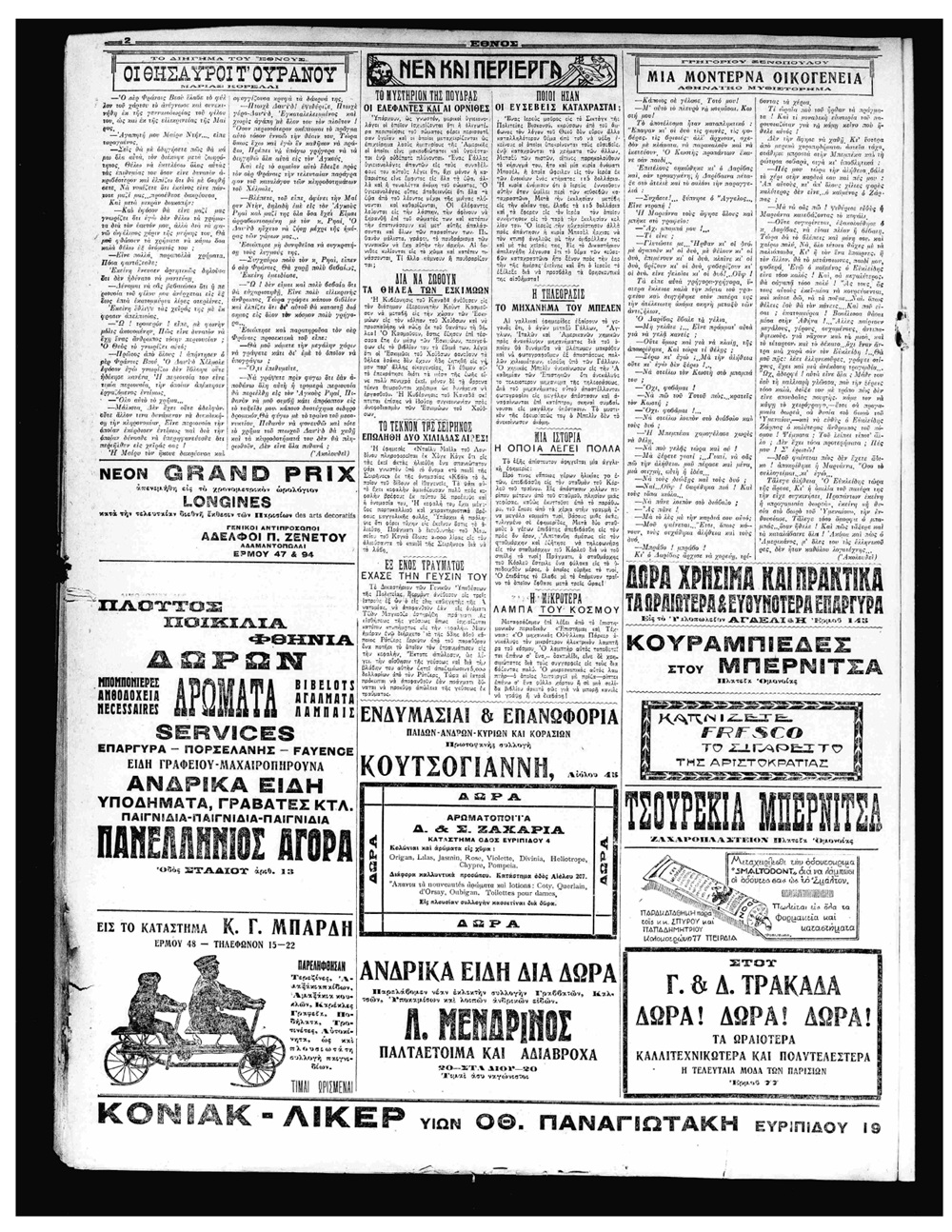
However, as the holidays approach, more and more articles and advertisements about gifts and events appear, if not on the front pages, then on the back covers of newspapers.
Focusing on these pages creates the image of a prosperous Athenian society, with its gaze turned more toward Europe than toward the refugee settlements.
The advertisements make it clear that the high-end shops were concentrated in the city center, on Ermou, Akadimias, and Stadiou streets. In fact, the City Police had banned vehicles from passing through Aiolou, Ermou, Stadiou, and Mitropoleos streets to facilitate the movement of shoppers looking for gifts for the holidays.
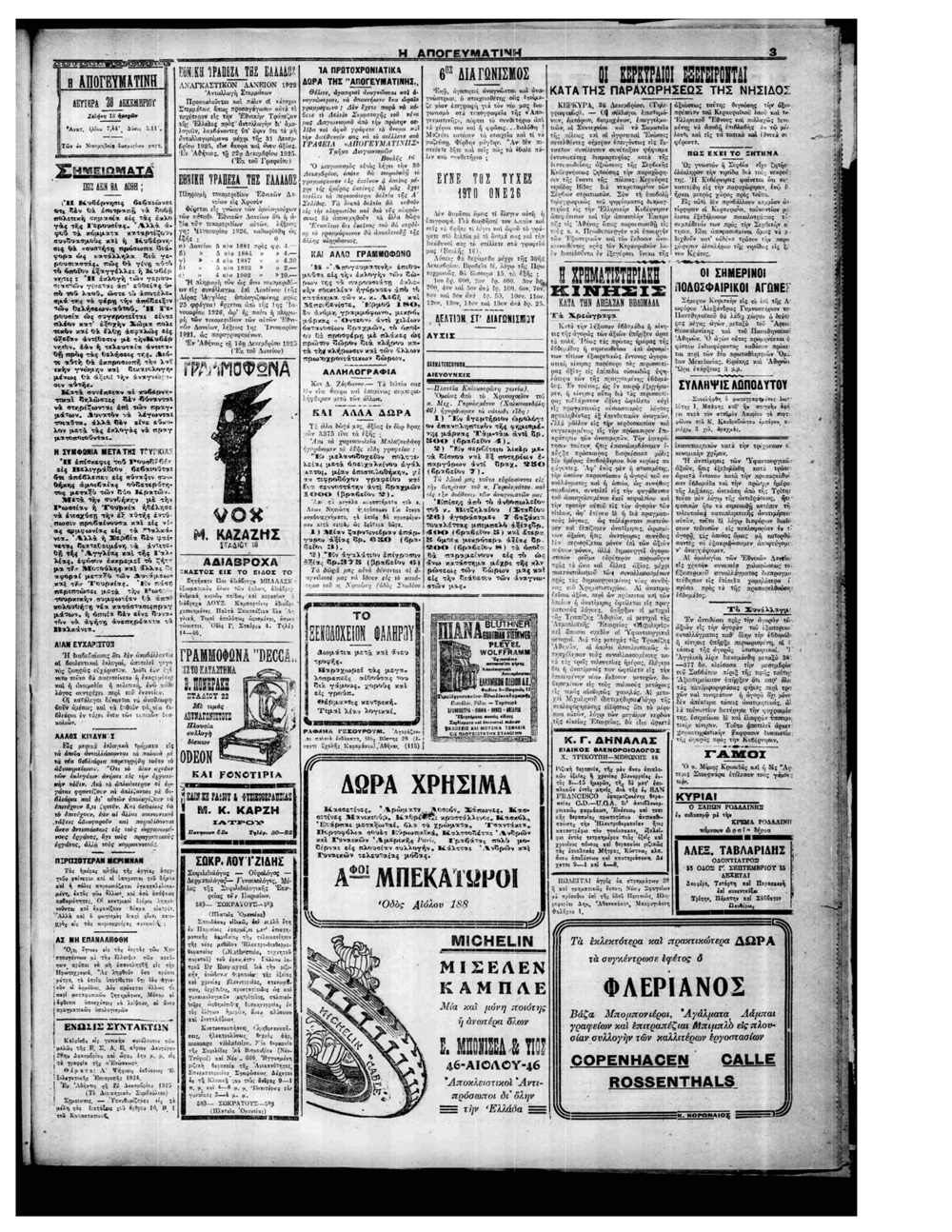
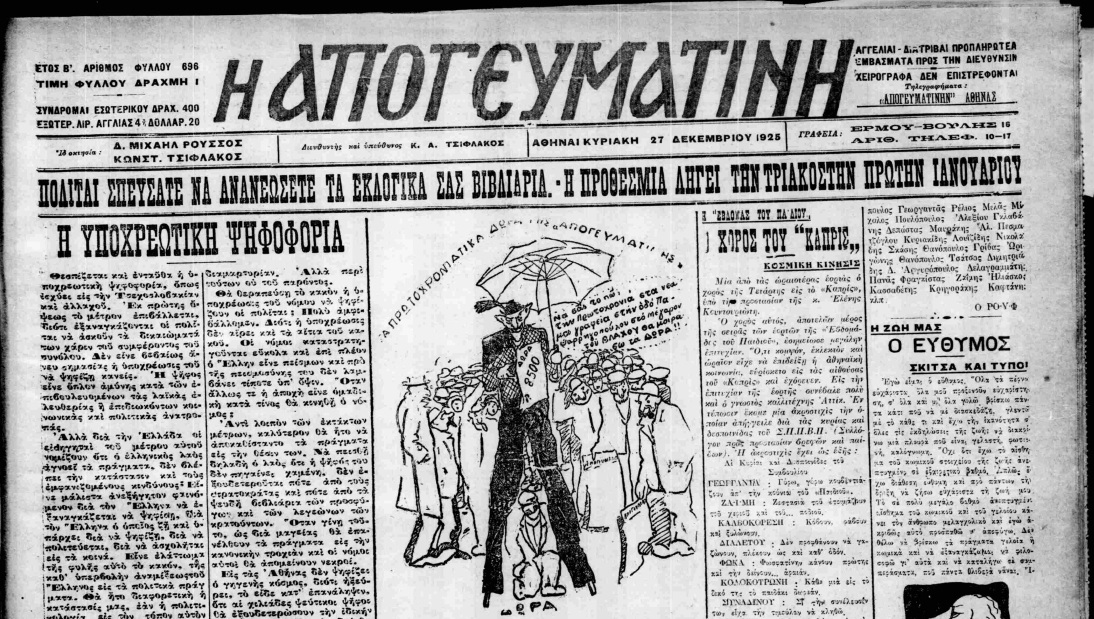
A typical advertising “trick” is to encourage consumers to choose “useful” gifts for the holidays. But what are useful gifts? According to the advertisements, they are: pen holders, “practical” Rohsenhtal porcelain, vases, statues, table lamps, desk lamps, and imported clothing. Among the ideas for practical gifts is the bicycle. It had appeared in Greece at the end of the 19th century, but by the 1920s it had become widespread as a means of transportation and a sign of modernization. The newspaper APOGEVMATINI followed the idea of giving gifts to its readers for the New Year. In fact, it did so in the form of competitions: readers were asked to find the missing vowels in sentences such as the historical phrase Μ Λ Ν Λ Β and send them to the newspaper’s offices to be entered into a draw to win gifts. The grand prize was a VOX gramophone. Gramophones were a much-advertised gift. The first gramophones arrived in Greece at the end of the 19th century and were considered a luxury item. In the 1920s, they began to spread to upper-class urban homes, and in 1928, COLUMBIA established a manufacturing plant in Greece. (https://vmrebetiko.gr/). But what did gramophone owners listen to? According to an advertisement by the Levis-Benveniste store, the latest Greek hits were the operettas: “Makris – Kontos” (Theofrastos Sakellaridis), “Modistroula” (N. Hatziapostolou), “Pan’oi Elpides” (N. Hatziapostolou), and Rosita (Serano?).

The music played at festive concerts in the cosmopolitan centers of Athens was similar. On December 22, KENTRIKON held a concert featuring the works of Manolis Kalomiris, on December 26 it organized a concert by the Athens Symphony Orchestra, and on December 29 a concert by Kl. Triantafyllou (Attik), who would not only present his hits, but also “whistle with a double whistle.” The very active KENTRIKON center was located in the arcade on Kolokotroni Street. It had been operating since the beginning of the century but experienced a great boom in the 1920s.
Another entertainment venue in Athens, the historic CAPRICE, advertised to the public with “Reveillon de Noel / Arbre de Noel, Jeudi 24 Decembre, Cotillon Etternnes.” The French text leaves no doubt that the advertisement was aimed at high society. Carpice was located on Valaoritou Street and was the first dance hall in Athens. At first, it was met with reservations by the Athenians. (https://www.taathinaika.gr/to-choreftiko-kentro-kapris-tis-odou-valaoritou-egine-aithousa-tis-gerousias/).
Another entertainment venue that advertised its Christmas Eve party was DELICE, which was even organizing a children’s dance with gifts. The advertisement emphasizes that the venue’s decorations included a Christmas tree. This was still a novel decorative idea, as the tradition of decorating trees began to spread in urban homes in Greece in the 1930s and even more so in the post-war years.
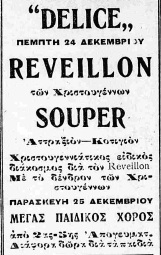
However, the sweets of the season were certainly already popular. Tsoureki, kourabiedes, and fruit – glazed, chocolate-covered, and fondant. Melomakarona are missing from the selection. Although this sweet has been known since ancient times, it was introduced to Greece by refugees from Asia Minor and became established as a Christmas treat. Thus, in 1925, either its consumption had not yet spread, or the middle-class community of Athens “despised” it.
Meat played a leading role at the festive table. As even today, there was concern about its sufficiency, and the Minister of the Internal Affairs took measures to address the problem. However, in the end, the measures did not seem to have the desired effect, as shortages eventually arose due to difficulties in imports from Russia and Serbia because of the winter.
100 years later. The city has changed, our needs have diversified, the pace of daily life has quickened. What remains constant is the magic and anticipation of the festive season.


Leave A Comment