
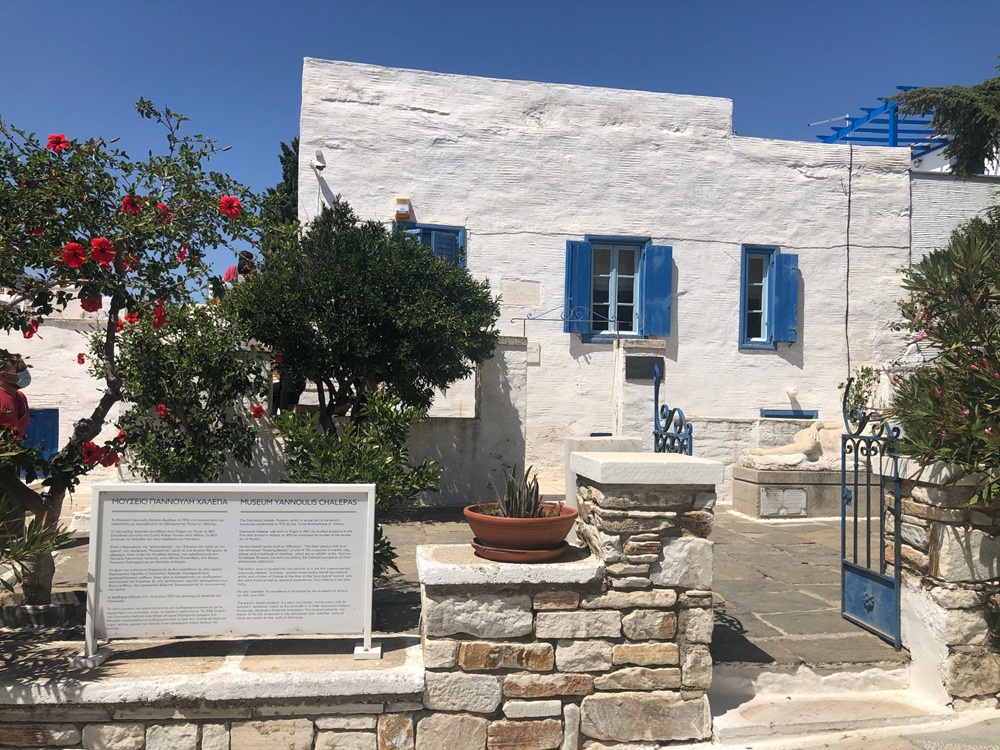
The Ministry of Culture, in its plan for the development and promotion of marble craftsmanship in Tinos, included the restoration and maintenance of the house of Giannoulis Halepas, a listed historical monument, with a re-exhibition of his works and personal belongings.
The Ministry of Culture is restoring the Halepa House with funds from the Recovery Fund, through the competent Service of Modern Monuments and Technical Works of Attica, Central Greece and the Cyclades, with the aim of highlighting the human dimension of the artist rather than analyzing his work stylistically. The spaces where he lived and created serve as an authentic setting for recounting his dramatic life, while his personal belongings reinforce the sense of authenticity. The spaces where he lived and created serve as an authentic setting for the narration of his dramatic life, while his personal belongings reinforce the sense of his physical presence. The exhibition material—personal objects, sculptures, and drawings by the great Tinian sculptor—is organized into narrative sections, suggesting the basic themes of the exhibition.
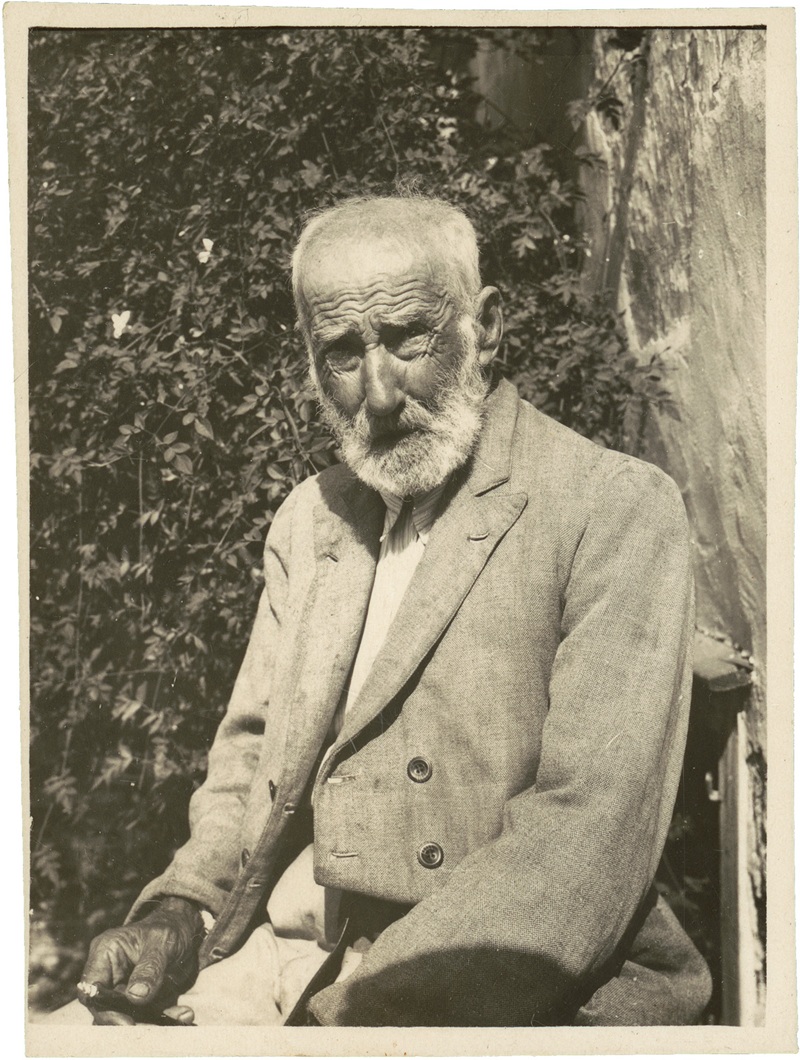
Halepas in the garden of his home in Pyrgos. Private Collection
The Minister of Culture, Lina Mendoni, stated: “In conjunction with the modernization, expansion of building infrastructure, and contemporary equipment of the Panormos Tinos School of Fine Arts and Marble Crafts — a project implemented by the Ministry of Culture, with resources of over €10,000,000 from the Recovery Fund — the historic house of Giannoulis Halepas, designated as a preserved historical monument, is being restored. The projects being carried out reinforce the identity of Tinos as a place inextricably linked to the art of marble, but also to the great Tinian carvers and sculptors. In the traditional settlement of Pyrgos, the artistic center of Tinos, where important Greek artists (D. Filippoti, N. Lytras, etc.) emerged, is the museum of the same name, named after Giannoulis Halepas, which ceased operations in 2023 in order to undergo restoration and maintenance work. In the two-story 19th-century building, the interior spaces function as exhibition spaces, while others, as well as various functional objects, recall the building’s original use as a residence, built with stone walls, wooden floors, a veranda, and a courtyard. Its architectural features differ from the traditional folk architecture of Tinos, probably due to alterations made during the artist’s lifetime. The restoration of the monument by the Ministry of Culture honors the artist’s memory, highlighting its authenticity and historicity through the proper display of its exhibits and movable equipment. The visitor’s experience is enriched by digital media, which complement the educational and entertaining nature of the exhibition, in terms of depth and experientiality.
During the period 2023–2025, the architectural study for maintenance and restoration, the museological implementation study, and the accessibility study were approved with the aim of promoting the house of Giannoulis Halepas and presenting his life and work using modern means. The main focus of the museological proposal is the life of Giannoulis Halepas, which is inextricably linked to the house. The exhibition is organized in a clear narrative sequence, with graded interpretative frameworks that are reflected in the museological structure. The sections are organized according to the defining milestones of the life and artistic career of Giannoulis Halepas, constructing the narrative of the “logical” and “metalogical” periods through sculptures, drawings, archival photographic material, and wall inscriptions.
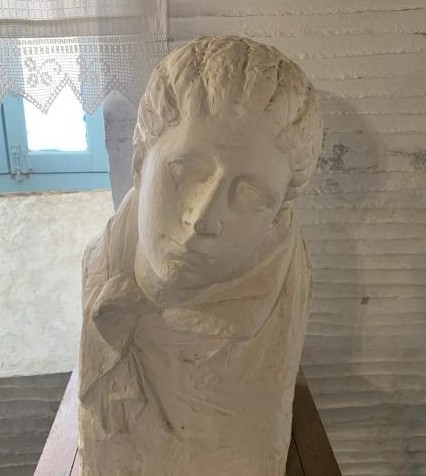
The collection of the house-museum includes 174 items: clay and plaster sculptures, drawings, photographic and archival material, clothing, and furniture. The exhibition presents 51 exhibits, including 16 drawings from the two phases of the “post-logical” period (1918–1930, 1930–1938) and 23 sculptures from his early academic work (1876–1877) and later phases (1918–1938). In addition, there are eight archival photographs, a relief medal with Halepas’ portrait, a handwritten note, the sculptor’s clothes, and furniture from his home. The documentation was based on bibliographic research and on-site recording of the collection and the space.
The exhibition aims to highlight the historic building, its collections, and their interpretation in a contemporary and explanatory manner, as it develops along four thematic axes: Chronology, Art, Technique, and the Artist’s Life. The upper floor presents Halepas’ biography with texts, digital applications, and exhibits from all periods of his creative life, as well as the wall inscriptions. The sub-sections cover his classical education, his early works, the creation of “The Sleeping Female Figure,” his mental illness, his awakening, his final creative period, and his ultimate recognition. The ground floor explores the themes of his art, technique, and life in Tinos, with sculptures, drawings, items from his workshop, personal objects, furniture, and audio narratives that bring visitors closer to the artist’s daily life and personality.


Leave A Comment