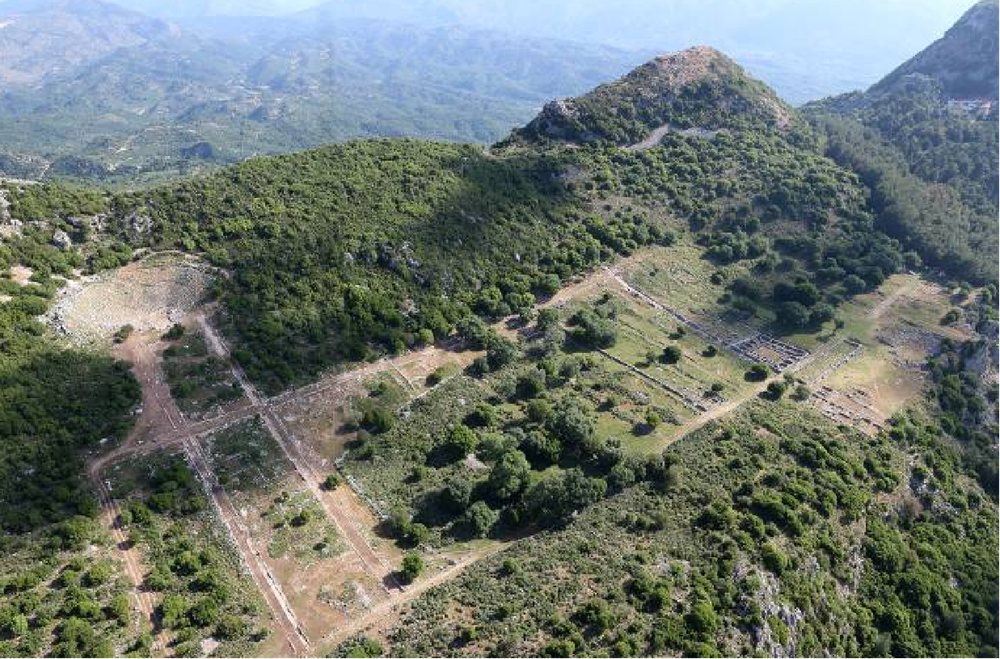
The Ministry of Culture, as part of its strategy of “equal access for all to our cultural heritage,” is improving, through the competent Ephorate, the infrastructure for unimpeded access and, at the same time, upgrading the archaeological site of Kassopi in Preveza, including interventions in the ancient theater, which is part of the Integrated Territorial Investment “Ancient Theaters of Epirus,” which has been developed and funded by the Region of Epirus through the Regional Operational Program “Epirus” – NSRF 2014-2020 and 2021-2027, both in the mountainous inland areas and in the plains and coastal roads.
The Minister of Culture, Lina Mendoni, stated: “Ancient Kassopi, founded in the 4th century BC in a strategic location with natural fortifications, is built on a small plateau on the western slopes of Zalongo, at an altitude of approximately 550 m. The terrain was considered ideal by the ancient Kassopians because it gave them complete visual control of the area. Our plan for the archaeological site of Kassopi included our comprehensive intervention in its restoration and promotion, as well as improving its accessibility. Recently, the restoration and enhancement of the ancient theater were completed, and work began on upgrading the existing parking lot and the new one under construction, improving the dirt road leading to the archaeological site, and upgrading the visitor reception facilities. The archaeological site is acquiring electric wheelchairs for the safe and comfortable movement of people with disabilities and visitors with reduced mobility. The vehicle allows visitors to tour the entire site, from the entrance to the ancient theater, with the option of stopping at selected viewing and information points. This enhances the inclusion and cultural experience for all visitors, without disturbing the aesthetics of the archaeological site and the integrity of the monuments.”
The use of an environmentally friendly UTV electric vehicle at the archaeological site requires no intervention, leaves no footprint during use, causes no noise pollution as it is an electric vehicle, and can comfortably and safely transport people with disabilities and mobility issues throughout the archaeological site, providing them with a complete experience of the city of Ancient Kassopι. The vehicle can carry up to four people and a load of 250 kg. A special configuration for wheelchairs is provided. The proposed route includes stops at important points in the site, offering a panoramic view and access to the theater. The vehicle follows a route that starts from the reception building and, via the construction site road, makes stops at selected points of the archaeological site to view important monuments and panoramic landscapes, such as the market, the bouleuterion, the prytaneion, the catagogeion, and the theater, with the option of disembarking at the orchestra. The return journey follows the same route, without stops, while visitors with disabilities are provided with transportation to and from the bus parking area. Information signs with QR codes for access to audiovisual material are placed at each stop.
Kassopi was the administrative and religious centre of the Kassopians. Organized as a city-state modeled on neighboring Ambracia, it developed rapidly and reached its peak at the end of the 3rd century BC, when it participated in the Epirote League, with a population of around 8,000-10,000 inhabitants. Despite the destruction of Epirus by the Romans in 167 BC, Kassopeia experienced a revival, but was finally abandoned with the founding of Nicopolis in 31 BC, when the Kassopians were forced to move there, as were the inhabitants of most of the cities around the Ambracian Gulf. In the centuries that followed, the area was never repopulated.


Leave A Comment