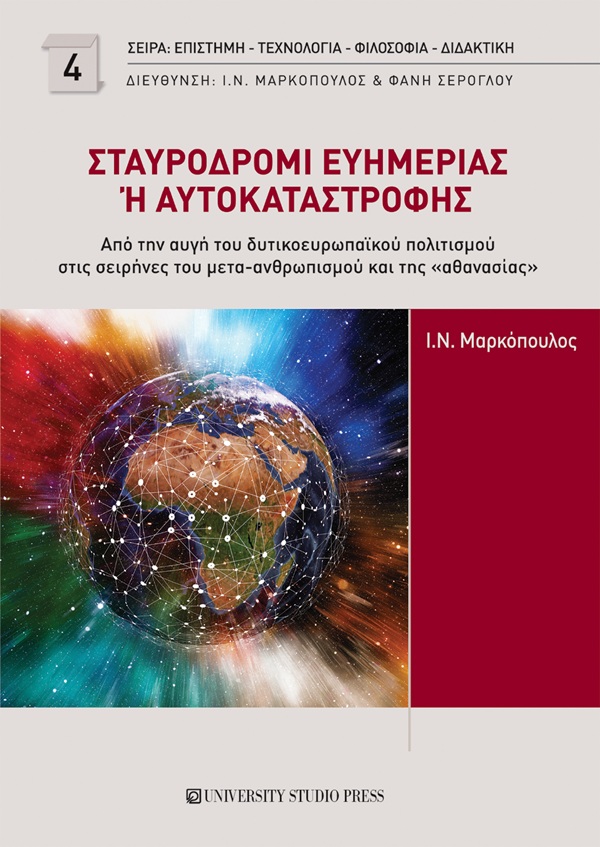
Title: A Crossroads of Prosperity or Self-Destruction
Author: Ioannis Ν.Markopoulos
Publisher: University Studio Press
Subject: Philosophy-Science
Year: February 2026
Pages: 208
Τechnical Features: 17Χ24
Despite significant social progress and tremendous advancements in science and technology, modern humanity has fallen into a dystopian state of intellectual, ideological, and moral confusion, as well as a sense of ambiguity and contradiction regarding its own achievements.
In this book—while simultaneously paying tribute to all those who have labored throughout history for the advancement of knowledge and the genuine well-being of humanity —the author endeavors, with objectivity and a sense of responsibility, to investigate this contemporary, globally dystopian situation. His intention is to identify and highlight, even if only minimally, certain pathogenic factors which, if they continue to exist, will lead us—instead of down the desired path of our true well-being—to our ultimate self-destruction.
Focusing on European culture—which for centuries has had a decisive influence on world history, not only through its authoritarian colonialism —but also, more broadly, on Western European culture, as it has historically influenced and continues, albeit to a lesser extent, to influence the world—it identifies and illuminates some of the myriad root causes of our contemporary global dystopia.
In this context, it highlights the historically, epistemologically, scientifically, and particularly virtue-theoretically grounded discourse of Greek—primarily classical—antiquity, which philosophically culminates in what is argued to be a virtue-theoretical and essentialist epistemology. He proposes as a solution the convergence of knowledge and ethics, since science and technology, in and of themselves, are not to blame for every instance of malpractice and destruction, but rather the eclipse of human moral and intellectual virtues.
● Ioannis N. Markopoulos is a professor of Technology and the Philosophy of Science and Technology at Aristotle University of Thessaloniki.



Leave A Comment