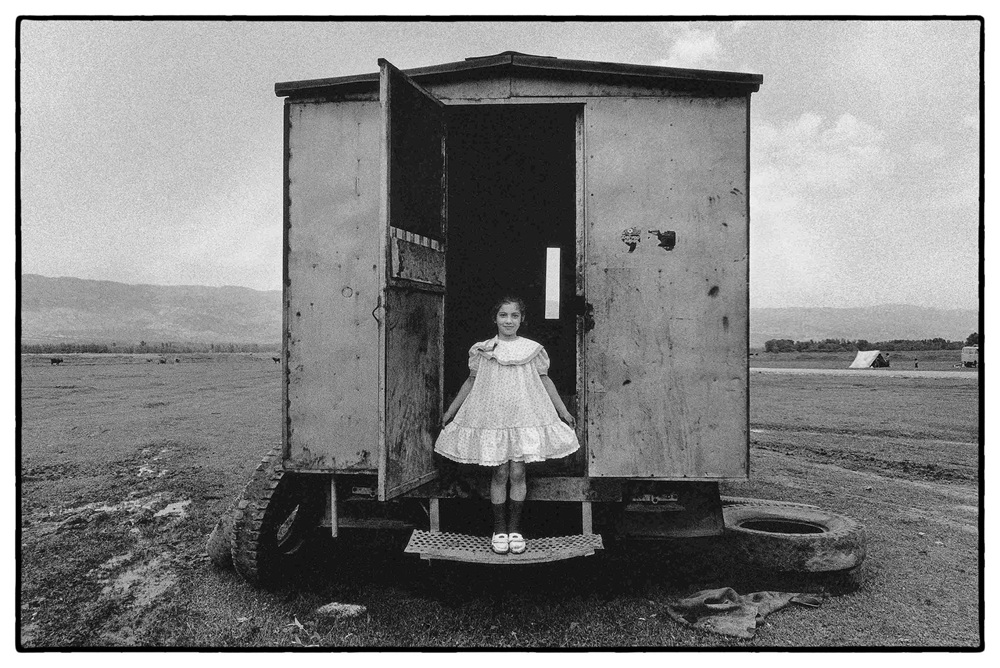
The exhibition “Three Paths: Constantine Manos, Nikos Economopoulos, Enri Canaj” presented at MOMUS-Thessaloniki Museum of Photography in collaboration with the Benaki Museum, from February 19 to May 24, 2026, is both an original proposal and a tribute. Using street photography, the dominant artistic trend in photography in the second half of the 20th century, it bridges three generations of creators with a common point of reference: their relationship with Greece and their membership in the renowned Magnum Photos agency, which, since its founding in 1947, has, to a large extent, written the history of the modern world in images.
In the 1960s, Greek-American Constantine Manos explored the country like a modern Odysseus, seeking to heal the latent trauma of immigration. Nikos Oikonomopoulos traversed Greece and the Balkans during the last two decades of the 20th century, focusing largely on vulnerable minorities and troubled communities. Greek-Albanian Enri Canaj, respectively, visits in the second decade of the 21st century a homeland he never really knew, but which is deeply imprinted in his childhood memories and still inhabits family narratives.
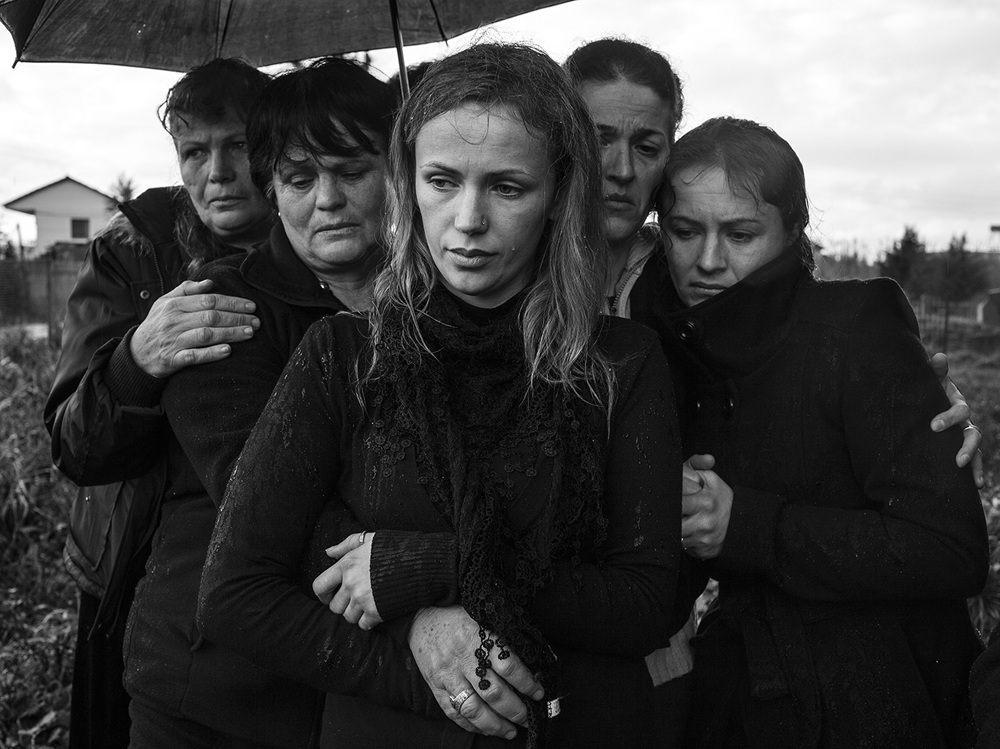
Enri Canaj
Women supporting each other during a funeral, Tirana 2012 © Enri Canaj – Magnum Photos
The vivid expressiveness of the snapshot, the focus on everyday, underprivileged people, the Balkan region as a cradle of shared experiences and traumas, the sometimes melancholic austerity of black and white tones in a contemporary world now clothed in bright, saturated colors, unite the three generations of creators, who maintained a relationship of support and/or apprenticeship between them. Walking through the exhibition, one also spontaneously identifies historical, aesthetic, and social connections in the work of the three photographers, as they distill the essence of life and photography from the world.
The works of Constantine Manos and Nikos Oikonomopoulos come from the collection of the Benaki Museum Photographic Archives, Athens.
Curated by: Iraklis Papaioannou, Curator, MOMUS-Thessaloniki Photography Museum
Artists’ Talks
MOMUS-Thessaloniki Photography Museum (Warehouse A, Pier A, Port of Thessaloniki)
Friday, 20 February 2026, 19:00-21:00
Photographers Nikos Oikonomopoulos and Enri Canaj discuss their work and the dimensions of street photography in the modern era with the exhibition curator, Iraklis Papaioannou, and the audience.
The discussion will be held in Greek, without interpretation.
Participation is included in the exhibition admission ticket.
CV’s
Constantine Manos (1934-2025) was born in Columbia, South Carolina, to Greek parents. At the age of nineteen, he was hired as the official photographer for the Boston Symphony Orchestra. He studied English literature and worked in New York as a photographer for Esquire, Life, and Look magazines. From 1961 to 1963, he lived in Greece taking photographs for the series A Greek Portfolio, which was published as a book in 1972 and won awards at the Arles Photography Festival and the Leipzig Book Fair. while the same series secured Manos’ acceptance as a regular member of the Magnum Photos agency in 1963. His photographs can be found in the collections of important institutions such as the Museum of Modern Art in New York, the Museum of Fine Arts in Boston, the Art Institute of Chicago, the Museum of Fine Arts in Houston, the George Eastman House in Rochester, and the Benaki Museum. In 1982, Manos transitioned from black-and-white to color photography. In 1995, he published the book American Color, followed by American Color 2 in 2000. In 2003, he received the Leica Medal of Excellence award.
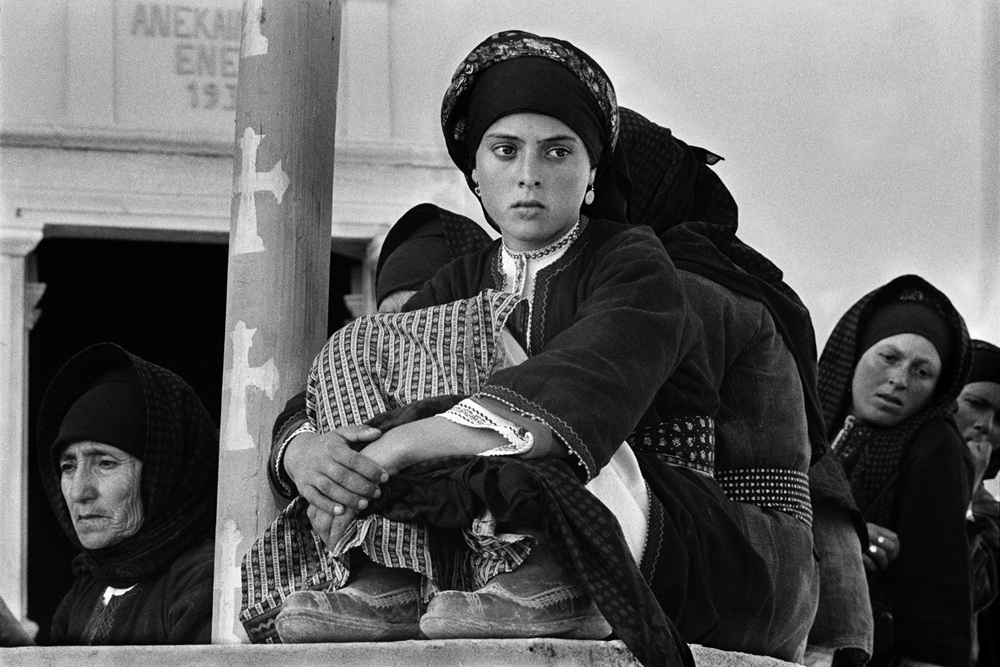
Constantine Manos
Olympus, Karpathos
© The Constantine Manos Foundation, Inc
Nikos Oikonomopoulos was born in the Peloponnese in 1953. He studied law and worked as a journalist in Parma, Italy, before devoting himself to photography. He joined Magnum Photos in 1990 after Constantine Manos suggested it, and his photos started showing up in newspapers and magazines all over the world. Around the same time, he started traveling and taking lots of photos in the Balkans. This series won the Mother Jones Award for work in progress. Upon completing the Balkan project in 1994, Oikonomopoulos became a full member of Magnum Photos. His book In the Balkans was published in 1995 in New York and Athens. In the 1990s, Oikonomopoulos began working on the theme of borders and border crossings, photographing the inhabitants of the “Green Line” in Cyprus, irregular migrants on the Greek-Albanian border, and the mass migration of Albanians from Kosovo. In the mid-1990s, he began photographing Roma communities and other minorities. In 2002, a retrospective edition of Oikonomopoulos’ work, Photographer, was published and presented as an exhibition at the Benaki Museum in 2005. Oikonomopoulos has turned to color photography and spends most of his time outside Greece, traveling, teaching, and photographing around the world.
Enri Canaj was born in Tirana, Albania, in 1980. He moved to Greece with his family in 1991. He studied photography in Athens and in 2007 participated in a British Council program on migration, attending a year-long workshop with Nikos Economopoulos. Since 2008, he has been collaborating with major national and international media outlets and is now a member of the Magnum Photos agency. Based in Athens, he has exhibited his work extensively in Greece as well as in Belgium, Luxembourg, France, Switzerland, Italy, and Germany, and has had a solo exhibition at the Rencontres d’Arles photography festival. His work has been honored with awards and distinctions and has been published in media outlets such as Times Magazine, CNN, The Guardian, New York Times, Financial Times, Newsweek, National Geographic, Le Monde, Wall Street Journal, and Arte TV. He has collaborated with institutions and organizations such as Princeton University, UNICEF, Melissa – Network of Migrant Women in Greece, MSF, Solidarity Now, the European Parliament, and the Thessaloniki Documentary Festival.
Translated with DeepL.com (free version)



Leave A Comment