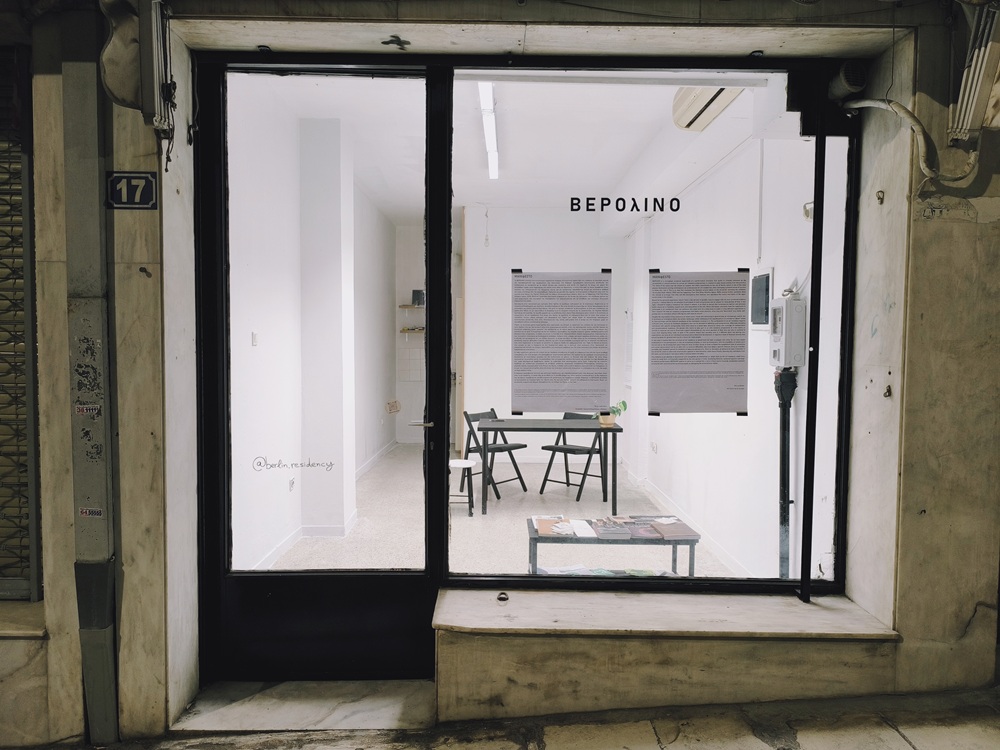
ΒΕΡΟλΙΝΟ functions as a conceptual, long-term performative experiment, which takes place not in Berlin but in Athens, using Berlin as a symbolic point of reference: a creative place often associated with professional success, mobility, and networking in the contemporary art world. The project poses the question: what does participation in an artist residency program mean today, and what costs (financial, labor, personal) does it entail?
Based on the personal work experience, academic and editorial activity of its founder, ‘Elli Leventaki, ΒΕΡΟλΙΝΟ highlights the class inequalities inherent in the residency system, excluding individuals with stable employment, family obligations, or mobility restrictions. Despite the rhetoric of inclusion, the art world often presupposes ‘free time’, financial security and availability, forms of immaterial labour that remain invisible but are decisive.
The project moves between curatorial gesture and institutional critique, attempting to deconstruct the mechanism of artistic hospitality from within and open a public dialogue around labor, privilege, networking, and sustainability in art today.
ΜΑΝΙφESTO| By Elli Leventaki, Art Historian and Exhibition Curator
ΒΕΡΟλΙΝΟ is a conceptual curatorial experiment of a performative character that seeks to critically comment on the accessibility of cultural workers to various art residency programmes, in relation to class issues arising from this practice. The name of the space was not chosen at random, but refers intentionally to the city of Berlin, which is one of the most popular destinations among contemporary art professionals for art residencies, often conveying a pretend sense of success to those who visit it. This is an idea that concludes the thematic around labour in the Artworld, following the exhibition Cornucopia (Kyan Athens, 2023) and the happening Free Time (Okay Initiative Space, 2025), posing further questions about the concept of privilege, free time, and the mechanisms that maintain and reproduce the reality and habits of the upper social strata in the industry.
Based on my personal experience, where I have a day job and, in parallel, have to engage with my own curatorial/academic projects, I realised that it is not possible to participate in such programmes and be absent for long periods of time. In this light, I decided to create a “residency” for myself in Athens, in an effort to disrupt this contemporary barrier and stimulate public discourse on flexibility, unpaid work, and inequalities in the arts. Which individuals ultimately have the opportunity to participate in art residencies? How can someone who must work on a daily basis to make a living add such experiences to their resume? Do most art residency programmes even make sense anymore, when they are “decorative” (e.g. online, self-guided, etc.) or even paid, without offering any real value in return?
Despite the degradation of this institution in recent years, travel and networking in general play an increasingly central role in professional emergence within the artistic landscape, while continuing to be manifestations of immaterial labour linked to class privilege and the material conditions of the individuals involved in it. The participation in an art residency requires sufficient time, unbound by livelihood obligations that can be devoted to attending such programmes, effectively excluding individuals with specific backgrounds. Even when there is a small daily allowance, along with coverage of transportation and accommodation expenses, the person who wants to take part in an arts residency programme of a few weeks or months is required not only to financially support themselves for the entire duration of their stay, but also to continue to cover their ongoing living costs. In spite of the positive impact that spending time in a different place and gaining new experiences can have on an individual’s personal and professional development, it requires a level of financial security that cannot be taken for granted and may be a luxury for many people.
In any case, it seems that the structure of art residency is aimed from the start at people who either do not have stable employment or are unemployed, or take on occasional projects, or work as freelancers, with the possibility of remote work and are not at risk of losing their jobs if they are away. In other words, in order to follow the established rules of networking and career advancement set by an elite with no financial difficulties, one must adopt a specific lifestyle, living as a flexible, available, and “resilient” person in conditions of absolute job precarity. There is, therefore, an absence of class inclusivity3in the Artworld, which is otherwise emphatically opposed to discrimination, while hypocritically allowing only individuals from the upper social strata to reproduce within it without others intruding.
This initiative is an attempt to deconstruct and renegotiate an institutional paradigm such as the art residency, which here, unlike its usual form, is financially supported by the very person it hosts. Oscillating between curatorial gesture and long-durational performance, ΒΕΡΟλΙΝΟ aspires to serve as a catalyst for a more critical stance towards established systemic structures and conventional forms of expression, by disrupting the Artworld from within.
berlin.residency
Megalou Spilaiou 17, Athens, Τ.Κ. 11522


Leave A Comment