Marginalia Gallery (Strovolos, Cyprus) presents, on Friday, May 8, 2026, at 7:00 p.m., an exhibition of paintings by Cypriot artist Rhea Bailey titled “Circles – All is in Flux”
Duration: May 8, 2026–May 30, 2026
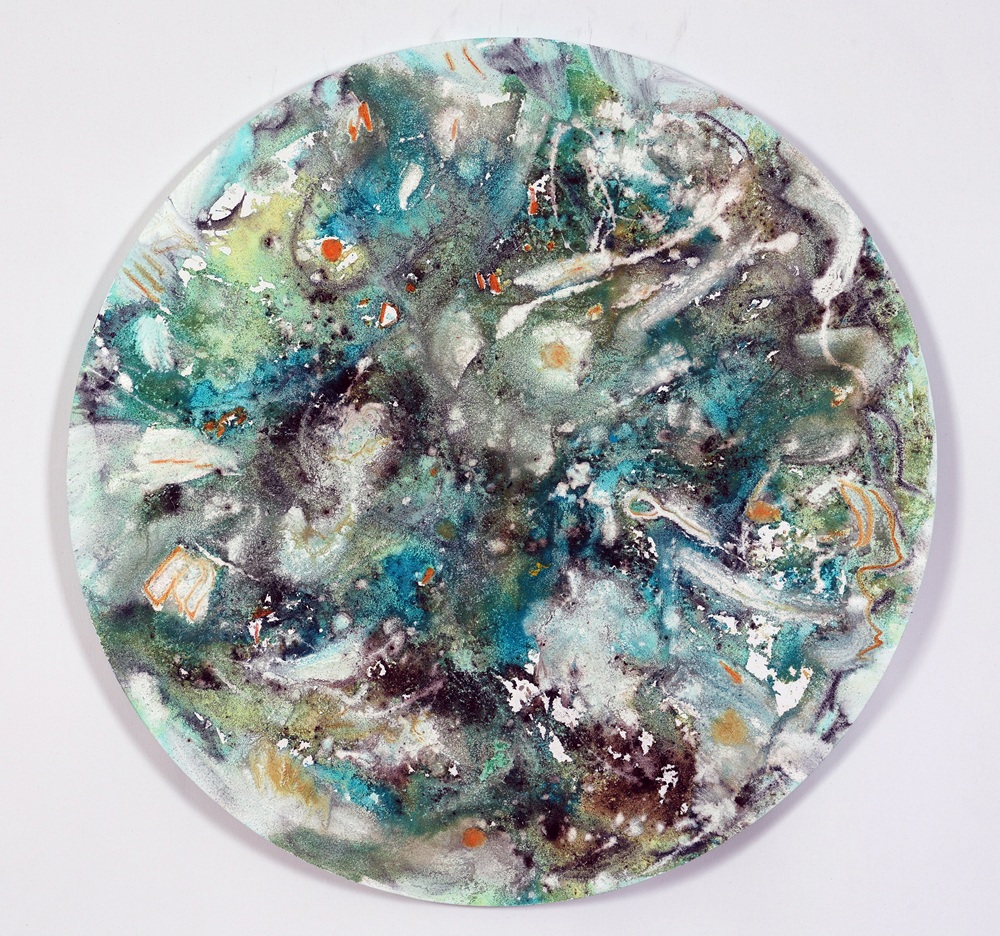
n her exhibition All is in Flux, Rea Bailey brings transformation to the forefront, both as a subject and as a mythological approach. The circular composition suggests a sense of wholeness and comprehensiveness, even though what unfolds within it resists stagnation; forms appear only to dissolve, and clusters emerge, scatter, and reform in the eternal state of becoming.
The work aligns with Heraclitus’ timeless proposition, “Everything flows; nothing remains static,” positioning change not as an incidental quality, but as the very condition of existence.
Rather than depicting static entities, Bailey creates a field of material mobility where color behaves as an active medium that diffuses, reacts, and connects with transcendent forms that oscillate between the microscopic and the cosmic, evoking cellular structures, ecological systems, or planetary fantasies without settling into a singular identity.
This premise aligns with Gilles Deleuze’s idea that “becoming is neither one nor two… but the in-between”—a space in which Bealy’s work resides precisely.
Here, form remains provisional and contingent, never fully resolved but constantly unfolding through the interplay of control and chance. Such an approach is reminiscent of process-based practices in contemporary art, where, as Robert Morris observes, “the focus on matter and processes rather than fixed forms challenges the perception of permanence in art.” In Bailey’s composition, the circular boundary does not fix the representation; rather, it frames a dynamic system within which a material transformation is constantly taking place. This view is further illuminated by Tim Ingold’s assertion that “the forms of the world are not imposed upon matter, but emerge from the flows and transformations of materials”—a view that finds direct expression in the painter’s method.
Ultimately, “Everything Flows” does not merely depict transformation; it brings it about.
The work presents instability not as disruption but as a productive state—through which complexity, vitality, and meaning constantly well up.
Dr. Arafat Al-Naim
Prof. of Graphic Arts, Design and Visual Culture
American University in the Emirates


Leave A Comment