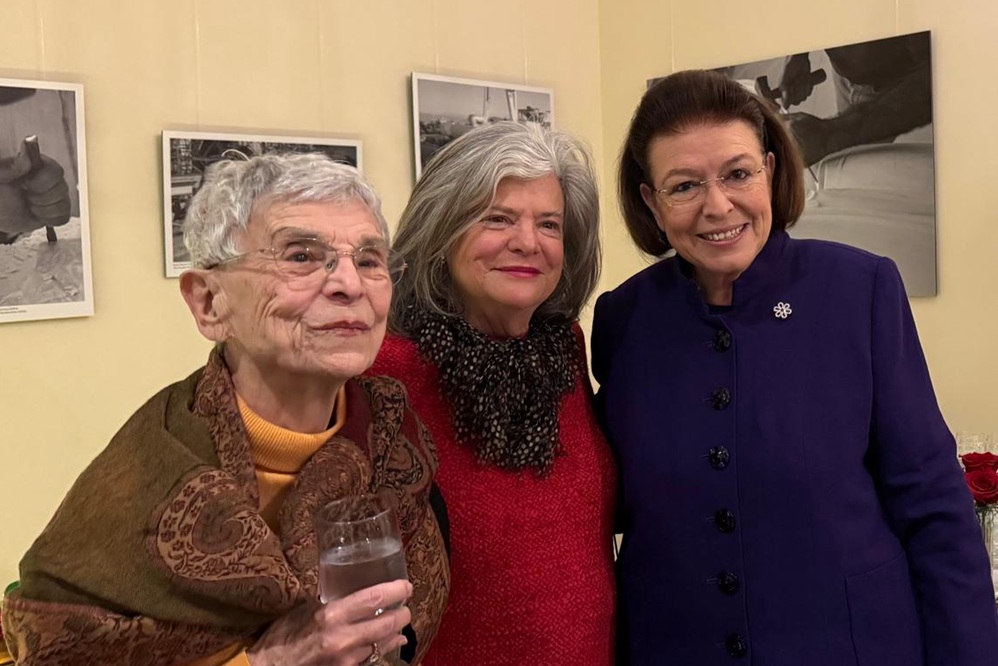
The strategic principles and key priorities of the Greek government’s cultural policy were presented yesterday by Minister of Culture Lina Mendoni, as a guest of the Center for Hellenic Studies at Harvard University.
The basic principles of preserving, protecting, and promoting Greece’s heritage, as well as contemporary artistic creation, the recognition and promotion of culture as national development capital and a fundamental lever for the intellectual, economic, and social revitalization, progress, and prosperity of the country, were presented in detail by Lina Mendoni to the large audience that attended her speech.
“Our heritage,” said the Minister, “must be protected, but not frozen in time. Museums, monuments, and archaeological sites are living parts of society, connected to communities, attracting visitors, and generating cultural, educational, and economic activity. When integrated into everyday life, heritage thrives, creating stronger incentives for protection and greater social impact.”
A key parameter for cultural heritage and contemporary creation is that it leads to economic growth, generates income and jobs, attracts investment, and boosts tourism, with which it is closely linked. “Monuments and museums,” said Lina Mendoni, “are not places of consumption. They are landmarks embedded in collective memory and identity. They unite generations, strengthen pride and social cohesion, and promote the image of a region beyond national borders.”
A fundamental principle, since 2019, when he took over the governance of the country, was that a fundamental change in cultural management was required so that culture could fulfill not only its vital social role, but also its developmental one.
“Over the past six years,” the Minister of Culture pointed out, “we have worked systematically to implement a new, flexible, and dynamic model, redefining both our goals and our methods. This approach is based on scientific knowledge, data analysis, coherent design, and realistic planning. It seeks to achieve multiplier effects and economies of scale, enhancing innovation, improving efficiency, and ensuring the efficient use of funding and resources.”
He then presented the “Cultural Charter for Development and Prosperity” for the 13 regions of Greece, with a planning horizon until 2030. The Charter serves as a dynamic roadmap for culture, as a strategic lever for development and social cohesion, as it is tailored to the needs of each region, including major infrastructure projects, cultural support, and institutional reforms.
”The Ministry of Culture, using EU funds from the NSRF and the Recovery and Resilience Fund (TAA), together with national funding, is implementing the largest cultural investment program ever undertaken in Greece: Over 850 projects and initiatives with a total budget exceeding €1.3 billion—in addition to its daily operations. These projects act as catalysts for local economic activity, strengthen the social cohesion of communities, promote balanced regional development, and currently employ thousands of people, directly and indirectly,” said the Minister of Culture. She noted that “since 2019, 28 new or fully restored museums have been opened to the public, while another 28 museums are planned and will be completed by 2028.”
Special mention was made of the Ministry of Culture’s program for the restoration and reuse of the former royal estate in Tatoi. “The project to restore and convert the estate into a vibrant cultural and entertainment hub is a milestone in the preservation of Greece’s heritage. This initiative aims to revitalize one of the country’s most historic properties by preserving its architectural heritage, restoring the royal residences and auxiliary buildings, and converting them into museums, exhibition spaces, and cultural venues. Beyond the built environment, extensive landscaping will transform the estate’s grounds into accessible green spaces for recreation and outdoor activities, promoting sustainable tourism and social engagement while respecting the site’s historical significance while creating a modern destination that harmoniously combines culture, nature, and recreation.”
Lina Mendoni referred extensively to the use of information technology and digital tools, in which the Ministry of Culture is investing, as in recent years it has significantly promoted the digital management of Greece’s cultural heritage through large-scale projects within the framework of the National Monuments Archive. “We have adopted emerging technologies, such as virtual and augmented reality for digital tours and educational experiences, alongside collaborations with major technology companies, including Microsoft and Google. Today, our comprehensive strategy for integrating Artificial Intelligence into key areas is underway, such as accelerating the digitization and documentation of cultural assets, enhancing conservation and ongoing monitoring, combating the illicit trafficking of antiquities, providing personalized cultural experiences, supporting research through big data analysis and machine learning, and developing ethical frameworks for transparency and data protection.”
The Minister of Culture insisted on the Ministry’s strategic goal: The protection of Greek cultural heritage from illegal trafficking, which is not simply a form of criminal activity, but a complex phenomenon linked to organized crime, resulting in the loss, fragmentation, and often irreversible destruction of the historical and cultural memory of nations. The Ministry’s strategy focuses on prevention, international cooperation, and the systematic repatriation of antiquities from foreign museums and private collections.
“This commitment of ours,” said Lina Mendoni, applies even more to Greece’s long-standing request for the repatriation and reunification of the Parthenon Marbles, which have been in the British Museum for more than 200 years. The Greek request for the sculptures began even before the Greek state was officially founded. Over the past six years, however, the landscape has changed significantly. Globally, governments, museums, and civil society are increasingly recognizing the need to correct historical injustices in the handling of cultural heritage. Our pressure on the UK government and the British Museum administration is steadily increasing.
Concluding her speech, Lina Mendoni noted that “the transformative potential of Greece’s cultural heritage is enormous when effectively integrated into holistic management and utilization strategies. By investing in culture, Greece can achieve economic growth, social progress, and cohesion. Such investments must be based on a combination of modern methods and practices with the necessary respect for our timeless values and traditions, while preserving both the physical and conceptual integrity of our cultural assets and ensuring environmental sustainability. This principle underpins our entire policy, which I believe ensures the long-term role of cultural heritage as a sustainable, vital resource for future generations.”




Leave A Comment