
In his heartfelt message accompanying the announcement of the program of artistic events that theatergoers will enjoy in June 2026 at the Odeon of Herodes Atticus, the new artistic director of the Athens & Epidaurus Festival, Michail Marmarinos, emphasizes:
“In June 2026—a month of special significance—thanks to an ingenious gesture that transforms a temporary setback into an opportunity for creativity, the Odeon of Herodes Atticus, just before it is sealed off and falls silent for several years, (so that, through an inspired and necessary project of restoration, reconstruction, and revitalization, it may carry forward into the next century its symbolism and significance for cultural life) opens its gates for a single month—this special June. This provides the opportunity for a wide range of artistic events to take place as Farewell Festivities. One might say that all the events to be presented this year on the Herodion stage—every unique night, every kind of “Tribute”—constitute a special Farewell Festivity.”
SCHEDULE OF EVENTS
OPENING CEREMONY: CLASSICAL MUSIC – FIRST PERFORMANCE IN GREECE –
June 3
Vikingur Ólaffson: Works by Bach, Beethoven, Schubert
The pianist Víkingur Ólafsson, originally from Iceland, is undoubtedly a rare phenomenon of our time. Now in his early forties, his performances have lost none of the youthful enthusiasm, the groundbreaking spirit, and the profound spirituality that have characterized him since he burst onto the global music scene fifteen to twenty years ago. One of the most acclaimed artists of our time, having signed an exclusive contract with Deutsche Grammophon years ago, Olafsson is above all a visionary musician, and his artistic choices stand out for their originality and the subversive perspective with which he approaches well-worn works—landmarks of the piano repertoire.

MUSIC EVENT AND SCREENING
June 4
The Avex Ensemble Blade Runner Live
I’ve seen things you people wouldn’t believe All these moments will be lost in time, like tears in rain When two people meet for the first time and share references to explore whether there is common ground between them, the reference to Blade Runner melts away any distance and becomes a tender code of understanding. Nearly half a century after its release, this futuristic noir—filled with darkness, rain, neon lights, and shadows slipping past the corner of the eye—holds a prominent place in the history of cinema and, above all, in the hearts of lovers of the future everywhere.
This is the film that restored science fiction to its rightful place and established it as a respected genre of fiction, bringing it back from the (self-imposed) exile it had fallen into as a genre aimed at the “select few.” It is also the soundtrack that brought electronic music into every home: Vangelis’s sweeping synth cathedrals forever haunted the cinematic imagination and the nascent genre of electronica, while setting the standard against which every original score would be measured in the future. Legend has it that there was never a definitive version of the film, but seven different incarnations of it.
Like an ironic echo of the theme of the replica that runs through the film, Vangelis’s music remains singular and unwavering, like a film within a film. It is not so much a soundtrack as a pulse running alongside and within the image, a valuable dramatic guide for every emotion articulated within Ridley Scott’s dystopian vision of the future. Vangelis’s music possesses a unique compositional genius. In the iconic “Love Theme” and “Runner’s Blues,” the melody emerges like an inner monologue, coloring the most fragile aspects of a world that oscillates between the human and the mechanical.
On June 4, beneath the Acropolis rock, the final cut of the historic film will be screened on a monumental HD screen, while the iconic score will be performed live by the eleven-member The Avex Ensemble, in perfect synchronization with the film. It is a moment of mysticism: a fragment of the future comes to life within the shell of the ancient theater, just before it closes for restoration work.

MUSIC
June 5 & 6
Stavros Xarchakos: In the Present
We can imagine Stavros Xarchakos’s evening at the Odeon of Herodes Atticus as a play in three acts. Part One: A meeting of two artists in the Present. He and Lina Nikolakopoulou converse and sing together, accompanied by a piano and a string quartet. He conducts. He comments. He reminisces. Part Two: The recent musical present. Iro Saia takes the stage and performs new songs she wrote for him. Part Three: The Everlasting Present. Dimitris Basis takes the stage, and together they perform songs that have found a place in our hearts and become part of our tradition. Joining them are the children of the “En Chordais kai Organois” School of Syros, whom many remember from the spontaneous musical moment in June 2022 on Syros —an evening at a tavern on the island, when the composer conducted them and the video of that moment went viral. Today, those children have grown up; some are already college students. For Stavros Xarchakos, the presence of children at the concert symbolizes the present, which is also the future. Thus, on the stage of the Odeon, generations come together, and the concert’s title takes on its most profound meaning: the present of music is where memory, experience, and new creation become one. Because whatever endures over time, Continues…

June 9
Select Epirus Ensemble – Vasilis Kostas Epirus “SPECIAL FEATURE” MUSIC
Featuring Kostas Tzimas, Antonis Kyritsis, and Petros Chalkias
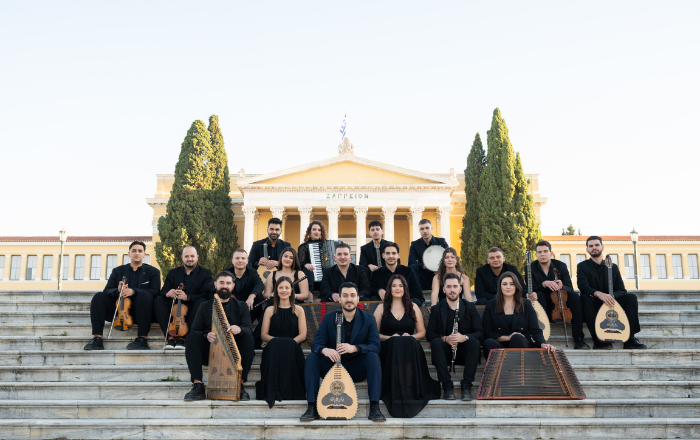
The “Epirus” tribute is a musical celebration of memory and continuity, dedicated to the rich tradition of Epirus music and its unwavering journey through time. At the heart of the performance lies the legacy of the late Petroloukas Chalkias, serving as a reference point for how the music of Epirus is transmitted, evolves, and gains new life through subsequent generations.
Under the artistic direction of lute player, lecturer at Hellenic College Holy Cross in the U.S., and Grammy nominee Vasilis Kostas—whose decade-long apprenticeship and collaboration alongside Petroloukas Chalkias shaped a valuable core of knowledge and aesthetic sensibility —this material now finds new expression through the Epilektos Epirus Ensemble, the performance’s main orchestra. The twenty-member ensemble of young musicians from all over Greece, based in Ioannina, brings to the stage a creative dialogue between the authentic interpretation of traditional folk songs and new orchestral approaches, preserving the character of the Epirus dialect and offering a contemporary artistic perspective on the region’s rich musical heritage.
The performance features guest musicians Kostas Tzimas (vocals), Antonis Kyritsis (vocals), and Petros Chalkias (clarinet), figures deeply rooted in the Epirus tradition who perform on selected tracks, reinforcing the intergenerational nature of the tribute with their presence. The coexistence of musicians from different generations creates a space where memory functions as a direct experience rather than a mere representation. The concert approaches Epirus music as a malleable artistic language that continues to evolve through collective action and personal expression.
June 10
Athens State Orchestra – Loukas Karytinos: Manos H.’s America – Part I
The 1960s found the world changing rapidly, with young people eagerly seeking new visions and meanings in life and art—culminating in May 1968—and Greece, in particular, grappling with its own political and social upheavals that led to the coup of 1967. Manos Hadjidakis was in a period of maturity and recognition—he had won the Oscar (1961) for “Never on Sunday” and, above all, had succeeded in speaking directly to the soul of the Greek (and not only Greek) public, blending the literary with the folk in a manner that was unprecedentedly natural, profound, and sincere. And he spreads his wings toward the United States, where he has lived for several years, consciously distancing himself from a dark Greek reality but at the same time far from his roots in sounds, images, and people.
In America, “dancing with his shadow,” he experiences the universality of Greek music in a different way and discovers new facets of his deep-rooted experiences. He thus composed the groundbreaking *The Smile of Joconda* (1965), which would become a seminal work for the artistic explorations of the era and for modern Greek music as a whole. Three years later (1968), he composed the music for the Western film *Blue* (or *Vromika Palikaria*, as it was translated into Greek) by the Canadian director Silvio Narizzano. And despite the film’s failure, Hatzidakis’s music stands out and, thanks to its merit, maintains an independent trajectory as one of the finest chapters of his orchestral oeuvre. The Athens State Orchestra, under the baton of its artistic director Loukas Karytinos, returns this year to these two great scores by Hadjidakis, honoring the centennial of his birth.
June 12 & 13
Stamatis Kraounakis
Lysistrata: A Hilarious Opera
When Aristophanes wrote it in 411 B.C., he did not make any veiled commentary on the situation Athens had fallen into amid the Peloponnesian War. In reality, he is keenly attuned to the political turmoil within the city walls, where the Ecclesia has been weakened and the oligarchs are returning to the forefront. With the hidden weapons of art—which do not name but reveal without pointing fingers—he speaks of the source of suffering: the mania for power and domination, which is nothing but a male trait, a hollow imperative that drags the whole of society toward annihilation. And what is the antidote? A resounding slap in the face to this lamentable masculinity.
Stamatis Kraounakis’s adaptation of the play is therefore a particularly fortunate development, as it leaves us wondering what will emerge from the encounter between Aristophanes’s sparkling wit and his unbridled musical imagination. The composer crafts a polyphonic operetta that gives equal weight to music and dialogue, all tuned to the key of the poet’s relentless satire. At times lyrical, at times folk, at times sarcastic cabaret, the music becomes the conduit of the action, while the spoken word perfectly complements this Aristophanic interplay, unleashing allusions to the present day and further fueling the overflowing theatricality of the performance.
At the same time, internationally acclaimed set designer Takis imbues the production with a thoroughly contemporary aesthetic that harmonizes with the play’s historical context, resulting in an irresistible visual feast. On stage, thirty prominent performers and musicians come together, with a special appearance by Dimitra Galani in the role of the goddess Athena. In the play, the women occupy the Acropolis—where the public treasury is located—to paralyze the men’s war machine. For two nights, their magnificent, theatrical phantoms will hover right above us, letting this raging river flow once more under the direction of Stamatis Kraounakis, flooding the tiers of the Odeon all the way to the stage and sweeping away the world’s certainties once again.

15 June
Estonian Philharmonic Chamber Choir – Tallinn Chamber Orchestra – Tõnu Kaljuste
Arvo Pärt works
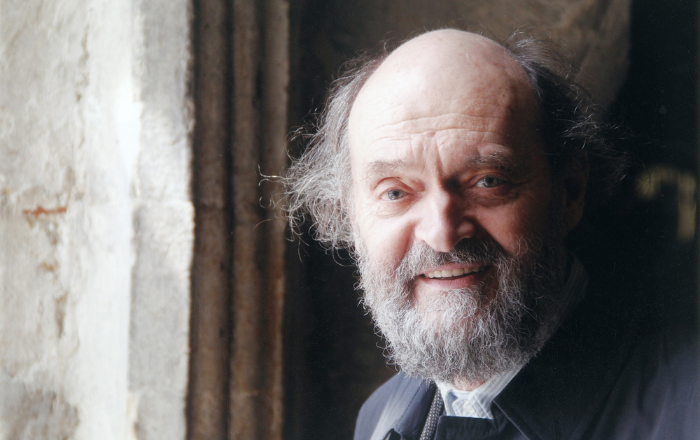
Arvo Pärt is everywhere. His works have been performed more often than those of almost any other composer in the first quarter of the century. The sonic world he conceived—a crystalline, almost monastic music that bears the touch of snow and resembles silence like no other —has long since left the realms of the composer’s imagination and is now recognized as one of the most evocative musical bodies of work of the past hundred years, adored by both classical music enthusiasts and followers of pop culture.
In a celebration of the Estonian composer’s life and work, the evening at the Odeon features iconic works from his vocal repertoire, including both solo and choral pieces. The demanding task of performing these works falls to the Estonian Chamber Philharmonic Choir and the Tallinn Chamber Orchestra, conducted by Tõnu Kaljuste —longtime collaborators of Pärt who have played a decisive role in the dissemination and interpretive understanding of his musical universe. Their presence on the Herodion stage promises an evening of genuine emotion, a heartfelt expression of gratitude toward a great master who summed up the power of music with the following words: “If one can kill with a sound, one can also heal with a sound.”
Conductor Tõnu Kaljuste • Voice Maria Listra
17 June///
George-Emmanuel Lazaridis – Raining Pleasure: Manos H.’s America – Part II
A leap back in time: in a studio outside Cologne in 2004, Raining Pleasure finished recording their album, with contributions from saxophonist David Lynch and Elli Paspala on the closing track “Noble Dame.” A band with innate melodic sensibility and European sophistication, Raining Pleasure recognized their affinity with the worlds of Reflections (English lyrics, rock energy) and delivered an unparalleled cover that propelled their domestic discography to new heights, while opening new avenues of acceptance abroad through live performances of “Reflections” at various venues. We will experience this unique collaboration this summer. And if we look closely at the Herodion stage when Raining Pleasure unfolds the gossamer world of Reflections, we might notice a reflection forming in front of the orchestra or in the sky, an electric ensemble under the baton of a magician-composer: the New York Rock and Roll Ensemble and the ever-present Manos Hadjidakis.
18 June
Einstürzende Neubauten
An Ode to Avant Garde
Those who make their way up to the ancient theater on that June evening will find themselves faced with a historical paradox: a demolition crew of musical conventions disguised as a band will have taken over the Herodion stage, transforming it into an exquisite industrial playground. We are, of course, referring to Einstürzende Neubauten.
Among the most important biological processes that keep a species alive and ensure its renewal and perpetuation is the ability to incorporate foreign DNA—even when it is potentially hostile. In a way that reflects this biological wisdom, the German ensemble has traversed half a century of music history while continuing to sound the same precisely because it sounds like nothing else. While they give a nod to fleeting sonic innovations, their ear remains firmly attuned to a sound that comes from within.
19 June
Lena Platonos – Maria Farantouri
Fates
In this unique production, created especially for this year’s Athens &Epidaurus Festival and the selected performances to be staged at the Odeon of Herodes Atticus, Lena Platonos and Thanos Tsaknakis rescue from oblivion Plato’s idea of the immortality of the soul and poetically reimagine it with the Fates, the composer’s new work, which will be presented to the public for the first time and performed by the international flute soloist, Stathis Karapanos. The texts are narrated by Maria Farantouri.
The unique Lena Platonos, as a natural kinswoman of the ancient figures, uses her music as the vehicle that dynamically transports the poetesses into the present and secures them a life in the future —now set to song—giving the works a contemporary tone with her electronic palette. At the same time, she highlights the tradition of the ancient Greek musical scale, incorporating elements from traditional song. The ideal performer of these works could be none other than the ageless—and therefore timeless—voice of Maria Farantouri.
21 June
ERT National Symphony Orchestra World Music Day
On June 21, as every year, World Music Day is celebrated with the traditional concert by the ERT National Symphony Orchestra.
22 June
Lykke Li
Lykke Li doesn’t just write songs. She writes moments that catch you off guard, turning your day upside down and transforming your night. The unforgettable voice behind “I Follow Rivers” and tracks like “No Rest for the Wicked” and “I Never Learn” is coming to Greece for the first time to meet her many fans and finally fulfill a long-held concert dream.
With over fifteen years in the industry, the multi-award-winning Swedish singer-songwriter, songwriter, model, and actress has built a world where pop leaves behind the glossy surface of modern productions and strips down to a more raw and authentic expression. She has repeatedly chosen the imperfect over the perfect, capturing in her recordings the intensity, the breath, the imperfection, and the spontaneity—all those elements that make an emotion feel dangerously vivid and true.
On June 22, the Odeon of Herodes Atticus transforms into the perfect setting for this highly anticipated gathering, a concert that will traverse every nuance of the fragile and the explosive. With new material on the horizon and a new album expected in 2026, Lykke Li continues to redefine what contemporary pop means, with an unbeatable style, instinct, and absolute control of the atmosphere.
June 25 & 26
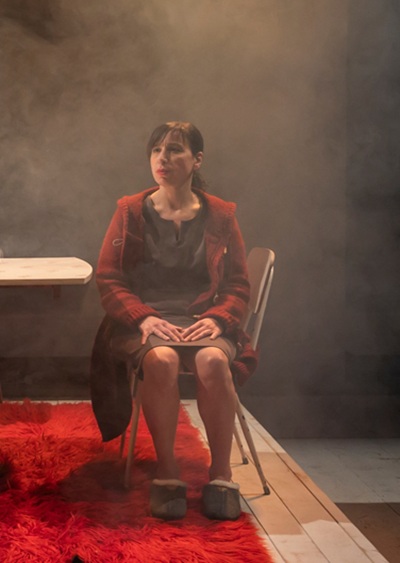
Stathis Livathinos
Euripides’ Hecuba
In the Shadow of the State
Euripides’ “Hecuba”, written in the early years of the Peloponnesian War, not only deals with the fall of mythical Troy but also reflects the twilight of the Athenian city-state as a fundamental unit of political organization. In the work, the invocation of rules and law recurs consistently, indicative of a period in which neither is functioning. In contrast, Plato’s Republic—written during a period of cultural revival—articulates a utopian vision of reconstruction, linking knowledge with political organization. Although they belong to different genres and are separated by time, these works converge on a common core of inquiry: What are justice, truth, and education? What are the limits of human morality?
The central theme of the stage adaptation is the allegory of the cave, Plato’s iconic allegory of delusion, knowledge, and the possibility of awakening. The image of the prisoners who perceive a world of shadows as reality establishes, here, a powerful theatrical condition. Within this, Hecuba acts as a catalytic presence, with Stathis Livathinos’s penetrating directorial gaze transforming the fusion of tragedy and philosophy into a realm of reflection and trial, where the limits of awareness, human measure, and responsibility are tested.
The performance is part of the celebrations marking the 100th anniversary of the Academy of Athens (1926–2026)
June 29
Athens State Orchestra – Michał Nesterowicz
Gustav Mahler’s Symphony No. 8
Even within the context of Gustav Mahler’s magnificent symphonic oeuvre, the Eighth Symphony holds a special place. It marks a turning point, not only for Mahler but for the Romantic symphony in general. The nickname “The Thousand” did not come from the composer himself, but from the impresario Emil Gutmann, who used it for publicity purposes before the work’s premiere. Today it may seem exaggerated, but it is estimated that 858 singers and 171 instrumentalists participated in that concert. However, the essence lies neither in the duration (the Third Symphony lasts longer) nor in the number of performers (and the Second Symphony requires a similarly large ensemble); the unique greatness of the Eighth lies in its affirmative tone, since it is the only symphony by the genius composer that bears no trace of irony, doubt, or inner conflict. On the contrary, it develops a majestic, robust rhetoric, conveying messages of profound spirituality with unwavering, inner, and musical self-assurance.
Its premiere on September 12, 1910, in Munich, conducted by the composer himself, was the greatest success of Mahler’s life—just seven months before his death. He himself recognized the Eighth as his greatest compositional achievement, while the great German writer Thomas Mann captured the essence of this colossal symphonic work by saying that “it expresses the art of our time in its deepest and most sacred form” . Certainly, purely practical reasons make the performance of the Eighth an unusual artistic event—and therefore one of particular value.
The internationally renowned Polish conductor Michał Nesterowicz leads the Athens State Orchestra, a host of distinguished opera singers and a large choir, offering the Festival audience a rare opportunity to enjoy this epic masterpiece live.




Leave A Comment