
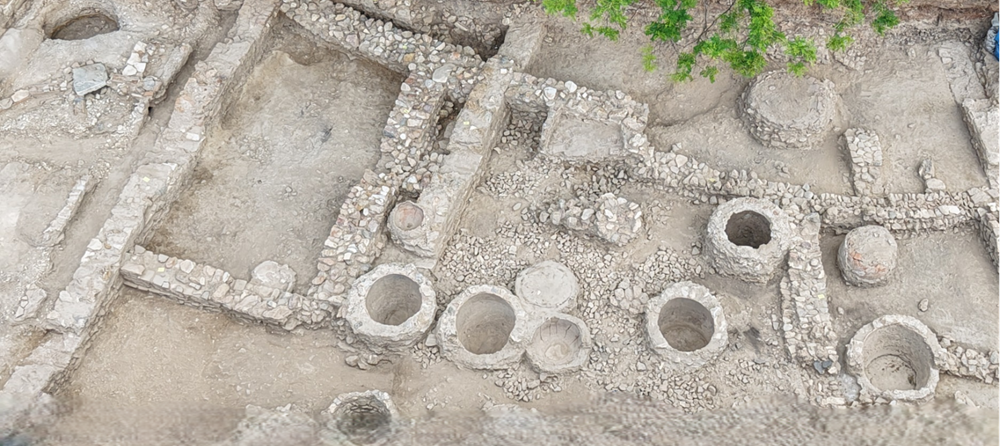
The Ministry of Culture, in keeping with its strategy to highlight previously unknown aspects of Athens’ history and archaeology, is restoring to the city a unique part of its historical memory: the Roman monumental complex and the archaeological remains uncovered during the redevelopment of Vasilissis Olgas Street.
The excavation on Vasilissis Olgas Street revealed a magnificent Roman complex, featuring a semicircular atrium, colonnades, organized spaces, and an extensive network of drainage channels, which underwent successive construction phases from the 3rd to the 5th century AD. The area north of the Olympieion, immediately adjacent to the Ilissos River, constitutes one of the most important historical centers of Athens, with an uninterrupted human presence from prehistoric times through the early Byzantine period.
Initially, it developed as a place of worship and settlement outside the walls of the ancient city, home to important sanctuaries; during the Roman period, particularly under Hadrian, it was incorporated into the urban fabric and evolved into one of Athens’ most affluent neighborhoods, featuring monumental public and private buildings. Despite the destruction of the late Roman period, the area experienced a new period of prosperity during the 4th and 5th centuries AD, before the gradual decline in population during the 6th century marked the transition to the Byzantine era.
Among the most significant remains uncovered, the moat of the Themistoclean Wall—hewn directly into the natural rock—stands out; it is the oldest preserved feature of the excavation and confirms the construction of the ancient fortification. The excavation revealed that the structure underwent two major construction phases—the first from the late 3rd century CE to the early 4th century CE and the second in the early 5th century AD—as well as smaller-scale alterations and extensions, which reflect its continuous use during the Late Roman period. The study of the remains also highlighted the different construction techniques of each period, from the meticulous stone masonry of the classical era to the characteristic Roman masonry systems, revealing the great historical and architectural value of the monumental complex.
The final phase of the site’s use dates back to the Byzantine period and is represented primarily by simpler masonry structures, underground built cisterns (pits) and storage jars—elements that attest to a significant change in the character of the area and a shift toward productive and storage activities, as further documented by findings from excavations in the wider region. The work includes the conservation and restoration of the masonry, the mosaic floor, and the architectural elements; vegetation management; the removal of more recent incompatible alterations; improving the site’s legibility, restoring historical layers, and implementing comprehensive stormwater management to protect the monuments.
The restoration and enhancement proposals were formulated with the aim of addressing conservation issues and restoring the legibility of the monumental complex. The interventions were designed in accordance with internationally accepted principles for the protection of architectural heritage, with respect for the authenticity of the monument and its building materials, and with the primary goal of enhancing the legibility of the monumental complex.


Leave A Comment